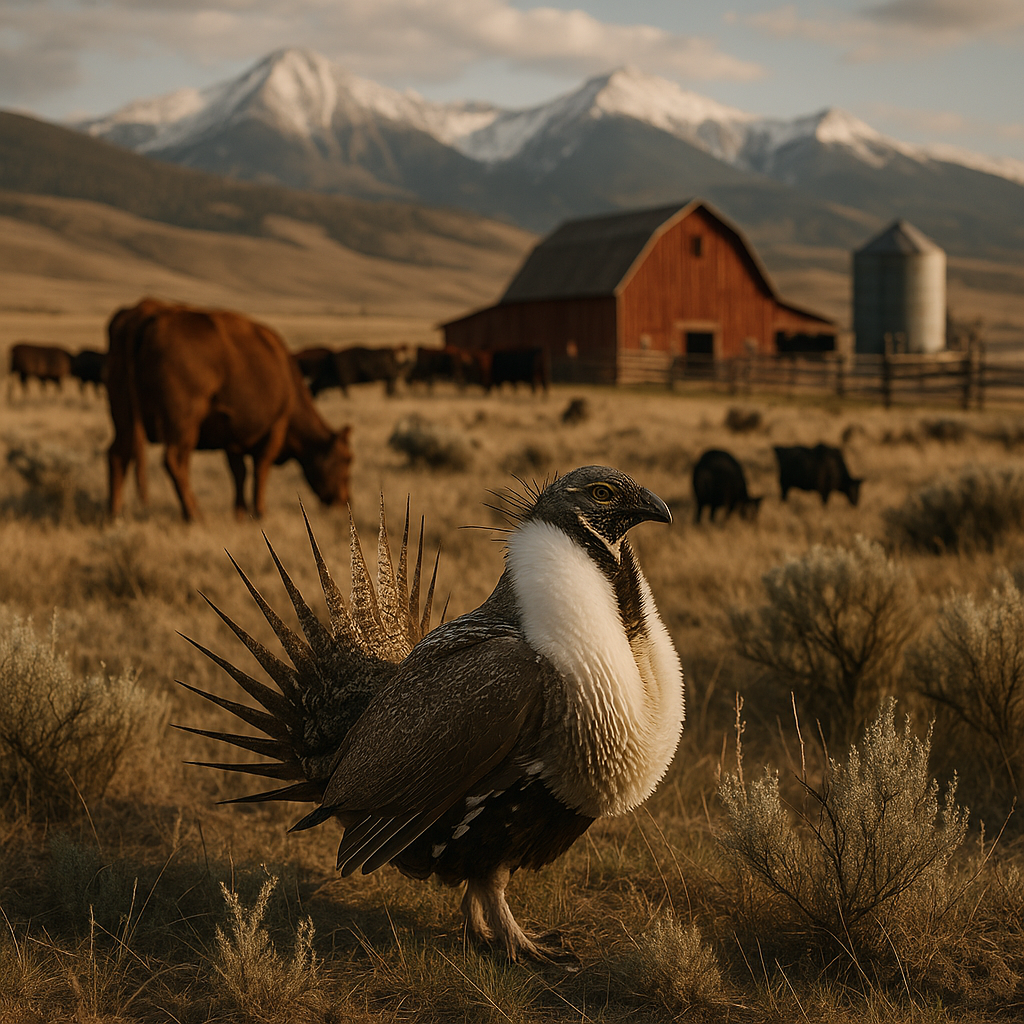
Sage Grouse, Grazing, and Montana Ranches: What Changes Could Actually Look Like
Across the Northern Plains and Intermountain West, the greater sage grouse remains a flashpoint species—part wildlife icon, part land-use barometer. Recent reporting has revived a familiar argument: that protecting sage grouse requires less livestock grazing. The reality on the ground in Montana is usually more complicated than a simple “graze” or “don’t graze” choice.
- Quick takeaways
- Research often links sage grouse success to intact sagebrush, healthy native grasses, and limited disturbance during nesting and brood-rearing.
- Livestock grazing can be a risk factor in some places and seasons, but outcomes vary widely by timing, intensity, and vegetation conditions.
- Montana producers may see increased scrutiny on public-land allotments and on private parcels tied to conservation plans.
- Targeted tools—like rest-rotation, riparian protections, and adaptive triggers—can sometimes reduce conflict without blanket removals.
Why sage grouse management keeps coming back
Sage grouse depend on big, connected landscapes dominated by sagebrush. They use different habitat types throughout the year: sagebrush cover for nesting and winter, and more forb-rich areas for broods in late spring and summer. Because those same landscapes are also working lands—grazing allotments, hay bases, and mixed private-public ranches—management decisions ripple through local economies.
In Montana, sage grouse issues often intersect with:
- Public land grazing (BLM and Forest Service allotments)
- Private deeded range that supports cow-calf operations
- Energy and infrastructure (roads, powerlines, development)
- Invasive annual grasses and changing fire cycles
That mix is why headlines that reduce the conversation to “less grazing” can miss important details—even if grazing pressure is a legitimate concern in certain settings.
What the research generally says—and what it doesn’t
Studies and agency assessments commonly emphasize a few habitat basics: sage grouse tend to do better where sagebrush is intact, where grasses and forbs provide cover and food during nesting and brood-rearing, and where disturbance is limited during sensitive seasons. Reports also indicate that heavy or poorly timed grazing can reduce grass height and residual cover, potentially increasing nest exposure to predators and weather.
At the same time, grazing effects are not uniform across landscapes. Outcomes can depend on:
- Timing (early spring vs. late summer/fall)
- Intensity and duration (how hard and how long a pasture is used)
- Plant community (native bunchgrass vs. already-degraded sites)
- Moisture year (drought can magnify impacts)
- Pasture layout (distance to water, fencing, salt placement)
In other words, “less grazing” may be one outcome in some high-priority habitats, but it’s not the only lever managers can pull. In some situations, changing when and where cattle graze may matter as much as changing how many cattle are on the landscape.
Where grazing becomes a bigger issue for sage grouse
Montana’s sage country is not all the same. The grazing-sage grouse conflict tends to sharpen in a few recurring scenarios:
- Nesting cover shortfalls: If residual grass cover is already low, additional spring use can leave nests more exposed.
- Riparian and wet meadow pressure: Broods often rely on greener areas later in the season; concentrated use around water can reduce insect-rich forbs and cover.
- Drought years: When growth is limited, grazing can more quickly push a pasture below habitat targets.
- Fragmented landscapes: In areas already cut up by roads, fences, and development, any added stressor can have outsized effects.
It’s also worth noting that grazing isn’t happening in a vacuum. Fire, invasive grasses, conifer encroachment in some regions, and predator dynamics can all affect sage grouse outcomes. That’s part of why wildlife managers often focus on “limiting cumulative impacts,” not just any single use.
What “less grazing” can mean in practice
When advocates or agencies talk about reducing grazing to benefit sage grouse, it can show up in several forms—some temporary, some long-term:
- Seasonal adjustments: Moving use away from early nesting windows or shifting to later turnout dates.
- Rest-rotation or deferred grazing: Building in rest periods to maintain residual grass cover.
- Utilization and stubble-height standards: Setting measurable thresholds and monitoring them.
- Pasture-level changes: Reconfiguring fences, water developments, or salt/mineral placement to distribute use.
- Targeted exclusions: Fencing off small high-value brood-rearing wet areas rather than removing grazing across an entire allotment.
- Stocking rate reductions: The most straightforward—and often most economically painful—tool, especially if reductions are long-term.
In many Montana operations, the difference between a workable plan and an unworkable one comes down to flexibility: whether a permittee can respond to monitoring results, drought conditions, or habitat needs without being locked into a rigid calendar.
What this means for Montana
For Montana ranchers, the immediate question is rarely philosophical. It’s practical: What changes might be required, and who pays for them?
Here are a few Montana-specific realities that shape the conversation:
- Public-land decisions can ripple into private hay bases. If an allotment’s season or numbers change, it can affect when cattle hit private pastures or when hay gets fed.
- Drought planning is now habitat planning. In dry years, agencies and producers may face pressure to reduce use to protect both range condition and wildlife cover.
- Monitoring matters more than ever. Photo points, utilization cages, and stubble-height checks can be the difference between “we think” and “we know.” Better data can protect permittees from one-size-fits-all assumptions.
- Conservation programs can help—but paperwork is real. Cost-share for fencing, water, or habitat improvements may be available through state, federal, or nonprofit partners, but it takes time to apply and implement.
Montana has also spent years building sage grouse strategies that try to avoid an Endangered Species Act listing. That history tends to push agencies toward proactive habitat measures—sometimes including grazing changes—especially in core areas.
Questions ranchers should ask when sage grouse comes up
If you’re hearing that a pasture, allotment, or neighborhood needs “less grazing,” it’s reasonable to ask for specifics. Useful questions include:
- What habitat metric is failing? (Residual grass height? Forb abundance? Sagebrush cover?)
- What season is the concern? Nesting, brood-rearing, or winter?
- Is the problem localized? If impacts are concentrated near water or a riparian draw, can solutions be targeted?
- What does monitoring show over multiple years? One bad drought year shouldn’t automatically define a long-term plan.
- What are the adaptive triggers? If conditions improve, does grazing return? If conditions worsen, what happens next?
These questions don’t dodge responsibility—they help ensure management is tied to measurable outcomes, not assumptions.
A path forward: fewer absolutes, more site-specific management
Montana’s working sagebrush country is too diverse for a single prescription. Reports indicating that grazing reductions are needed in some sage grouse habitats may be accurate in certain places—especially where nesting cover is consistently short, riparian areas are stressed, or drought has hammered plant recovery. But broad claims can obscure the middle ground where many solutions live: timing changes, distribution fixes, rest periods, and adaptive management that keeps ranches operating while improving habitat.
For producers, the stakes are real: grazing flexibility is often the difference between a ranch that pencils out and one that doesn’t. For wildlife managers and the public, the stakes are also real: sage grouse are a bellwether for sagebrush ecosystems that support a long list of other species.
The next round of sage grouse debates in Montana will likely hinge less on slogans and more on details—pasture by pasture, season by season, and year by year.
Inspiration: “cattle,livestock” – Google News (link)