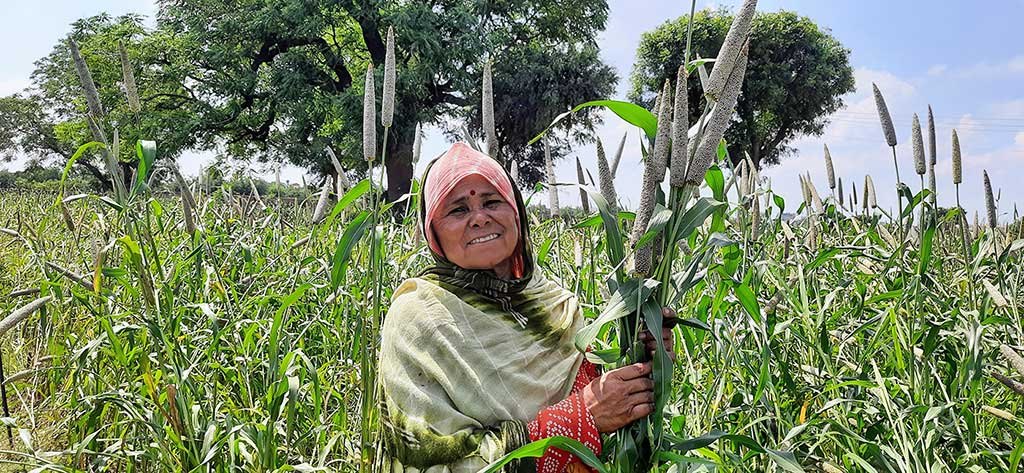
ICRISAT and Partners Develop and Release the World’s First Three-way Pearl Millet Hybrid
By Harry Ward
ICRISAT, working with the Indian Council of Agricultural Research (ICAR) through the All India Coordinated Research Project on Pearl Millet (AICRP) center at the Rajasthan Agricultural Research Institute (RARI), has developed what it describes as the world’s first three-way pearl millet hybrid, RHB 273.
On 4 January 2026, India’s Union Minister of Agriculture & Farmers Welfare, Shivraj Singh Chouhan, announced the release of 184 improved crop varieties across 25 crops for cultivation in India. RHB 273 was among those notified for cultivation in A1 dryland zones—parts of Rajasthan, Gujarat, and Haryana—areas characterized by annual rainfall below 400 mm.
Unlike standard pearl millet hybrids that use two parents, a three-way hybrid combines three parental lines to bring multiple traits together, including higher yield, drought tolerance, and improved fodder quality. ICRISAT leaders said the approach is aimed at drought-prone regions where pearl millet is already valued for handling heat and low water availability.
According to the report, RHB 273 was tested over three years (2022–2024) across 30 sites in three states. It averaged about 2,230 kg/ha in grain yield, reported as a 13–27% advantage over regional varieties, and about 28% higher than HHB 67 Improved. The hybrid is also described as having good resistance to downy mildew, blast, and smut, with partners emphasizing its potential to support both grain production and fodder availability in water-scarce areas.
Why it matters
- Dryland zones with rainfall below 400 mm face recurring production risk, and new hybrids are being positioned to improve reliability under drought stress.
- RHB 273 is presented as a dual-purpose option, targeting both grain yield and fodder quality—an important issue where water scarcity can drive fodder shortages.
- Multi-location testing across 30 sites over three years suggests the hybrid was evaluated across a range of conditions before notification for cultivation.
What to do next
- Producers and advisers in the A1 dryland zones of Rajasthan, Gujarat, and Haryana can watch for local guidance on seed availability and recommended management for RHB 273.
- Track follow-up performance data as adoption expands, including yield results and disease response under farm conditions.
Source
Original reporting by agriculturepost.com: https://agriculturepost.com/farm-inputs/icrisat-and-partners-develop-and-release-the-worlds-first-three-way-pearl-millet-hybrid/