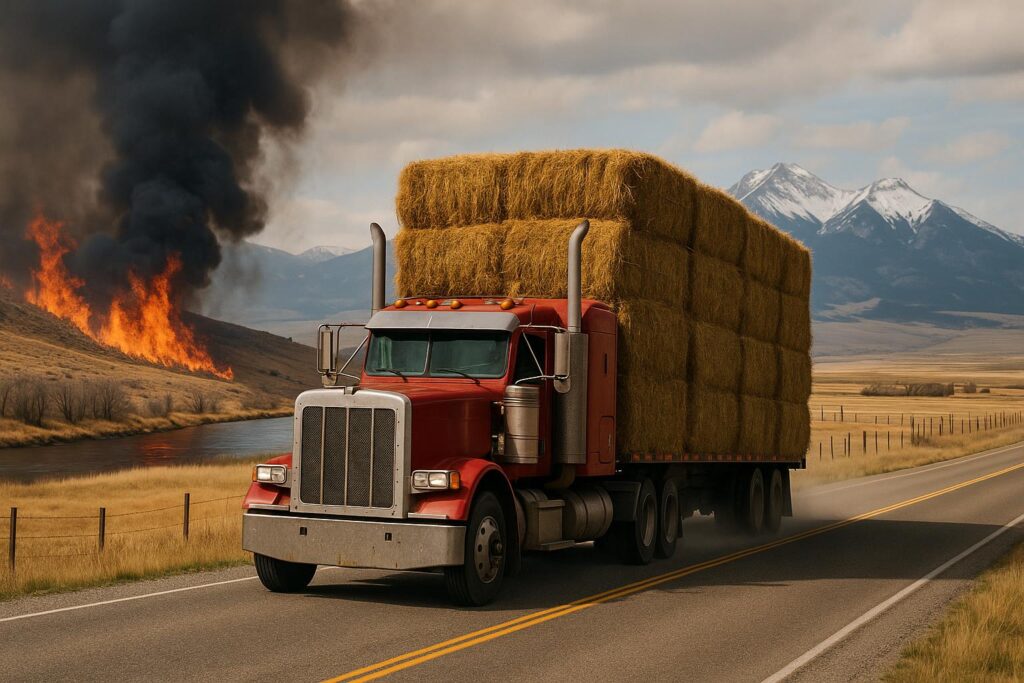
As wildfire seasons stretch longer across the West, one of the first pinch points for ranchers is rarely the flames themselves—it’s feed. Reports indicate Farm Rescue has activated its “Operation Hay Lift” effort in response to wildfire impacts, coordinating donated hay and trucking to get roughage to ranch families dealing with burned pasture, evacuations, and disrupted grazing plans.
Even when a fire doesn’t burn barns or equipment, it can wipe out weeks or months of forage in a day. That forces tough decisions: ship cows early, buy expensive hay, find emergency pasture, or try to hang on and hope the market and weather cooperate.
For Montana producers—from the Bitterroot Valley to the Hi-Line—the story is familiar. When smoke is in the air, the hay market and the cattle market often start moving before the fire is even out.
Wildfire feed losses: what happened
According to industry reporting, Farm Rescue has mobilized hay deliveries to ranchers affected by wildfires through a program commonly referred to as “Operation Hay Lift.” The basic model is straightforward: donated hay is assembled, trucks are arranged, and bales are delivered to operations that have lost grazing capacity or stored feed due to fire activity.
Mutual-aid efforts like this don’t replace a full winter’s feed, but they can bridge a ranch through the immediate aftermath—especially when roads are closed, pastures are blackened, and local hay supplies are already tight.
- Immediate problem: burned pasture and disrupted grazing rotations
- Secondary problem: sudden demand for hay in a short window
- Long-tail problem: rebuilding feed inventories while markets fluctuate
Wildfires also create hidden costs: time spent moving cattle, fencing damage, water system repairs, and the stress of managing livestock under heavy smoke.
Why hay relief matters in Montana
Montana’s livestock sector depends on a delicate balance between pasture, hay ground, and the ability to move cattle across large landscapes. When fire takes out grazing, the pressure shifts quickly onto hay—both homegrown and purchased. That dynamic can hit different regions in different ways:
- Bitterroot Valley: Smaller parcels and a mix of hay ground and pasture can mean limited options when a fire knocks out local grazing. Hauling hay in becomes expensive fast.
- Hi-Line: When rangeland is stressed by drought and then fire, ranchers may be forced into earlier marketing decisions. Freight distances for hay can be long.
- Yellowstone Valley: Irrigated hay can be a stabilizer, but water availability and pumping costs can limit how much “extra” feed is available in a bad year.
- Gallatin Valley: Competition for land and hay, plus higher baseline costs, can make emergency feed purchases especially painful.
- Flathead Valley: When wildfire and smoke coincide with peak tourism season, labor and logistics can get complicated—moving equipment and livestock isn’t always simple.
In a normal year, a ranch might pencil out winter feed by combining hay, aftermath grazing, crop residues, and a plan for when to wean and sell. Fire can blow up that plan overnight. Relief hay doesn’t solve the whole equation, but it can keep cows in place long enough for a rancher to make a decision that’s based on economics—not panic.
How hay, freight, and cattle markets interact during fire season
When wildfire activity spikes, three markets tend to tighten at the same time:
- Hay: Local supplies can disappear quickly, and quality hay gets bid up first. Lower-quality roughage may still be available, but it can require supplementation.
- Freight: Trucks become scarce when multiple regions are moving hay, equipment, and livestock. Fuel prices and driver availability can be the difference between “possible” and “not happening.”
- Cattle: If enough producers are forced to sell early, local sale barns can see a surge. Depending on broader demand, that can pressure prices—especially for lighter calves or cows that don’t fit buyers’ immediate needs.
The hard part is timing. Selling early may protect range and reduce feed costs, but it can also mean selling into a crowded market. Buying hay may keep cows longer, but it can turn into a cash-flow problem if freight and feed costs run away.
One practical takeaway: if you’re in a fire-prone area, it’s worth knowing your “break-glass” options before smoke season—who has hay, who can haul, where cattle could go, and what your lender needs to see if you have to pivot.
What This Means for Montana Ranchers and Farmers
For Montana agriculture, hay relief efforts underscore a bigger reality: wildfire is now a recurring production risk, not a one-off disaster. That matters for both ranchers and hay producers.
- Ranchers: If pasture burns, your feed budget becomes your survival budget. Relief hay can buy time, but it won’t replace a full-season forage loss. The earlier you run the numbers on destocking, the more choices you keep.
- Hay producers: Fire years can bring strong demand, but also higher risk—smoke can slow harvest, labor can be pulled toward firefighting, and irrigation constraints can limit yields. If you’re selling hay, clear contracts and realistic delivery timelines matter.
- Irrigated operations: Valleys that rely on irrigation—parts of the Yellowstone and Gallatin, among others—may be positioned to produce more consistent tonnage, but only if water supplies hold and infrastructure stays intact.
- Community resilience: Volunteer hay moves highlight how quickly neighbors respond, but they also point to gaps: limited local storage, long freight distances, and a lack of slack in the feed system during drought-and-fire cycles.
Bottom line: relief deliveries are a helpful tool, but they’re also a signal that producers should treat feed contingency planning as part of annual management—right alongside vaccination schedules and marketing plans.
Practical steps producers can take now
Every operation is different, but these are the conversations happening across rural Montana when fire risk rises:
- Inventory feed early: Count bales, estimate tons, and match it to cow numbers and winter length assumptions.
- Line up freight contacts: A trucker who answers the phone in July is worth more than one you meet in September.
- Review insurance and documentation: Photos of stacks, receipts, and grazing plans can matter after a loss.
- Plan for water: If a fire damages pipelines or power, know where backup water is and how you’ll move cattle.
- Consider strategic destocking triggers: Decide ahead of time what conditions force a sale—so you’re not deciding under stress.
For producers looking for broader context on conditions and agricultural data, the USDA National Agricultural Statistics Service (NASS) is a common reference point for acreage, production, and longer-term trend information.
What to Watch Next in Montana Agriculture
The next few months will tell producers a lot about how tight the feed picture could get and how severe fire impacts may be in specific regions. Key items to monitor:
- Fire activity and closures: Watch for grazing disruptions on both private and public lands, and for road closures that affect hay hauling.
- Hay price signals: If second cutting is light or smoke delays harvest, expect quality hay to firm up first. Pay attention to delivered cost, not just “at-the-stack” price.
- Irrigation water and drought indicators: Reservoir levels, streamflows, and late-summer heat can determine whether irrigated hay areas can compensate for range losses.
- Cattle movement patterns: Early weaning, heavier cull runs, and more private-treaty listings can be signs that producers are reacting to forage pressure.
- Relief availability and eligibility: If you’re impacted, keep an eye on nonprofit efforts and government disaster programs that may open or expand during major events.
Montana ranching has always been built around weather risk. Now, wildfire risk is part of that same calculus—affecting hay, grazing, labor, and marketing all at once. The operations that come through best tend to be the ones with a written plan, a realistic feed budget, and a few backup options already lined up.
Inspiration: www.nass.usda.gov