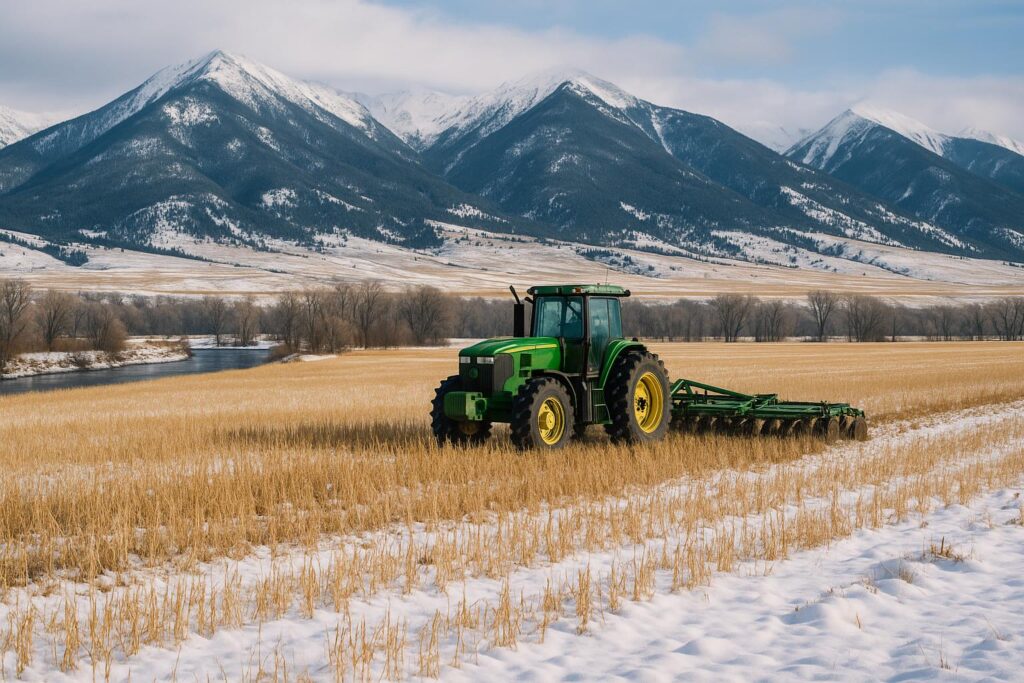
Across Montana, winter wheat is often the crop that bridges seasons—seeded into late-summer dust or fall moisture, then asked to survive wind, cold snaps, and spring swings that can go from blizzard to bare ground in a week. The payoff can be strong, but the margin is made (or lost) in small decisions: seed placement, residue management, nitrogen timing, weed pressure, and how closely you scout once the crop breaks dormancy.
Reports from agronomy groups and university extension programs indicate that winter wheat yield is most sensitive to stand establishment, early-season competition, and fertility that matches yield potential. Below are field-ready considerations that fit Montana’s realities—dryland rotations, variable soils, and the ever-present question of whether spring will arrive early or not at all.
1) Start with a stand you can live with
Uniform emergence is the foundation for everything that follows. In many Montana fields, the biggest threat isn’t a lack of seed—it’s uneven moisture and inconsistent seed depth.
- Calibrate seeding rate to your environment and planting window. Earlier planting in good moisture can often use fewer seeds per square foot than late planting into marginal moisture.
- Place seed consistently. Aim for a depth that finds moisture but avoids burying the crown too deep. Uneven depth can create uneven tillering and maturity.
- Check seed quality. If you’re using bin-run seed, consider a germ test and seed cleaning. For certified seed and variety information, Montana growers often reference MSU variety trials.
2) Pick varieties with Montana in mind
Variety choice is risk management. Beyond yield potential, consider winter hardiness, stripe rust tolerance, and maturity timing for your area.
- Match maturity to your moisture pattern and harvest window.
- Look at disease packages. If your area has a history of stripe rust or leaf diseases, tolerance can reduce the need for rescue treatments.
- Consider end-use and contracts. Protein targets and market class can influence fertility strategy.
3) Manage residue like it’s part of the crop
In no-till and reduced-till systems common across Montana, residue can be your moisture bank—or your stand’s worst enemy if it creates hairpinning or cold, wet seedbeds.
- Spread straw and chaff evenly at harvest to avoid thick mats that delay emergence.
- Watch opener performance in heavy residue. If you’re hairpinning, you’re not placing seed into soil contact.
- Think snow catch. Standing stubble can help trap snow in some landscapes, supporting spring moisture.
4) Soil test—and treat the test like a budget
Fertility decisions are easiest when they’re tied to realistic yield goals and soil supply. A soil test won’t predict rain, but it can prevent expensive guesswork.
- Test for nitrate-N and sulfur. In parts of Montana, sulfur can be a quiet yield limiter, particularly on lighter soils or where organic matter is low.
- Don’t ignore pH and salinity in problem areas. Patchy stands and “mystery” yellowing sometimes trace back to soil constraints rather than pests.
- Use local guidance. MSU Extension soil fertility resources can help interpret results and plan rates.
5) Time nitrogen for both yield and protein
Nitrogen is often the biggest lever you can pull, and the easiest to overpull. In winter wheat, timing matters because the crop’s demand ramps up quickly as it greens up and starts stem elongation.
- Split applications can reduce risk in variable springs—some upfront to support early growth, with a later pass if moisture and yield potential justify it.
- Consider protein goals. If you’re chasing a protein premium, late-season N can help, but it’s not a guarantee and depends on moisture and uptake.
- Mind losses. Volatilization or leaching risk varies by product, placement, and weather. Incorporation and inhibitors may pencil out in certain scenarios.
6) Control weeds early—before they steal tillers
Weeds compete when the crop is setting yield components. Once weeds have taken moisture and nutrients, you rarely “spray your way” back to full yield.
- Scout in fall and early spring for winter annuals and early flushes.
- Rotate herbicide modes of action to slow resistance. If you suspect resistance, document escapes and talk with your agronomist.
- Watch crop stage and label restrictions, especially during rapid spring growth.
7) Keep an eye on disease—especially in wet springs
Montana’s disease pressure can be highly year-dependent. In some years, fungicides don’t pencil out; in others, timely protection can preserve yield and test weight. Reports indicate stripe rust can move quickly when temperatures and moisture align.
- Know your risk factors: susceptible variety, dense canopy, irrigated ground, and extended leaf wetness.
- Scout the lower canopy and field edges first, then work inward.
- Use thresholds and economics. A fungicide pass should be based on disease presence or strong risk, growth stage, and grain price—not habit.
8) Don’t overlook insects, but treat only when warranted
Insect issues in winter wheat can include aphids, wireworms, and other sporadic pests depending on region and year. The goal is to protect yield without creating unnecessary costs or secondary problems.
- Scout with a purpose: identify the pest, estimate pressure, and note crop stage.
- Use integrated pest management principles. IPM resources (while not Montana-specific) provide useful scouting and decision frameworks.
- Protect beneficials by avoiding broad-spectrum sprays when they’re not needed.
9) Manage water and compaction where you can
Most Montana winter wheat is grown under dryland conditions, where “water management” often means residue, rotation, and weed control. On irrigated acres, it also means scheduling and avoiding ruts.
- Dryland: prioritize weed control and residue to conserve moisture.
- Irrigated: avoid overwatering early, which can favor disease and shallow rooting.
- Compaction: limit traffic when soils are wet. Compacted headlands often show up as yield maps’ worst spots.
10) Measure results, not just inputs
The best operations build a feedback loop. That can be as simple as a notebook and a yield map, or as detailed as zones and tissue tests.
- Record what you did: planting date, variety, seed treatment, rates, and application timing.
- Compare fields and zones to see what consistently pays.
- Check test weight and protein alongside yield—quality often drives net return.
What this means for Montana
Montana winter wheat success usually comes down to reducing risk rather than chasing a single “silver bullet.” The state’s wide range of environments—from Hi-Line wind and cold to central Montana’s variable spring moisture to irrigated valleys—means any recommendation should be filtered through local conditions.
- If you’re in drier country: stand establishment, residue management, and early weed control are often the most reliable return on time and money.
- If you’re in higher moisture or irrigated areas: disease scouting and timely fertility (including sulfur where needed) may be bigger drivers.
- Across the board: variety selection and nitrogen strategy are the two decisions that tend to show up most clearly at the scale ticket.
As always, work with your local agronomist and lean on Montana-specific data when you can. Conditions change fast here, and the best plan is one that can adapt when spring shows its hand.
Inspiration: www.agdaily.com