Most poisonous plants give you a little room. A cow has to eat a good bellyful of larkspur, and knapweed won’t hurt her at all. Water hemlock is not like that. A couple of inches of the root will drop a full-grown cow, and she’ll be dead before you ever notice she’s sick. If you run cattle on wet meadows, creek bottoms, or ground fed by ditches and seeps, this is the plant that ought to have your attention right now.
It’s worst in June for two reasons. The plant is up and green while a lot of the surrounding forage is still short, and the ground is soft. High water and irrigation keep the soil loose along the banks, and that lets a cow pull the whole plant — root and all — instead of just grazing the top. The root is where nearly all the poison sits.
Learn to pick it out of the green stuff
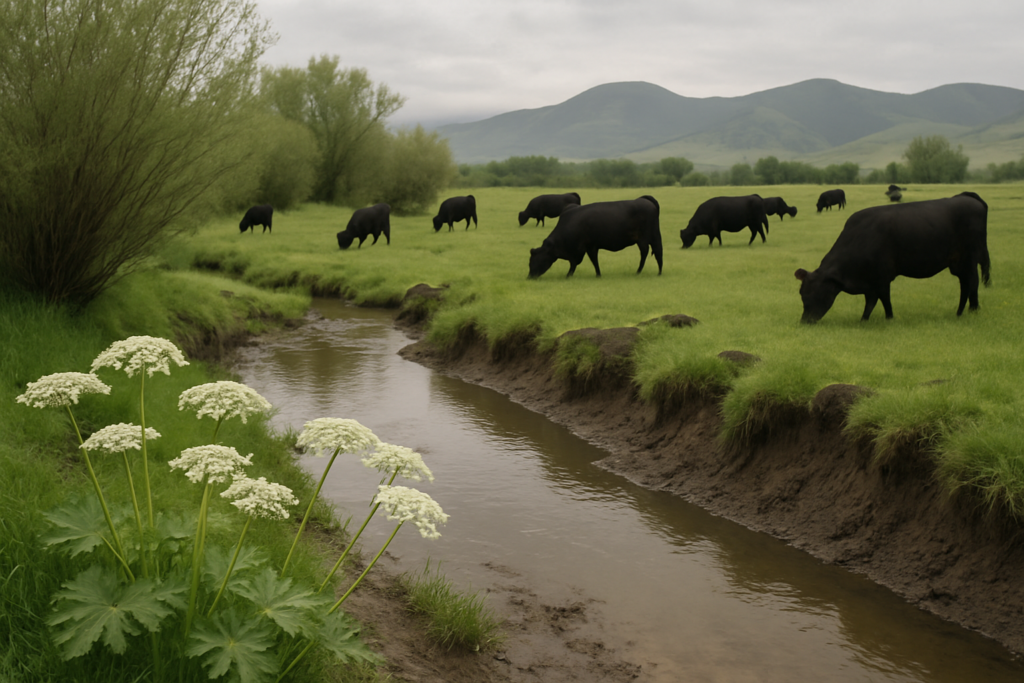
Water hemlock runs three to six feet tall with a hollow, stout stem that’s often streaked or blotched with purple down low. The flowers come in loose white umbels — the flat-topped, umbrella-shaped clusters you see on a lot of the carrot-family plants. That’s the problem: it looks a fair amount like cow parsnip, water parsnip, and a few harmless natives, and people mix them up.
The dead giveaway is the base. Dig up the root crown and slice it lengthwise. Water hemlock has a thick, tuberous root with hollow chambers separated by cross partitions, like little rooms stacked up. Cut into it and it weeps a yellowish, oily liquid that smells rank, something like raw parsnip or celery gone wrong. Nothing else you’ll find in a Montana ditch looks like that inside. If you’re going to dig one to check, wear gloves and don’t let kids or dogs chew on it — the toxin, cicutoxin, works on people too.
It grows exactly where you’d expect: creek and slough banks, the muddy edge of a stock pond, marshy corners of a hay meadow, the wet strip below a leaky headgate, and along irrigation ditches. Dry hillsides won’t have it. Wet feet will.
Why cattle eat something that smells that bad
They mostly don’t, when there’s good grass and the roots are locked in firm ground. Trouble starts when the two things line up: hungry cattle and soft, saturated soil. Turn a bunch onto a wet spring pasture before the upland grass has come on, and they’ll nose around the green growth in the low ground. In mud, the whole plant comes up with the bite. That’s how they get a mouthful of root instead of a leaf.
The same thing happens after you’ve cleaned a ditch or high water has cut a bank and left roots exposed on top of the ground. A root lying loose on the surface is far easier to eat than one anchored in sod. Cattle have died from roots that floated downstream and lodged where they could reach them.
When it hits, it hits fast — often inside an hour. Frothing, muscle tremors, then violent convulsions and seizures. There’s no practical treatment out on the range; by the time you find a sick one it’s usually too late. Most producers never see the animal go down. They just find her dead near the water, and if the legs are thrown out and the ground is torn up around her, water hemlock ought to be on the short list.
Keep the cattle off the root
The cheapest fix is fencing. If you’ve got a known patch along a creek or a slough, string a wire and keep cattle back from it, at least until later in summer when the upland feed is good and the ground firms up. A cow with a full belly on solid grass isn’t hunting roots in the mud.
Don’t turn hungry cattle onto a wet meadow first thing in spring. Give them somewhere else to fill up so the low, boggy ground isn’t the only green thing in front of them. Watch your ditches after you clean them or after a high-water year rearranges the banks — that’s when loose roots show up on top.
If you’ve got a small stand, dig it out, root and all, and haul it off. Grubbing works because the whole plant is the problem and it doesn’t sucker from a hundred feet the way some weeds do. Mowing alone won’t do much; it knocks the top off but leaves the root, and a chopped plant in a wet meadow can still poison an animal that finds it.
One more spot people forget: hay. If a wet corner of a meadow grows water hemlock and you swath through it, pieces of plant end up in the bale. The foliage is less deadly than the root, and it dries down some, but a fresh-cut root going into the stack is not something you want fed back to your cows in January. Walk the wet ground before you drop the sickle, and steer around it.