You gather the calves, run them through, and everybody goes home tired and satisfied that the herd is covered for the summer. Trouble is, half the protection you paid for can be gone before the syringe ever touches a calf. Vaccine is a live or delicate biological product, not a can of Copenhagen you can leave rattling around the toolbox. Handle it wrong and you’ve spent the money, burned the daylight, and stressed the calves for nothing.
This matters more in June than folks realize. A lot of Montana outfits are running late brandings, giving boosters, or working calves before they head to summer range, and by now the days are long and hot. That afternoon sun on the back of the flatbed is exactly what kills a vaccine’s punch.
Heat and light are the two things that ruin it fastest
Most vaccines want to stay between roughly 35 and 45 degrees, cooler than a warm morning and a lot cooler than a truck seat. Once a bottle warms up, the label’s shelf life stops meaning anything. Modified-live products are the touchy ones. The virus in them is alive but weakened, and heat or direct sunlight kills that virus the same way it would kill anything else. Once it’s dead, it can’t stimulate an immune response. The calf gets a poke and nothing more.
Sunlight alone will do damage even if the bottle feels cool. UV breaks down the product, which is why the good bottles come in that amber glass. Set a mixed bottle on the fender in full sun while you catch the next calf and you’re cooking it.
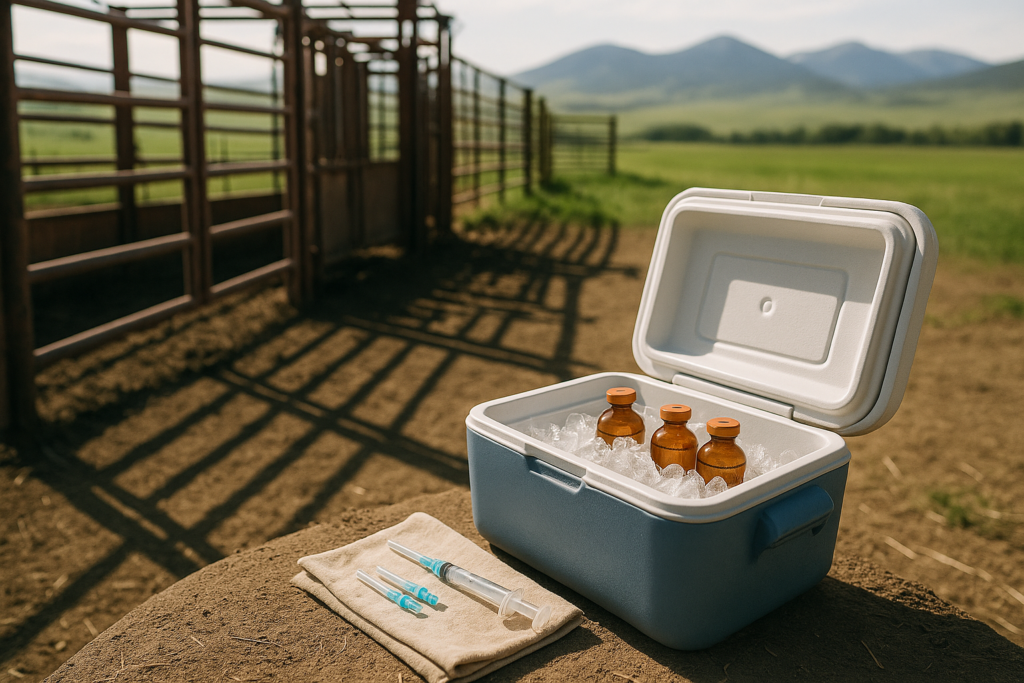
Keep the working supply in a real cooler with ice or frozen jugs, not the truck cab, not a five-gallon bucket in the shade. Pull one bottle at a time. Everything else stays on ice with the lid shut. When you knock off for lunch, the vaccine goes in the cooler too, not on the tailgate.
Mix small, and use it fast
Modified-live vaccines come as a powder and a diluent you mix at the chute. The clock starts the second you reconstitute them. Once mixed, that product is only good for an hour or two, and less than that if it’s warm. Mixing up a whole day’s worth first thing so you don’t have to stop is a good way to inject dead vaccine into the last two-thirds of the calves.
Mix one bottle at a time and only what you’ll use in the next hour. If the crew slows down or a wreck holds things up in the alley, you’re not throwing away half a bottle. Swirl it gently to dissolve the cake; don’t shake it like a paint can. When you draw up, keep the bottle in the shade of the chute or back in the cooler between fills.
Clean needles and honest technique finish the job
A vaccine held perfectly can still fail if the delivery is sloppy. Change needles often. A dull, burred needle tears tissue, hurts, and shoves manure and hair under the hide, which is where you get lump-jaw knots and abscesses that show up as trim loss on a fed steer. Run a fresh needle every ten to fifteen head at minimum, and swap immediately if you bend one or hit bone.
Never disinfect a modified-live syringe with alcohol or chemical cleaners. The residue that keeps the barrel sanitary will also kill the live virus in the next dose. Rinse transfer needles and syringes with near-boiling water and let them air dry instead. Keep separate syringes marked for killed and modified-live products so you don’t cross them up.
Give the shot where it belongs. Nearly everything goes subcutaneous now, in the neck, not the hip or the top of the rump. Injection-site lesions in the round cost the whole beef business money, and the neck heals cleaner. Tent the hide, slide in under it, and move on. Keep the dose the label says. Doubling up doesn’t buy extra protection, and cutting it doesn’t save enough to matter.
One more thing worth a minute at the end of the day: write down the product, the serial number, and the date. If a batch of calves breaks with something later, or you get a question at the sale, that record is the only way to know whether the problem was the vaccine, the handling, or something else entirely. It also tells you when the boosters are due, which for a lot of these summer programs is sooner than you’ll remember on your own.
The vaccine itself is the cheap part of the day. The gather, the crew, and the handling on the calves cost more than the bottle. Keep it cold, mix it small, and put it in clean under the hide, and you get what you paid for.