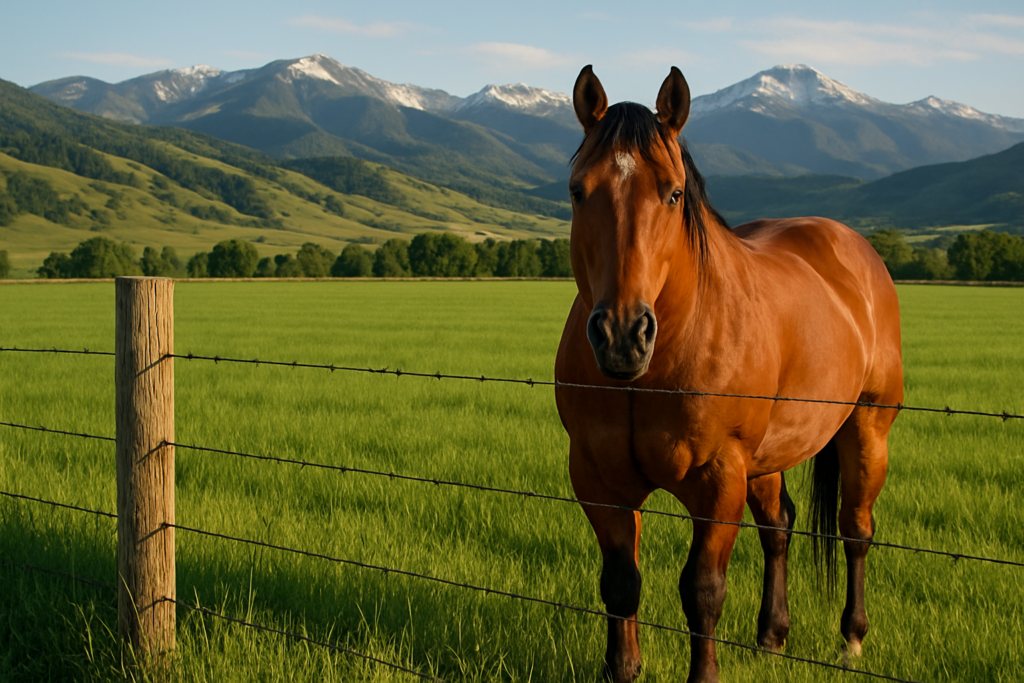
You spend all spring getting a horse legged up for branding and moving pairs, then you turn him out on the irrigated meadow for a few weeks of rest and come back to a horse that won’t hardly walk. It happens more than people like to admit, and it usually isn’t a wreck or a bad step. It’s founder — laminitis — and June grass is one of the surest ways to bring it on.
The mechanics are simple enough. Fast-growing green grass, especially the second flush of spring on an irrigated meadow or a fertilized hay field, is loaded with sugars. So is grass that’s been through a cold night and a sunny morning. When a horse takes in more of that than his gut can handle, the fermentation upstream sets off a chain of events that damages the laminae — the tissue that holds the coffin bone in place inside the hoof wall. In a bad case the bone rotates or drops. That’s the difference between a horse that’s sore for a week and one you’re deciding whether to keep.
Who ends up on the fence rail
The horse most likely to founder is the one that looks the best going into summer. Easy keepers, ponies, and anything carrying a cresty neck and fat pads over the tailhead are prime candidates. Older horses that have foundered before will do it again on a lot less grass. And a horse pulled off dry lot and dumped straight onto knee-deep alfalfa regrowth is asking for trouble even if he’s in decent shape.
The grain bucket does its share too. A horse that breaks into the feed room, or one that’s getting a big scoop of sweet feed he doesn’t need for the work he’s doing, can founder off grain alone. If you’re feeding a using horse hard, feed him for the work he’s actually doing that week, not the branding he did a month ago.
Catch it before the bone moves
Founder shows up in the feet, but the first sign is often just a horse that doesn’t want to move. He’ll stand with his front feet stretched out ahead of him and his weight rocked back onto his hind end, trying to get off those sore toes. He shifts from foot to foot. He’s reluctant to turn, and turning tight on hard ground looks especially painful. Put your hand on the hoof wall and it may feel warm, and you can sometimes feel a bounding pulse in the arteries at the back of the fetlock.
If you see that, get the horse off the grass right now and call your vet. Time matters here more than almost any other lameness. The window to limit the damage is short — a day or two, not a week. Standing him in cold water or ice on the feet in those early hours can help, and your vet may want to get an X-ray to see whether the bone has started to move. Don’t force him to walk to “work it out.” Walking a foundering horse on sore feet does more harm than good.
Keep them off it in the first place
The cheapest founder is the one that never happens. A few things that actually work on a ranch:
- Bring horses onto lush pasture gradually. Start with an hour or two a day and build up over a couple of weeks rather than turning out full-time overnight.
- Graze the fat ones in the early morning. Sugar content in grass runs lowest overnight and climbs through a sunny afternoon, so late day on cured-off or grazed-down pasture is safer than a hard frost followed by bright sun.
- Use a dry lot or a grazing muzzle for the easy keepers. A muzzle looks fussy, but it beats a rotated coffin bone.
- Keep grain out of reach and match feed to workload. Lock the feed room.
- Learn to read the neck. A firm, cresty neck and fat over the ribs is a warning sign, not a sign of good keeping.
Once a horse has foundered, he carries that risk the rest of his life, and managing his grass and weight becomes a year-round job. That’s a long time to babysit a horse you could have kept sound by fencing him off the good meadow in June.
The using horse is worth more to most outfits than a couple of yearlings, and he’s a lot harder to replace mid-summer. Watch the fat ones, watch the grass after a cold snap, and don’t let a few weeks of easy green pasture cost you the horse you counted on to get the cattle to the mountain.