Most of the plants that worry a Montana cattleman take their time. Larkspur, leafy spurge, cheatgrass awns — they cost you over days or a season. Water hemlock doesn’t work that way. A cow can graze a wet meadow at daylight, tug a root out of soft ground, and be down and convulsing before you’ve had your coffee. By the time you find her, there’s usually nothing to do but pull the body out of the ditch.
It doesn’t kill many cattle in a given year on most outfits. But when it does, it kills fast, and the animals it takes are often your best — the ones grazing hardest in the greenest, wettest corner of the pasture. Early summer is the window, because that’s when the ground is soft and the roots come free.
Where it grows and why June is the problem
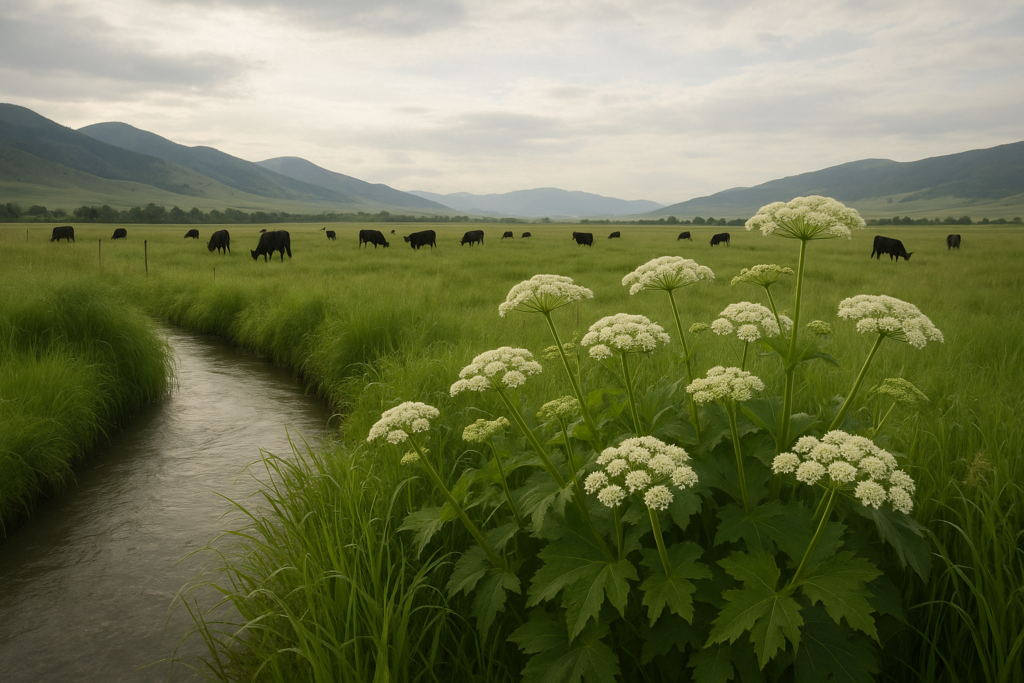
Water hemlock likes its feet wet. You’ll find it along irrigation ditches, spring seeps, the edges of stock ponds, marshy spots in a hay meadow, and the low ground where a creek spreads out. It’s a native plant, not a weed you brought in, and it turns up in country that otherwise looks clean and productive. That’s part of the trouble — the sites it favors are the same sites cattle drift to when the upland dries.
The plant grows two to several feet tall with hollow, jointed stems that are often streaked purple near the base. The leaves are divided and the flowers come in white umbrella-shaped clusters, a little like wild carrot or the water parsnip that grows in the same wet ground. The tell is in the root. Slice the base of the stem or the tuber lengthwise and you’ll see chambers — hollow crosswise sections — and a yellowish, oily juice that smells sharp, something like raw parsnip. That juice is where the poison sits, and the root holds the most of it.
June matters because saturated spring ground lets a grazing cow pull the whole root out instead of just biting off tops. A mouthful of leaf is bad. A mouthful of root can be a lethal dose in one bite. Ditch cleaning and bank work make it worse — freshly turned or dug roots left lying on the bank are the most dangerous thing on the place, because they’re loose, exposed, and cattle will nose right into them.
What it looks like when a cow gets into it
The poison is a nerve toxin, and it moves quick. Within an hour, often much less, an affected animal gets nervous and starts drooling and grinding her teeth. Then come the convulsions — violent seizures, teeth clenched, legs paddling. Animals often die during a seizure from respiratory failure. There is no practical treatment once a cow shows signs. Trying to handle or drive her makes it worse.
If you catch it early and can get a vet, sedation and supportive care are the only shot, and honestly, by the time symptoms are obvious the outcome is usually already decided. The realistic play is prevention, not rescue.
One hard rule: if you lose a cow near a ditch or wet meadow and you don’t know why, don’t assume bloat or lightning and move on. Look at the ground where she went down. A dug-up hole, a chewed root, plants pulled at the bank — that’s your answer, and it tells you the rest of the bunch is standing in the same danger.
Keeping cattle off it
You can’t spray your way out of this one overnight, and grubbing every plant on a big place isn’t realistic. What works is managing where cattle are and when.
- Walk your wet ground before you turn out. Ditch banks, seeps, and pond margins are where to look, and June is when the plant is up and identifiable.
- Fence cattle off the worst patches during the soft-ground weeks of early summer, even a single hot wire down a ditch line. The risk drops once ground firms up and roots stay put.
- Never leave dug or pulled roots where cattle can reach them. If you clean a ditch, haul the spoil and the plants off, don’t windrow them on the bank.
- Don’t graze wet meadows short. Hungry cattle on grazed-down ground are the ones that start rooting into the low, green plants they’d normally walk past.
If you want the patches dead, herbicide works on actively growing plants, but the roots stay toxic even after the top browns off, so treating an area doesn’t make it safe to graze that same season. Grubbing individual plants with a shovel is worth doing around corrals, tank aprons, and heavily used water — just get the whole tuber and pack it out.
Water hemlock is one of the few things on a ranch that gives you no second chance and no warning. The cheap insurance is knowing the plant, knowing your wet ground, and keeping cattle out of it for the few weeks in June when the roots pull free.