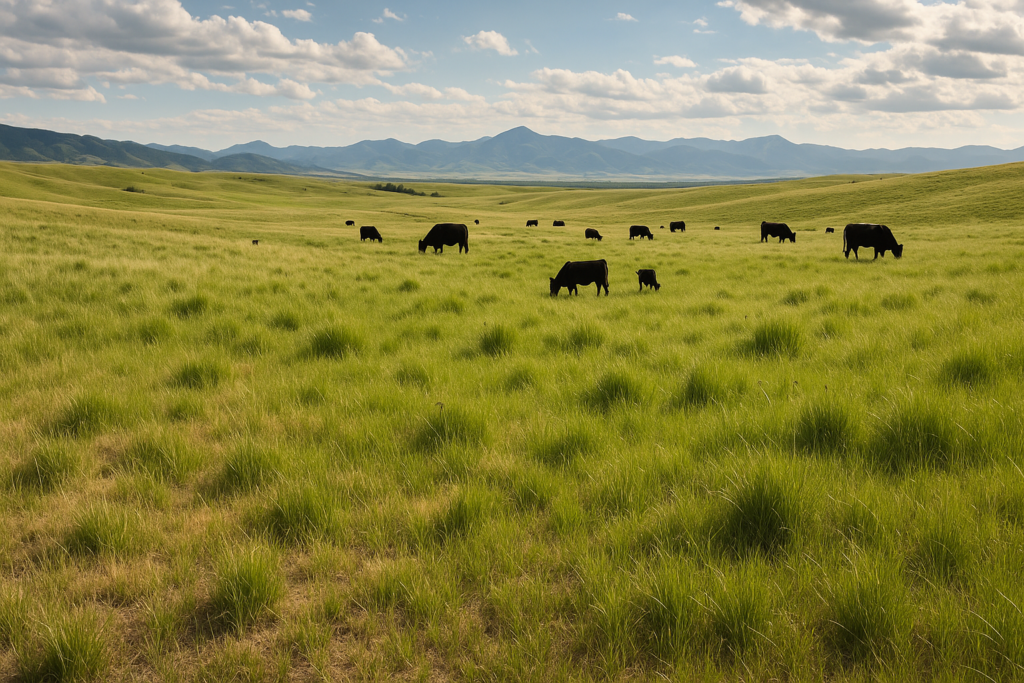
June is the one month the range is trying to give you everything at once. Cool-season grasses are shooting up, the draws are still green, and it’s easy to look at a full pasture and figure you’ve got all summer. That’s exactly when a lot of good grass gets ruined. The plant putting on the most growth right now is also the one most vulnerable to getting hammered, and how short you graze it in June decides how much regrowth you’ll see when the rain quits.
The old rule holds up: take half, leave half. Roughly half the year’s leaf growth by weight can come off, and the plant keeps rolling. Graze past that and you start eating into the plant’s ability to recover. It’s not a slogan, it’s a plant-physiology fact. The leaf is the solar panel. Strip too much of it and the roots pull back, the plant slows down, and it takes a lot longer to green up after each bite.
Why the short-grazed pasture stays short
When cattle graze a plant to the crown, the plant has to rebuild leaf out of root reserves before it can photosynthesize again. Every time that happens, the root system shrinks a little. Shorter roots reach less moisture. In a wet year you might get away with it. In a normal Montana summer, where the tap shuts off sometime in July, a pasture grazed hard in June simply can’t pull water from deep enough to keep growing.
You’ve probably seen it without naming it. One pasture got grazed flat in early summer and by August it’s brown stubble, while the neighbor’s ground that got moved off in time still has standing feed and some green at the base. Same rain, same country. The difference is how much leaf was left behind to catch the next shower and to shade the ground so the soil didn’t bake dry.
Leaving residue does more than protect the individual plant. That litter and standing stubble keeps soil temperature down, slows evaporation, and gives the next rain somewhere to soak in instead of running off. Bare, pounded ground sheds water. A pasture with cover uses it.
Move on time, not on the calendar
The trick is reading the grass, not the date. If you’re running a rotation, watch the grazed plants, not the fence line. When the better forage species are grazed down to about half their height and the cattle start working the stuff they’d been walking past, it’s time to move, whether that’s five days in or fifteen. Waiting for the pasture to look completely used up is how you take the last half and leave nothing.
A few things that make it easier to pull the trigger on a move:
- Set a stubble height in your head before you turn in and honor it. Four inches left on most upland bunchgrass is a lot more useful than two.
- Watch where the cattle are grazing, not just how full they look. When they quit the good plants and start hunting the coarse stuff, you’ve hit the halfway mark on the desirable species.
- Give grazed ground real rest. Regrowth in June might take a few weeks; by August it can take the rest of the season. The pasture you rest hard now is the one you graze in the fall.
Continuous grazing makes this harder, because cattle keep coming back to the same tender regrowth on their favorite plants and never touch the rank spots. Those preferred plants get bitten again and again while they’re trying to recover, and they’re the first ones to thin out over a few seasons. Even a rough split into two or three pastures with some rotation lets you leave half somewhere.
Stocking rate is the other half of it. All the moving in the world won’t save a pasture carrying more cows than it grew grass for. If spring came in dry and the grass is short to start, that’s the year to run fewer pairs or plan on pulling off early, not the year to hope it rains into it.
Grass grown in June and left standing is money in the bank for a dry August. Grazed to the dirt now, it’s just gone, and no amount of late-summer rain buys it back before fall.