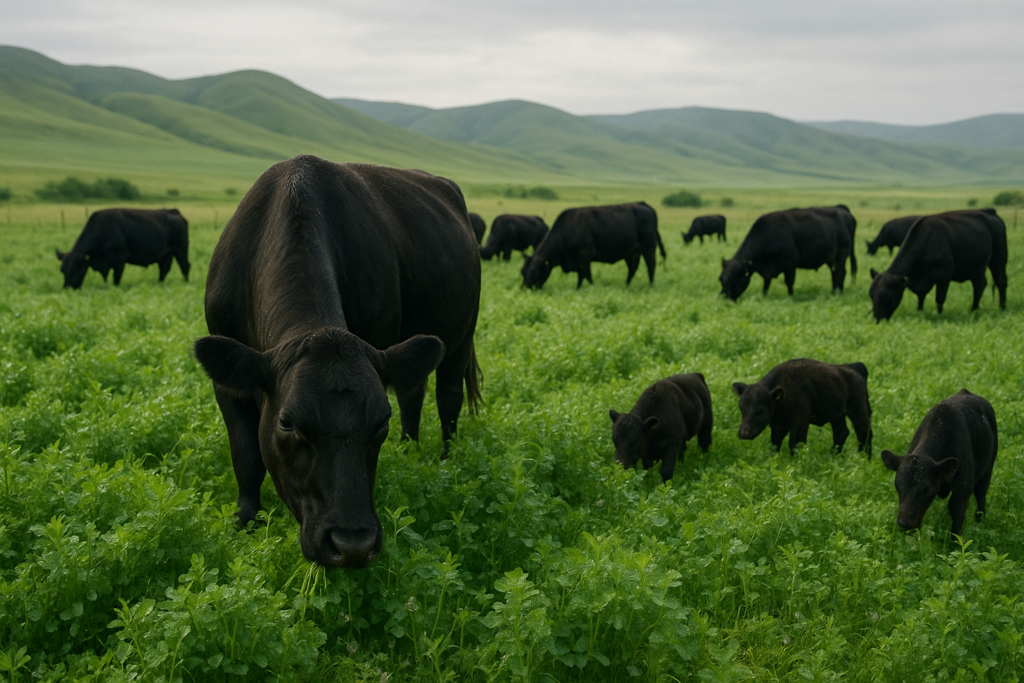
Every June a few producers walk out to a pasture that looked like money the day before and find a cow dead on her side, legs stiff, left flank swelled up like a barrel. No sign of a fight, no predator, nothing chewed on. That’s frothy bloat, and it happens fastest on exactly the kind of feed you want your cows on — thick, green, growing legumes with the dew still on them.
It doesn’t take a big alfalfa field to do it. A wet meadow that’s gone heavy to clover, a hayfield you turned cows onto after a rain, a ditchbank thick with sweet clover — any of those can set a cow up. The risk runs highest when the plant is young and lush, before it starts to bloom, and when the leaves are wet from dew or a shower.
What’s actually going on inside her
A cow’s rumen is a fermentation vat. When she eats fast-growing legumes, the plant proteins and fine particles trap the gas she’d normally belch off into a stable foam. She can’t burp foam. The gas keeps building, the rumen keeps expanding, and pretty soon it’s pressing on her lungs and her heart. A cow that’s really loaded can go from grazing to down in an hour or two. On the worst mornings you’ll lose one before you ever knew she was in trouble.
Grasses don’t do this the same way. It’s the legumes — alfalfa, both the red and white clovers, and sweet clover — that carry the real bloat load. That’s why a straight native range or a grass-heavy pasture rarely gives you trouble, and a fresh alfalfa regrowth after first cutting is one of the most dangerous places you can put a hungry cow.
Turning out without blowing up half the herd
The single biggest mistake is turning hungry cattle onto lush legume in the morning. A gut-empty cow will gorge, and dew makes it worse. Fill them up first on hay or dry grass, then move them onto the legume later in the day once the dew has burned off. Afternoon turnout on a dry plant beats a dawn turnout on a wet one every time.
A few things that hold up in practice:
- Fill cattle on dry hay or coarse grass before they ever see the legume pasture. A full cow eats slower and pouches less foam.
- Wait for the dew to dry. Don’t turn out into a wet field, and be extra careful the morning after a rain.
- Move them on gradually. Short grazing windows the first few days let the rumen bugs adjust instead of shocking a cow that’s been on dry feed.
- Don’t pull them off and starve them, then throw them back on. That empty-gut, gorge-again cycle is what puts cows down.
- Graze legume stands after they’ve started to bloom when you can. Mature plants carry less bloat risk than young, pre-bud regrowth.
Poloxalene, the bloat-preventive you’ll find in blocks and mixed into some minerals and supplements, breaks up the foam and works well — but only if the cattle actually eat enough of it, and only if you get it in front of them a day or two before turnout, not the morning after you find a dead cow. Cattle are picky about a new block. Set it out early and make sure the whole bunch is hitting it before you trust it to carry them.
When one goes down
A bloated cow stands with her head out, drooling, uncomfortable, stomping, and that left flank pushed way up. If you catch her early and get her walking, keep her moving — motion helps her belch. Poloxalene drenched down her can break the foam if you’ve got it and can get it into her safely.
The stomach tube is the tool that actually saves cattle, and it’s worth knowing how to use before you need it in the dark. Run a tube down and you may relieve gas, but with froth it doesn’t always vent — you’re mostly getting a defoaming agent to where it can work. Sticking a cow with a trocar or a knife is a last-ditch move for an animal that’s going to die in front of you otherwise, and it’s a good way to set up peritonitis if she lives. If you’re at that point, you’ve usually already lost the timing.
The honest truth is that bloat is a management problem far more than a treatment problem. By the time you’re chasing a down cow across a legume field at daylight, the decisions that mattered got made the day before — how full they were, how wet the grass was, and whether you eased them onto that feed or turned them loose to gorge. Get the turnout right and you’ll spend your Junes checking cattle instead of dragging them off.