Dry years push a lot of Montana producers toward annual forages — oats, barley, spring wheat cut for hay, millet, cane. They grow fast, make tonnage when perennial grass quits, and fit a tight summer. They also happen to be the crops most likely to load up nitrate when the weather turns against them. A field that looks fine can carry enough in the lower stems to kill a cow within hours.
Nitrate trouble doesn’t announce itself. Producers tend to learn about it the hard way, finding dead animals in a pen the morning after turning out on green chop or feeding a load of stressed oat hay. By mid-June, with subsoil moisture already short across much of central and eastern Montana, it’s worth knowing how this works before you cut or graze anything.
Why drought-stressed forage stacks up nitrate
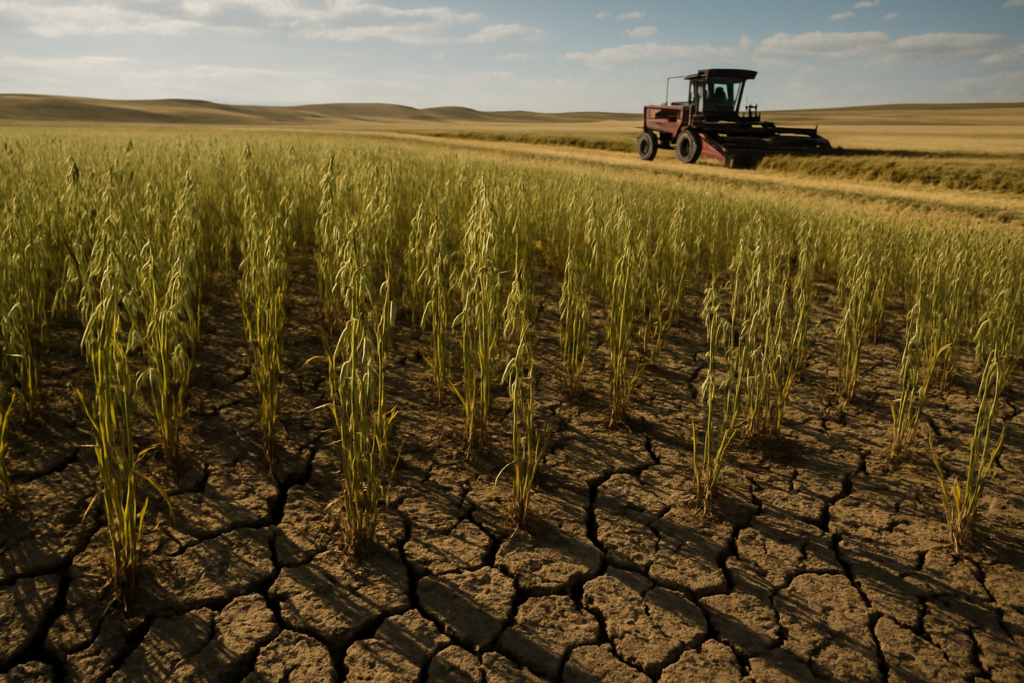
Plants pull nitrate out of the soil and convert it into protein as they grow. That conversion needs steady moisture and sunlight. When a plant is stressed — droughty, hailed, frosted, or coming back after a dry spell breaks with a quick rain — it keeps taking up nitrate from the roots but stalls out on turning it into protein. The nitrate piles up, and it concentrates in the bottom third of the stalk.
That’s why the worst-case scenario is a heavily fertilized cereal field that struggled through drought, then caught a rain. The plant goes back to pulling nitrate hard before it gets growing again. Cutting or grazing in that window, especially within a few days of rain breaking a dry spell, is asking for it.
A few patterns to keep in mind:
- Nitrate concentrates low. Leaving taller stubble — say six to eight inches — leaves the most dangerous part of the plant in the field.
- Oats, barley, wheat, cane, sudangrass, and millet are common offenders. So are some weeds, including kochia, pigweed, and lambsquarter, which show up thick in stressed fields and drought years.
- Nitrate doesn’t break down in dry hay the way prussic acid does. If it’s high when you bale it, it stays high in the stack all winter.
What it does to a cow, and what you’ll see
Nitrate interferes with the blood’s ability to carry oxygen. An affected animal essentially suffocates from the inside. It moves fast — sometimes you find them down before you see any warning at all.
When you do catch signs, watch for labored, rapid breathing, weakness and staggering, trembling, and a brownish or chocolate cast to the blood and the membranes around the eyes and mouth instead of healthy pink. Pregnant cows may abort even after a dose that doesn’t kill them. A veterinarian can treat acute cases with methylene blue if you catch them in time, but the practical reality is that prevention beats treatment by a wide margin here.
If you suspect it, get a vet involved immediately and pull cattle off the feed or pasture. Don’t wait to see whether the next cow goes down.
Test before you feed, and feed smart
The only way to actually know what you’ve got is a forage test. Pull a representative sample of hay — cores from several bales — or fresh-cut material, and send it to a lab for a nitrate analysis. Your county Extension office can point you to a lab and help interpret the results, which are reported either as nitrate or nitrate-nitrogen, so make sure you know which number you’re reading. If you’re standing in a stressed cereal field wondering whether to cut it, that test is cheap insurance.
A few practices lower the odds even when forage tests on the high side:
- Raise the cutter bar. Leaving the bottom of the stalk in the field removes the most loaded part of the plant.
- Delay cutting after a rain. Give a stressed crop several days of good growing weather to convert nitrate before you lay it down.
- Don’t turn hungry cattle out on suspect forage. A full rumen handles a moderate nitrate load far better than an empty one. Fill them on safe hay first.
- Dilute. High-nitrate hay can sometimes be fed by blending it with clean feed to bring the total ration down to a safe level — but only if you’ve tested and know the numbers.
- Watch your weeds. Kochia and pigweed thriving in a thin, dry field can be the real hazard even when the crop itself is borderline.
Ensiling can cut nitrate levels somewhat through fermentation, but green chop fed fresh off a stressed field is among the riskiest things you can do. The nitrate is all still there, and you’re delivering it in a big, fast dose.
None of this means you should write off annual forages in a dry year. They earn their keep when grass runs out. Just treat a stressed crop as a question mark until the lab answers it, and feed it with your eyes open. A test costs a fraction of one cow.