If you summer cattle along the foothills of the Rockies, the Bridgers, the Crazies, or any of the timbered breaks where snowmelt keeps the ground wet into July, you’ve probably got larkspur whether you’ve looked for it or not. It’s one of the few range plants that can drop a healthy cow in a matter of hours, and it does most of its killing in late spring and early summer when the grass looks good and nobody’s watching for trouble.
The frustrating part is that the cattle aren’t sick from anything you can vaccinate against. They eat a plant, the toxin hits the nerves and muscles, and a big animal goes down. Producers who lose cows to it often find them dead near water or on a trail with no sign of a struggle. Understanding the plant’s timing is most of the battle.
Know what you’re looking at
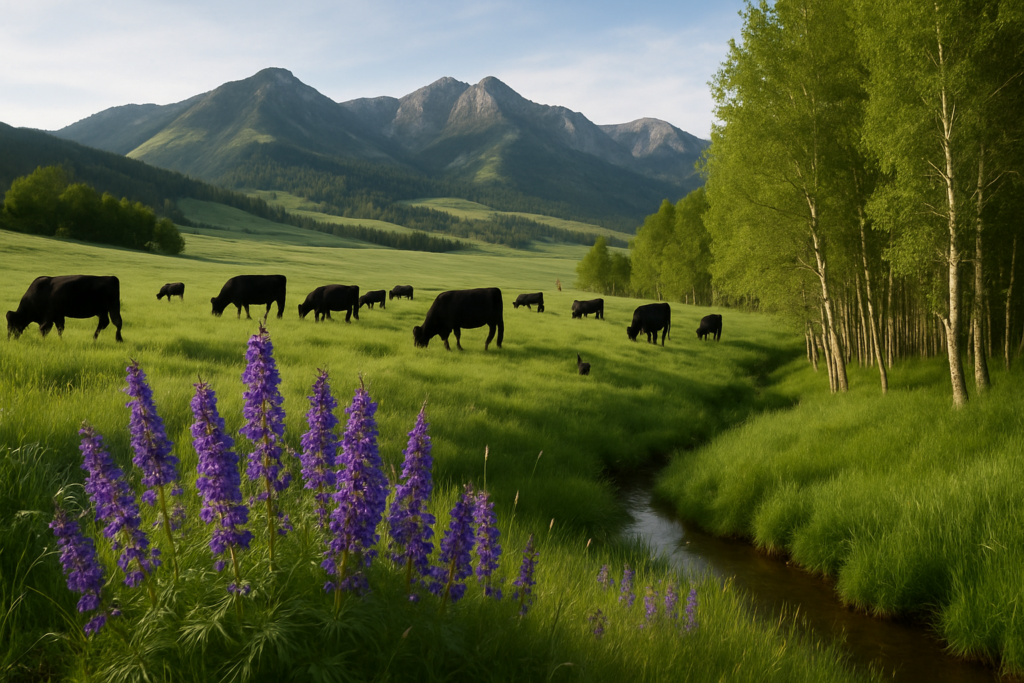
Montana has both tall larkspur and low larkspur. Low larkspur is the short one, ankle to knee high, that shows up early on open foothill and sagebrush ground and dies back by early summer. Tall larkspur grows in wetter spots—aspen pockets, north slopes, along seeps and drainages—and can stand chest high by midsummer. Both carry the same family of alkaloids that interfere with the nerve signals to the muscles.
The flowers give it away. Larkspur blooms in a spike of blue to purple flowers, each one with a little spur sticking off the back, which is where the name comes from. Before it blooms, the leaves are deeply divided, almost palm-shaped. If you’re not sure what you’ve got, dig out a plant and learn it cold, because mistaking it for a harmless forb is how people get surprised.
The danger isn’t constant—it’s a window
Larkspur is most toxic when it’s young and leafy, and the total poison load in a patch stays high through the bud stage. As the plant flowers and especially as it goes to pod, the concentration of toxin per pound drops. The catch is that cattle don’t want much to do with larkspur early on. They tend to start eating it about the time it bolts and flowers—right when a lot of Montana cattle are getting turned onto summer range.
So you end up with two things lining up badly: cattle becoming willing to eat it, and the plant still carrying enough toxin to matter. That overlap, roughly through bud and early bloom, is the high-risk stretch. Once the plants are well into pod and starting to dry, the risk falls off considerably.
A few things make a bad situation worse. Cattle that are hungry—just trailed in, just off a truck, or turned onto a pasture after the good grass is grazed down—will eat larkspur they’d otherwise walk past. A storm that knocks them off feed and then sends them out grazing hard can do it too. And the toxin works against muscle control, so anything that makes a poisoned animal exert itself—being gathered, pushed, or run—can turn a sub-lethal dose into a dead cow. More than one outfit has lost cattle not to the plant alone but to moving them right after they’d been grazing it.
How to graze around it
You can’t spray your way out of larkspur across big foothill country, and you usually wouldn’t want to. The practical approach is to work with the plant’s timing.
- Walk your larkspur patches before turnout and know where they are. The wet draws and aspen edges are the spots to check.
- If you can, hold cattle off the heaviest larkspur ground during the bud-to-early-bloom window and bring them on later, after the plants have set pod and the risk drops.
- Turn out cattle full, not hungry. Don’t dump them onto a larkspur pasture straight off a long haul.
- Leave them alone on larkspur ground. Don’t gather or push hard during the risky weeks. If you have to move them, do it slow and early, before they’ve filled up for the day.
- Sheep tolerate larkspur far better than cattle and will graze it down. Where it pencils out, running sheep through a patch ahead of cattle is an old fix that still works.
If you do find a cow down, the kindest thing is to keep her quiet and let her metabolize the toxin—stress and movement are what kill. Keeping her sternal so she doesn’t bloat helps. There are treatments a veterinarian can discuss for high-value animals, but for most outfits, prevention through grazing timing is the only thing that reliably keeps cattle alive.
The cows that die to larkspur are rarely the poor ones. It’s the big, dominant cows that eat the most and go down first. That’s reason enough to learn the plant and graze around its worst weeks.