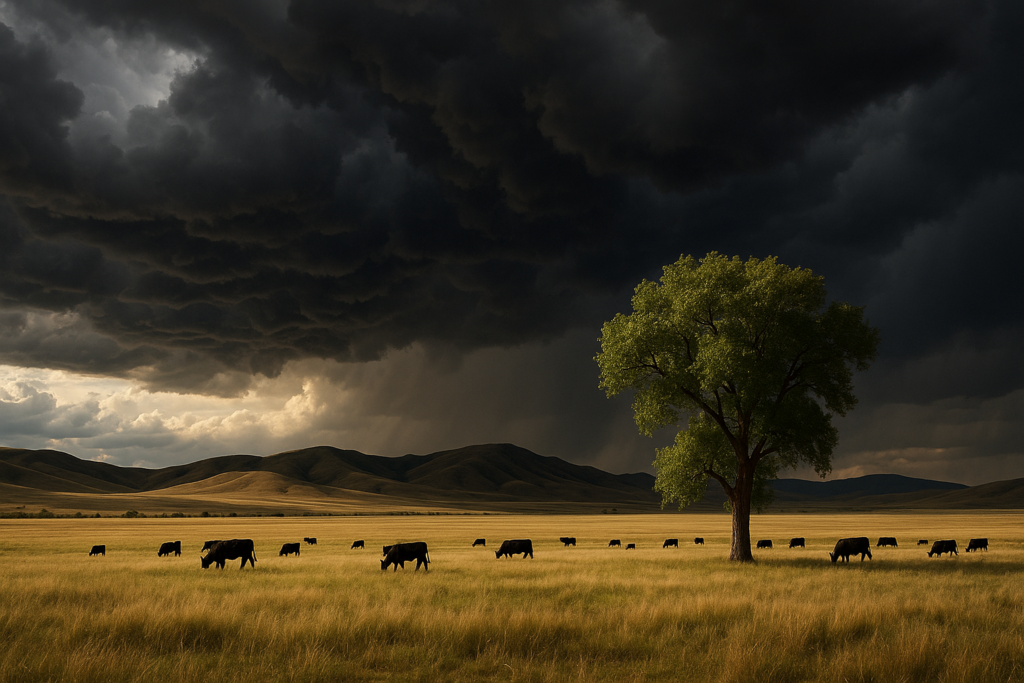
The first big cell of the year usually rolls through in June, and it doesn’t take much of one to kill cattle. A dry lightning strike on a ridge, a cow standing under the only cottonwood in the pasture, a wire fence that carries current a quarter mile — any of those can leave you loading dead cows into the pickup instead of moving them to fresh grass.
Lightning is one of the more common weather losses on Montana summer country, and it’s one people underestimate because they don’t see it happen. You turn out, the cattle scatter, and you might not lay eyes on every bunch for a week. When a storm hits and takes several head, you can go a good while before you find them.
Why it usually kills more than one
People picture a single cow taking a direct hit. That happens, but it’s not the usual story. Most lightning losses come from what runs along the ground after the strike, or from what a tree or fence does with the charge.
Cattle bunch up when the weather turns. They’ll crowd under the biggest tree, pile along a fence corner, or stand shoulder to shoulder on a high spot. A bolt hits the tree, travels down through the roots and out through the wet ground, and the current fans out into every animal standing on it. That’s ground current, and it’s why you’ll find four or five head dead in a tight circle around one tree with not a mark on the tree worth noting.
Fences do the same thing over distance. A strike anywhere along a long run of wire can push current down the line, and a cow standing against the wire or a metal water tank becomes part of the circuit. I’ve seen cattle killed a long way from where the bolt actually came down because the fence carried it to them.
What you can actually do about it
You can’t stop lightning, but you can quit setting cattle up to die in a group. A few things help.
- Take out the lone trees in the middle of open pastures, or at least know that cattle will head for them and plan accordingly. A single tall tree on a flat is the worst place cattle can be in a storm.
- Ground your fences well, especially long straight runs and anything tied to a metal building or corral. Good grounding gives the current somewhere to go besides through a cow.
- Put water and shade in low ground and in spots with several trees rather than one, so cattle aren’t drawn to the highest, most exposed feature in the pasture.
- Ride the high country and the fence corners after a storm, not just the easy bottoms. That’s where you’ll find them if you’re going to find them.
None of this is a guarantee. Cattle do what cattle do, and a bad enough storm will find them wherever they are. But you can quit making it easy.
The morning you find them
Finding dead cattle bunched together with no obvious cause is the first clue. Look for singed hair, a split hoof, or a burn mark that runs in a line down a leg — lightning often leaves a mark where it entered and exited. A tree with a fresh strip of bark blown off, or a scorched fence post, backs it up. Sometimes there’s almost nothing to see, and the tight grouping of the carcasses is the best evidence you’ll get.
Document it before you move anything. Photograph the carcasses where they lay, the tree or fence nearby, and any burn marks. Note the date and the storm. If you carry livestock coverage that includes lightning, or if you’re going to claim the loss come tax time, that record is what makes the difference between a paid claim and an argument. Get your insurance agent or brand inspector out if the policy calls for it.
Then get the deadstock handled the same way you would any summer carcass — moved well away from live cattle, water, and the places you ride, so you’re not drawing bears and coyotes into the herd on top of the loss you already took.
Lightning isn’t something you’ll ever prevent entirely. But knowing how it kills, where cattle go when the sky turns, and what to do the morning after keeps a bad afternoon storm from turning into a mystery you never solve and a loss you never get paid for.