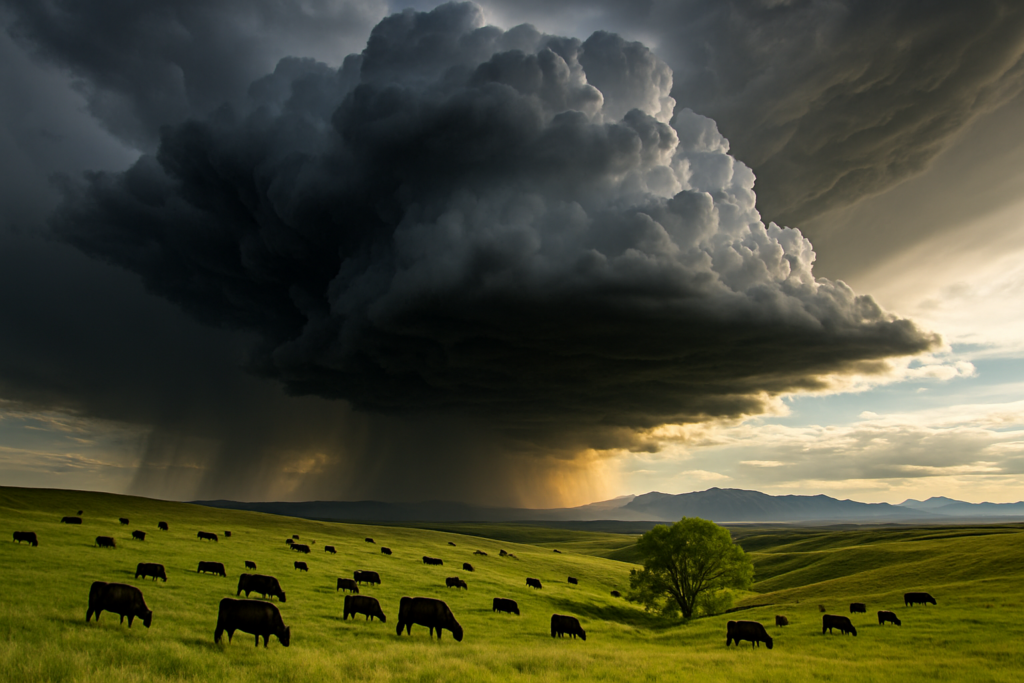
You watch it come up out of the southwest most afternoons in June. Clear morning, the ground still damp from the last front, and by two o’clock there’s an anvil sitting over the Crazies or the Highwoods with a black bottom to it. An hour later the wind’s flat and the first close crack rattles the truck windows. That storm can put more money on the ground in ten seconds than a week of doctoring saves.
Lightning is one of those losses nobody plans for because it feels random. It isn’t, entirely. Cattle die from it in predictable places, doing predictable things, and while you can’t hang a lightning rod over a section of summer range, you can quit stacking the deck against yourself.
Why they die in bunches
The thing that makes lightning ugly on a cow outfit is that it rarely takes just one. A single strike into a tree, a fence line, or wet ground spreads current through the soil, and every animal standing in that spread picks up the difference in voltage between its front feet and back feet. A big animal on four legs several feet apart is about the worst possible shape for that. So when the storm rolls through and the cattle have bunched up tight for shelter, you can lose five, eight, a dozen in one spot.
Two situations account for a lot of it. The first is the lone tree. Cattle head for the biggest cottonwood in the draw when the rain starts, and that’s exactly what the strike is looking for. The current jumps off the trunk into the ground and into everything crowded around the base. The second is the wire fence. A barbed-wire fence a half-mile long is a good conductor, and a strike anywhere along it can travel and drop stock that happen to be standing against it or bedded in the corner where two fences meet.
You’ll find them in a rough circle or a line, legs stiff, often no mark on them at all. Sometimes there’s singed hair or a burn track down a leg, sometimes nothing. If you find dead cattle grouped under a tree or along a fence the morning after a storm and there’s no other explanation, lightning is the first thing to suspect.
What actually cuts the odds
You can’t storm-proof open country, but a few things genuinely help over the years.
- Give them somewhere better to go than the one big tree. A shelterbelt, a stand of timber, or broken terrain spreads cattle out and gives the strike more targets than a single trunk. Pastures with only one lone tree in the middle are the classic setup.
- Watch your fence corners and long straight runs of wire. If you keep losing cattle in the same corner after storms, that’s telling you something. Some outfits ground their fences on high, exposed ground, running a ground rod every so often to bleed a strike into the earth instead of down the line into the herd.
- Think about where the water and mineral are. If the only stock tank or mineral feeder sits under the biggest tree on the ridge, you’ve trained the cattle to gather at the worst spot every time weather comes up. Move it out into the open or down off the high ground.
- Don’t put salt and mineral on the highest knob in the pasture. High, exposed ground gets struck first, and cattle standing on it are exposed.
None of this is a guarantee. Cattle do what cattle do, and a bad enough storm will find them anywhere. But the difference between a pasture where they scatter into broken country and one where they jam under a single tree is real, and it’s the part you control.
After the storm
Ride the high spots and the lone trees the morning after a hard cell moves through, especially if you didn’t hear from a neighbor or see the cattle at last light. Carcasses found in a group with no bloat history, no bad feed, no water problem, and often not a mark on them point to lightning. If you carry livestock mortality coverage, document it before you move anything: photograph the group where they lie, the tree or fence, and any burn marks. Loss adjusters want to see the pattern, not a report after the fact.
Most Junes you’ll never think about it. Then one afternoon the sky turns green over the divide, and you’ll be glad the cattle have somewhere to go besides the cottonwood.