Every year some outfit turns cattle out to good mountain grass and comes back a week later to find a dead cow or two, bloated and stiff, usually near a draw or a north slope where the ground stays damp. No sign of a fight, no predator, nothing chewed on. More often than people admit, the answer is larkspur.
Larkspur is a bigger cattle killer on western range than most producers give it credit for. It doesn’t leave a mark you can read from the truck, it works fast, and it hits the animals you can least afford to lose \u2014 the big, healthy cows that graze aggressively and cover ground.
Know which larkspur you’re dealing with
Two kinds matter in Montana, and they run on different clocks. Low larkspur comes on early, down in the foothills and on open sagebrush and grassland, often before much other green is up. It’s short-lived \u2014 it grows, flowers, and dries down through late spring and early summer, and once it’s cured out the risk drops off. The trouble is that it greens up when cattle are hungry for anything green and there’s not much competition.
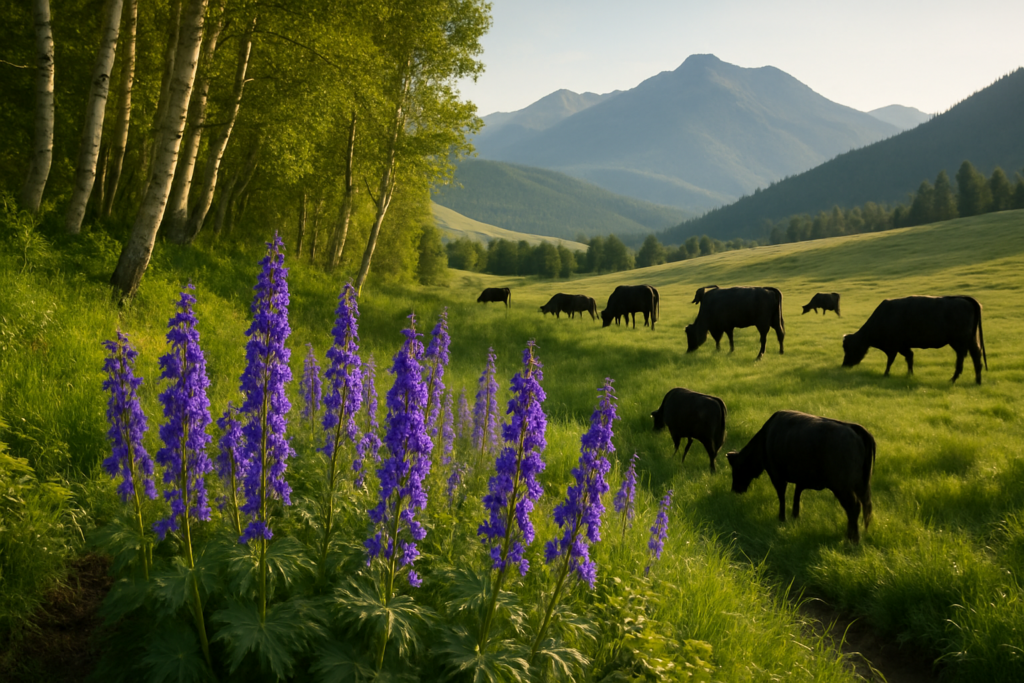
Tall larkspur is the one that catches outfits running yearlings and cows on summer mountain range. It grows in the moist spots \u2014 aspen pockets, north slopes, the heads of draws, seeps and swales that hold water into July. It can stand waist high with those deep blue-purple flower stalks. It’s on those slopes well after the low country has dried, which lines up almost exactly with when a lot of Montana cattle are pushed up to high summer pasture.
Both plants carry the same class of alkaloids. The poison is strongest in the young, fast-growing plant and stays high through the bud stage. What makes tall larkspur especially dangerous is that cattle tend to leave it alone when it’s vegetative and then eat more of it once it flowers and sets pods \u2014 which is also when the plant is still packing a serious toxic load. So the plant gets more palatable right as it stays deadly.
How it kills, and why the timing matters
The alkaloids block the signal between nerve and muscle. A cow that has loaded up on larkspur gets weak, wobbles in the hindquarters, goes down, and then can’t get the muscles working to keep breathing. Bloat is common because she can’t stay upright and can’t belch. What ties a lot of larkspur deaths together is stress or exertion right after a cow has eaten a bellyful \u2014 gathering, trailing, spooking, running them to water or to a new pasture. A cow that might have metabolized a marginal dose while standing quiet will tip over if you push her.
That’s the practical hook. You can’t pull every larkspur plant out of a mountain allotment, but you can control when and how hard you press cattle through it.
- Don’t gather or trail cattle through heavy larkspur patches when the plant is at its worst. If you have to move them, do it slow and let them travel on their own feet.
- Watch the flowering. On tall larkspur, the highest-risk stretch tends to run from bud through flowering and into early pod. Once the pods mature and the plant dries and drops its seed, toxicity falls off and the danger eases.
- Consider grazing the larkspur country early, before it bolts and flowers, or holding cattle off it until it’s past flowering and into the drying pod stage. The window in the middle is where cattle die.
What you can do on the ground
Walk your summer pastures before turnout and find the patches. They don’t move much year to year \u2014 the same seeps and draws grow it every season. Knowing where the heavy stuff is tells you where not to bed cattle, where not to put a salt or mineral station, and where not to trail a full bunch.
Sheep tolerate larkspur far better than cattle do, and running sheep through a patch ahead of cattle knocks the plants back and reduces what’s left to tempt a cow. That’s not an option for most outfits, but it’s worth knowing if you share country or lease grazing to a sheep man.
Herbicide can work on defined patches if you hit them early enough in the growth, but a sprayed plant can stay standing and palatable for a while, so treated ground still needs to be kept off cattle until the plants are dead and cured. Spot spraying the draws and aspen edges over a few seasons will thin a bad patch, but it’s a long game, not a fix for this June.
There’s no reliable field antidote a rancher can count on. A vet can sometimes help an animal caught early, but by the time you find a larkspur cow she’s usually down and short of breath, and handling her makes it worse. Keep her quiet, keep her upright if you can, and get help \u2014 but the real defense is not letting a hungry cow fill up on it in the first place, and not stressing the ones that already have.