You gather to move pairs to fresh grass and one cow hangs at the back, packing a hind leg, hoof swollen up above the hairline. Two days ago she walked out to water fine. That’s foot rot, and it’s about the most common lameness you’ll deal with on Montana summer range once the low spots stay wet and the ground around the tanks turns to soup.
It isn’t a bruise or a rock stone. Foot rot is a bacterial infection that gets in between the two claws, usually where the skin is already soft from standing in mud, or where a sharp rock, a stubble stalk, or frozen ground earlier chewed up the skin. Once the bug is in, it swells the whole foot evenly — both claws spread apart, the leg puffs up to the dewclaws, and the smell is bad enough you’ll know it before you get the foot in your hands. That even swelling is what tells you it’s foot rot and not a bruise from a rock, which usually shows up in one claw.
Catch it while it’s still just a foot
The reason to move on it early is that foot rot doesn’t stay in the skin if you leave it alone. Give it a week or ten days and the infection can work up into the joint above the hoof. Once it’s in the joint you’re not curing it with a shot of antibiotic — you’re looking at a chronically lame cow, a salvage decision, or a vet bill for cleaning out the joint that rarely pencils out on a commercial animal. The difference between an easy fix and a wreck is how fast you catch her.
So when a cow starts limping, get a look at the foot before you decide it’s nothing. That means running her into a chute or roping and stretching her out, not squinting at her across the pasture. Spread the claws and look for the split, cracked skin between the toes with dead gray tissue in it. Clean it out if you can. Most cases respond to a long-acting antibiotic labeled for foot rot — talk to your vet about which one and the dose, and honor the withdrawal time, because a cow you treat in June may be one you ship in the fall.
A cow caught early and treated usually turns the corner in a few days. If she’s not sound in three or four days after a shot, get her looked at again. Either it’s gone deeper than the skin or it was never foot rot to start with — a nail, a wire cut, or a deep sole abscess can all send a cow off on the same leg.
The wet spots are where it lives
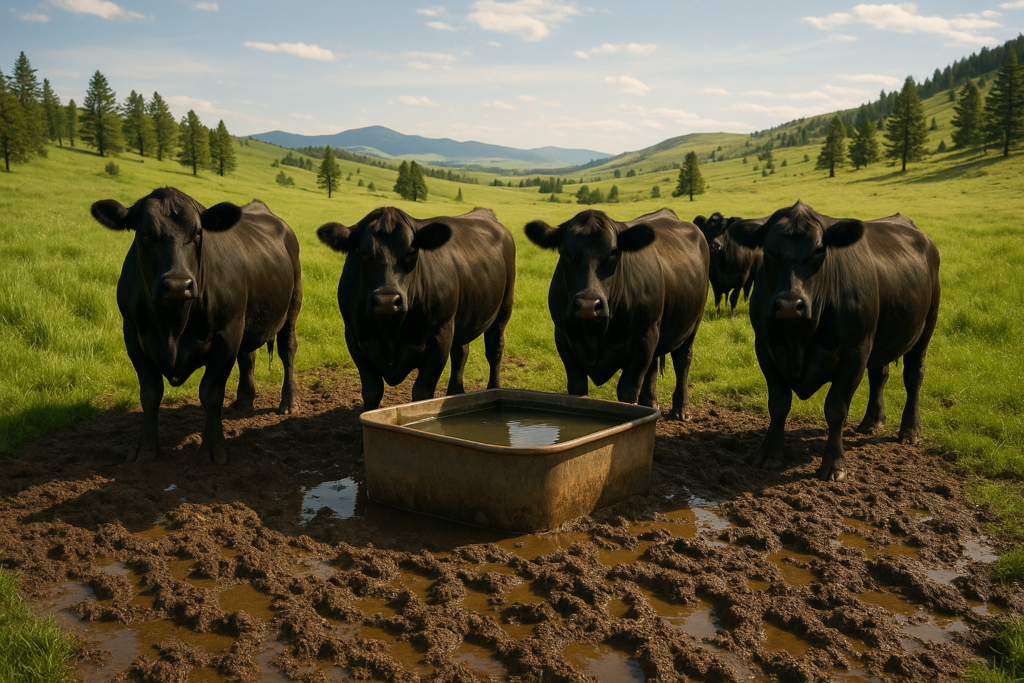
Foot rot doesn’t spread cow-to-cow through the air. It builds up in the ground — in the churned mud around a leaky stock tank, the boggy edge of a spring, the trail that funnels every animal through one gate. The more cattle stand in the same wet, manure-packed dirt, the more the bug loads up and the more feet it finds a way into. A summer that runs wet, or a July when everything crowds the one water source that hasn’t dried, is a summer you’ll pull more feet.
You can’t dry out the whole country, but you can fix the worst pinch points. Gravel or haul rock into the muddy approach at a tank. Fix the float that’s been overflowing and turning the ground to gumbo. If cattle are pounding one gateway into a bog, a second gate or a bit of rock spreads out the traffic. Spreading salt and mineral well away from water pulls animals off the wet ground and gets them standing on dry grass instead.
Zinc in the mineral is worth a look too, since it helps keep hoof and skin tissue tough. It’s not a cure and it won’t make up for a mud hole, but on outfits that fight foot rot year after year it’s cheap insurance. There’s a foot rot vaccine on the market as well; results are mixed and it’s not a fit for every operation, so that’s a conversation to have with your vet rather than a blanket recommendation.
Watch the whole bunch, not just the lame one
One cow with foot rot in a wet pasture usually means the ground is set up to give it to others. When you find the first one, start counting feet on the rest as you ride through. It’s a lot easier to rope and doctor a cow in the pasture the day she starts limping than to gather the whole herd because half a dozen are three-legged lame and one has gone into the joint.
None of this is complicated. Look at feet early, treat what you find, and quit letting your cattle stand knee-deep in the same mud all summer. The cow that drops off the back today is telling you something about the ground the rest of them are standing on.