You buy the vaccine, you pay somebody to give it, you run the calves through, and you check the box. Nobody stands at the chute and watches the immune response, so it’s easy to assume every dose worked. A lot of them don’t. Not because the product was bad, but because it sat on the tailgate in June sun for two hours, or got drawn up in a syringe that had bleach residue in it, or went in warm and half-dead.
Modified-live vaccines are the ones that bite you here. The virus in them is alive but weakened, and heat, sunlight, and disinfectant kill it just like they’d kill anything else living. Once it’s dead, you’re injecting saltwater. The calf takes the poke, bawls, goes back to its mother, and gets no protection at all. You find out in the fall or the following spring when something moves through that bunch that shouldn’t have.
Heat and light do the damage before you notice
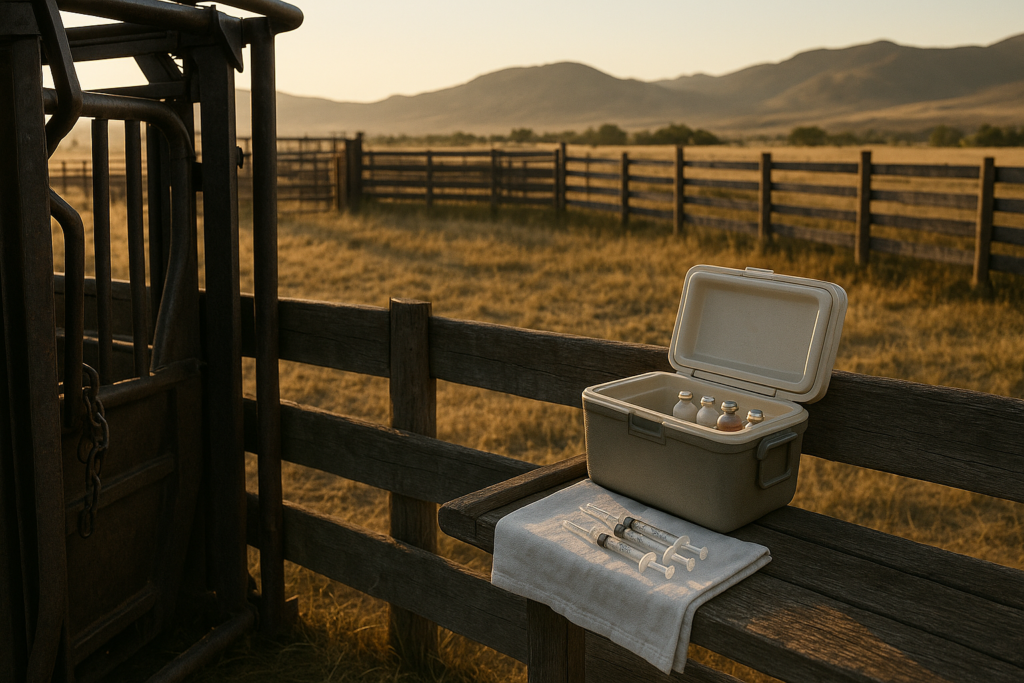
Most cattle vaccines want to stay cold, roughly refrigerator temperature, from the time you buy them until they go in the animal. That’s easy in the store cooler and easy in your fridge at home. It falls apart at the corral. A cheap foam cooler with a couple of thawing ice packs will hold temperature for a while, but if you crack the lid every thirty seconds to grab a bottle, or set the whole thing where the sun hits it, the inside warms up fast. On a hot afternoon a cooler sitting on a truck seat behind glass can get downright warm inside.
Sunlight is the part people forget. Ultraviolet light kills the modified-live virus even when the bottle is still cold to the touch. A reconstituted bottle sitting on the chute rail in direct sun is losing potency by the minute. Keep the working bottle in the shade, in the cooler, out until you actually draw from it, then back in. If you’re mixing your own modified-live from the powder and the diluent, only mix what you’ll use in about an hour. Once it’s reconstituted the clock is running whether it’s cold or not.
Two coolers beats one. Put the unmixed and unopened product in a cool box you barely open, and keep a small working cooler with just the bottle you’re pulling from. That way the main supply isn’t getting warmed every time somebody reaches in.
The syringe is where good vaccine goes to die
You can do everything right with the cooler and still ruin the dose in the gun. Any soap or disinfectant left in a syringe will kill a modified-live vaccine on contact. When you clean vaccine equipment, use hot water only, no bleach, no dish soap, and let it dry. Boiling water or near-boiling rinse works for the barrel, but never run disinfectant through a gun you’ll load live vaccine into. Keep a set of syringes that only ever sees vaccine, and mark the killed guns and the live guns so they don’t get crossed.
A few more things that cost you doses at the chute:
- Draw-up needles left stuck in the bottle let air and bacteria in and heat the contents. Pull the needle when you’re not actively filling.
- A bent or burred needle tears tissue and can back product out of the hole as the calf lunges. Change needles often, and change them when they get dull or dirty.
- Guns left lying in the dirt or sun between rounds warm the loaded dose and pick up grit. Set the gun in the shade, in a clean spot.
- Dosing by guess. A gun that’s out of adjustment can throw a partial dose all day. Check it against a marked syringe before you start.
Time your working so the heat isn’t fighting you
If branding ran late and you’re vaccinating in July, the same rules that keep cattle from overheating help your product too. Early morning is your friend. It’s cooler on the calves, cooler on the cows waiting in the pen, and cooler on the cooler. Get the hard part done before the sun climbs and the tailgate gets hot enough to fry on.
Buy what you’ll use and use what you buy. Vaccine that’s been through a season of warm truck rides, back and forth to the fridge, isn’t the same product it was. Note the expiration, keep it cold and dark, and don’t hoard partial bottles thinking you’ll finish them next time. A leftover half-bottle that rode around warm is not worth the calf.
None of this is complicated. It’s a shade spot, a good cooler, clean guns, and doing the work when it’s cool. Skip it and you’re paying full price for a shot that protects nothing, and you won’t know until the sickness shows up long after you’ve forgotten the day you gave it.