You spend real money on vaccine. You schedule a crew, sort the pairs, heat the irons, and run cattle through the chute on one of the longest days of the year. And every summer, somewhere in Montana, a producer does all of that and protects nothing — because the product cooked in the back of the pickup or sat mixed in the sun for three hours before it ever hit a calf.
Vaccine is the one input where the work and the cost happen up front and the failure shows up months later, quietly, as a sick calf or an open cow. You don’t get a warning light. So the only way to know it worked is to handle it right every single time.
Modified-live is the touchy one
The killed and toxoid products — your blackleg, your basic clostridials — are more forgiving. They tolerate a warm afternoon better and they come ready to use. The modified-live viral vaccines are the ones that punish sloppy handling. Those are live, weakened organisms, and once you mix the powder with the diluent they start dying. Heat speeds it up. Sunlight speeds it up. A few hours on the chute rail in June sun and you may be injecting saline.
The rule most producers already know but skip when it’s busy: mix only what you’ll use in the next hour or so. Don’t reconstitute the whole rack at daylight to save trips to the cooler. Mix a bottle, run it, mix the next one. It feels slower. It isn’t, if you count the calves you’d otherwise be revaccinating.
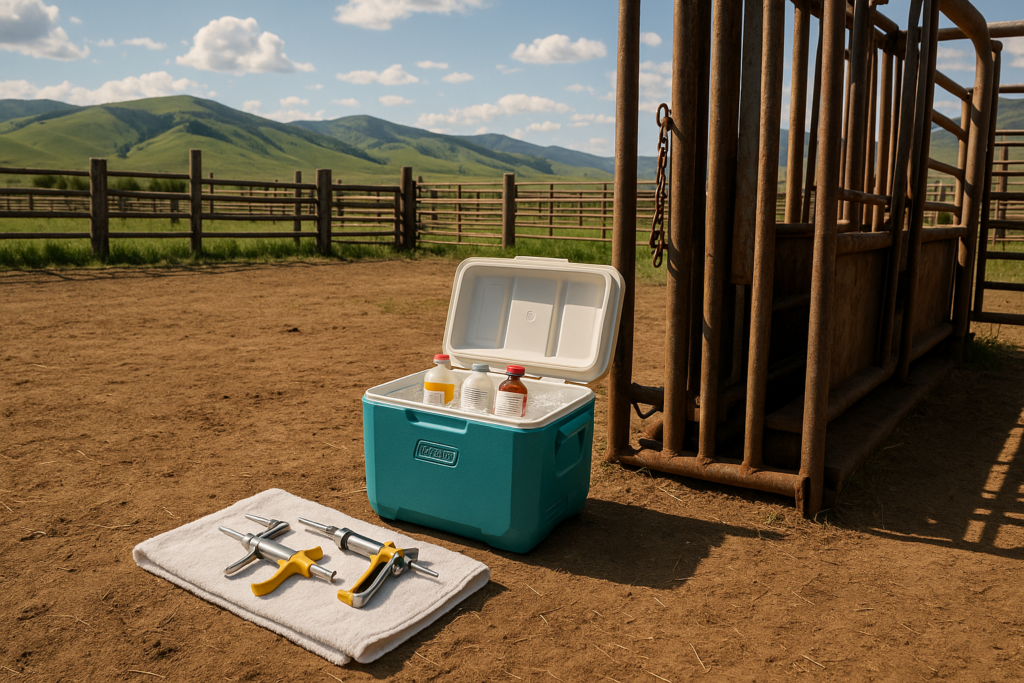
Keep mixed and unmixed product in a cooler with ice or frozen jugs, out of the direct sun, with the lid shut between draws. Not on the tailgate. Not on top of the cooler. Inside it. A wet rag over a loaded syringe gun does more than you’d think on a windy 85-degree day.
Don’t freeze it either
Cold chain cuts both ways. Most cattle vaccine wants to live in that 35 to 45 degree range — refrigerator cold, not freezer cold. Freezing a product, especially anything with adjuvant in it, can wreck it just as surely as heat. That matters in two places on a Montana ranch. One is the ranch fridge that runs too cold and freezes the back shelf — check it with a cheap thermometer before you trust it with a season’s worth of vaccine. The other is the cooler itself, where a bottle pressed against a block of ice can freeze even while the air in the cooler is fine. Keep a layer between the product and the ice.
The syringe is the other half
A clean dose into a dirty injection site, or through a dirty syringe, gives you abscesses, knots, and sometimes a wreck. A few habits keep that from happening:
- Never wash a syringe gun used for modified-live vaccine with soap or disinfectant. Residue kills the live organisms. Hot water only, and let it dry. Save the disinfectant for the gun you use on killed products and pour-ons.
- Run separate, marked syringes for separate products. Mixing a clostridial and a modified-live in the same barrel can inactivate one of them.
- Change needles often — a fresh one every several head, and immediately when one bends or burrs. A dull, dirty needle drags hide and bacteria into the muscle and hurts your injection-site quality.
- Give it where it belongs. Subcutaneous products go under the hide; intramuscular where the label says. Both go in front of the shoulder, in the neck, never in the hip or top butt where the good cuts are.
Keep the working area as clean as a corral gets. Vaccinating a calf with manure caked on the neck is asking for a knot. If the alley is a mudhole, hit a cleaner patch of hide.
Buy it right, store it right, read the label
Pay attention to where your vaccine came from. Product that sat on a hot loading dock or rode home in a warm truck from town may already be compromised before you open the box. Haul it in a cooler from the supply store, same as you’d haul anything that has to stay cold. Watch expiration dates, and don’t hang onto half-used bottles of modified-live for next time — once it’s mixed, it’s done.
None of this is exotic. It’s a cooler, a thermometer, hot water, and the discipline to mix small batches when you’d rather mix big ones. The calves you’re working in June are the ones you’ll ship in October and the ones you’ll keep as replacements. Cheap insurance only pays if the policy was real.