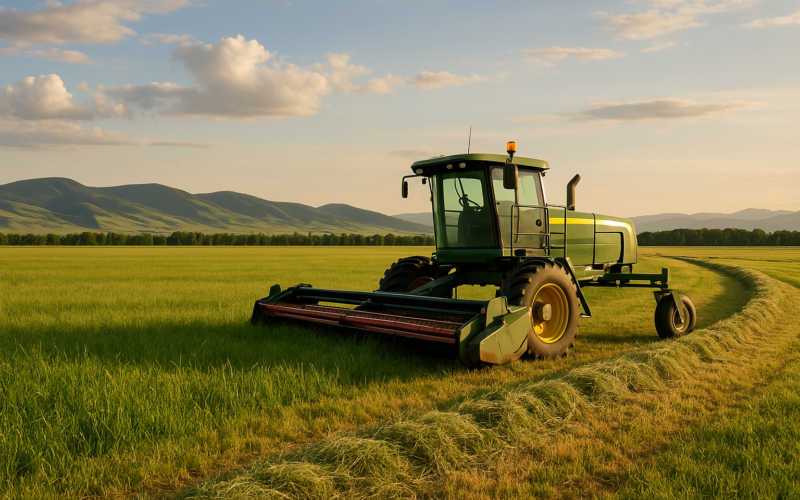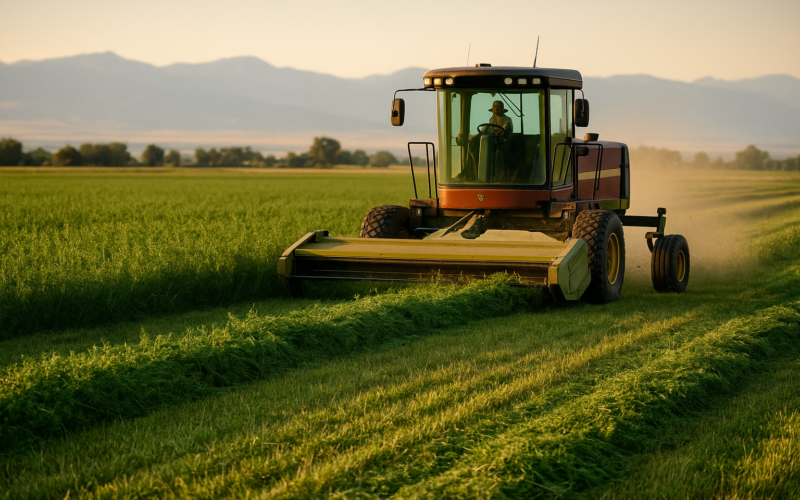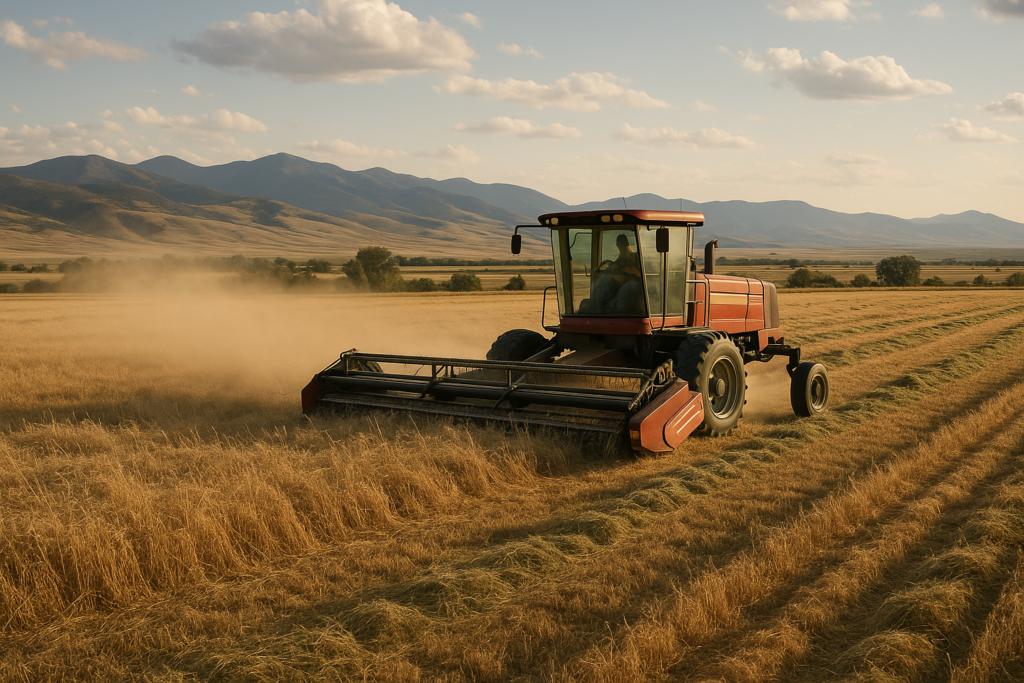
By the time first cutting is down and the swather has a few hundred acres on it, there’s a mat of dry chaff and leaf packed around every hot part of the machine. Add a bearing running warm, an exhaust manifold, and grass that’s cured off in the afternoon sun, and you’ve got the makings of a fire nobody planned for. Every dry summer some outfit in the Golden Triangle or down in the Bighorn country loses a windrower, or a hayfield, or worse, to a fire that started with a handful of smoldering chaff.
You can’t take all the risk out of running iron through dry grass. But most equipment fires are preventable, and the fixes are cheap compared to a burned-up machine and a call to the neighbors for help on a fire you can’t get ahead of.
The fire usually starts in the stuff you can see
Chaff and leaf build up where the air doesn’t move it off — around the engine, on top of the manifold, packed into the belt shields, wedged against hydraulic lines. It’s dry, it’s fine, and it catches a spark like tinder. On a hot afternoon that debris only needs a little help.
The help usually comes from a bearing. A dry or failing bearing runs hot enough to ignite the chaff sitting against it, and by the time you smell it or see smoke in the mirror, it’s already spreading into the windrow behind you. Belts that slip, brakes that drag, and a plugged exhaust that runs the engine hot will all do the same thing.
So the two-part job is keep the machine clean and keep it from running hot. Neither one takes long if you do it every day instead of once a season.
What to actually do
Carry an air compressor or a leaf blower and blow the machine down at the end of every day, or at noon fill-up if it’s really dry. Get on top of the engine, around the manifold, into the belt guards. A shop vac and a compressor both work; a stick and your hands work when that’s all you’ve got. Don’t just knock the loose stuff off — pull the packed mats out from behind the shields where they’ve been baking all afternoon.
Grease the machine on schedule and put a hand on the bearings when you stop. If a hub or a bearing is too hot to hold your hand on, it’s telling you something before it fails. Keep a few common bearings in the pickup so you’re changing one in the field instead of driving to town while the crop cures past you.
Watch the exhaust and the belts. A belt slipping and squealing is heat and dust. A muffler or manifold caked in debris holds heat right where you don’t want it.
- Keep a working fire extinguisher mounted on the machine, not in the shop. An ABC dry chemical unit is fine — check that the gauge is in the green before you start.
- Haul water. A tank on the pickup, even a couple of hundred gallons, buys you time and gives you something to put on a windrow fire that an extinguisher won’t reach.
- Keep a shovel on the machine. You can throw a lot of dirt on a small fire fast, and dirt is what the fire department will tell you to use anyway.
Time the day and mind where you park
The worst fire hours line up with the worst part of the day — mid to late afternoon when the grass is driest, the humidity has dropped, and the wind comes up. If it’s blowing and the grass is snapping dry, that’s the time to grease, fuel, and knock the machine down rather than push through. Cutting earlier and later in the day, when there’s a little more moisture in the air, isn’t only about leaf retention.
Park in a road, a fireguard, or bare dirt at night, not out in the standing crop or the stubble. A bearing that let go quietly after you shut down has burned up plenty of machines sitting in dry grass with nobody around. Same goes for the baler and the pickup — hot catalytic converters sitting in tall grass start fires without any help from you.
Know who you’d call and have the cell number handy, and know whether you’ve got service where you’re cutting. A lot of hay ground in this state doesn’t have a bar of signal, which is one more reason the water tank and the shovel matter. The fire you put out in the first two minutes is the one that doesn’t cost you the field.