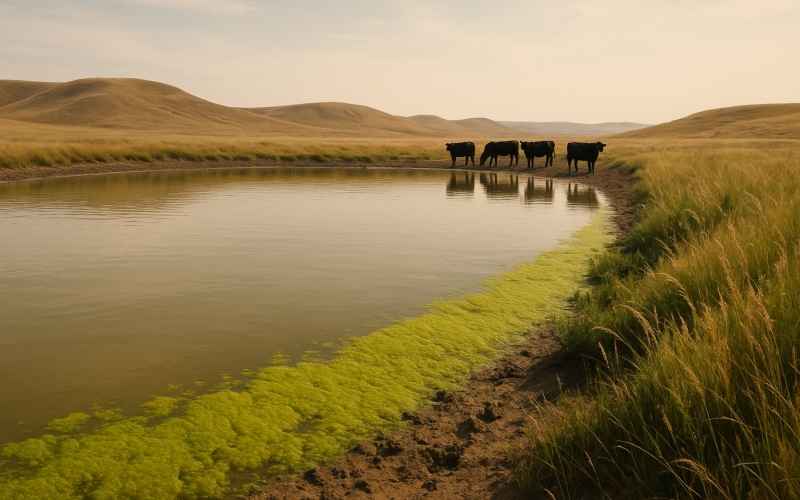
Everybody worries about the green scum on the pond. Fewer producers think about the water that looks perfectly clear and still puts a cow flat on her side, blind, paddling. That water is usually loaded with sulfate, and the problem gets worse the further into summer you go — right when a lot of cows in eastern and central Montana are drinking out of dugouts and shallow wells that started dropping in May.
Sulfate is a dissolved mineral, not a bloom or a bug. You can’t see it, smell it much until it’s high, or filter it out with a screen. And it does its damage slowly enough that you may not connect the down calf to the tank he’s been drinking from for three weeks.
Why it gets worse as the water drops
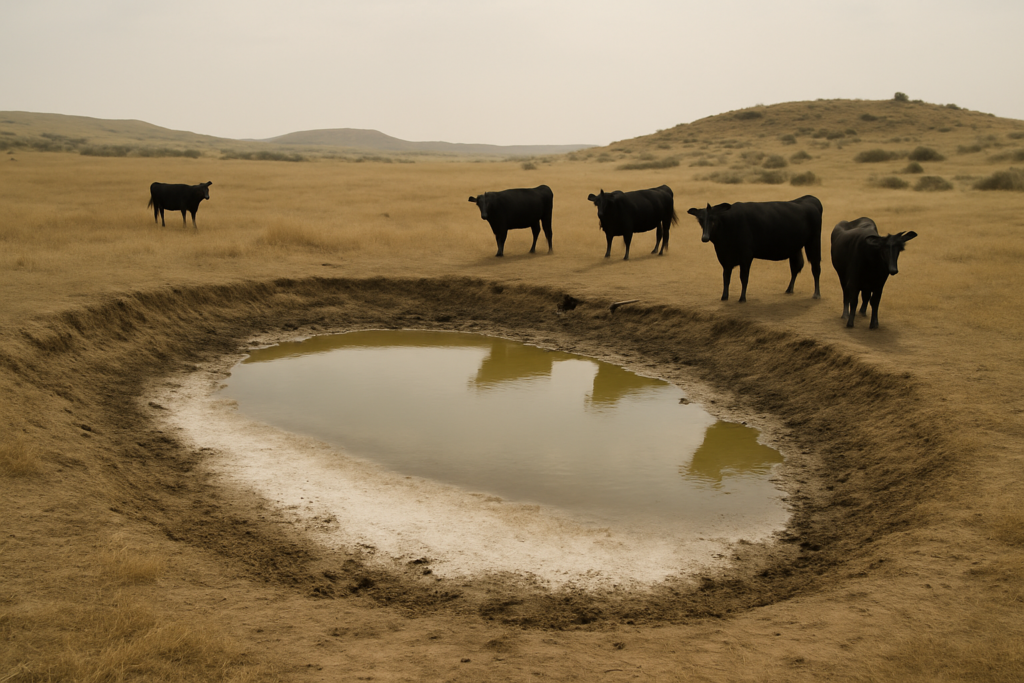
Sulfate concentrates. A dugout or reservoir that tested fine in a wet spring can climb steadily as the sun pulls the water level down and there’s less volume to dilute the mineral coming in. Shallow wells in the sedimentary ground across much of the eastern half of the state carry sulfate to begin with, and by August that water is a lot stronger than it was at turnout. The same thing happens to any water source that isn’t getting recharged — the pond that’s half mud by late July is the one to watch.
Alkali flats, seeps, and reservoirs sitting in gumbo are the usual suspects. If you can see a white crust drying around the edge of a dugout, that’s a flag. So is water that cattle walk up to, smell, and back off from. Cattle will drink bad water if they’re thirsty enough and there’s nothing else, which is exactly the trap in a dry summer.
What sulfur poisoning looks like in the pasture
High sulfate intake interferes with the way cattle handle thiamine, and the result is a brain condition — polioencephalomalacia, or PEM, the same “polio” people talk about with grain overload. The animal you find is often a good, growing calf or yearling because they’re drinking a lot relative to their size.
Early on they get dull and wander off from the bunch. They go blind but their eyes look normal — no cloudy cornea like pinkeye, they just don’t track your hand or blunder into the fence. From there it moves to staggering, head pressing, going down, and convulsions with the head cranked back over the shoulder. It can look like a lot of things: lead poisoning, a listeria case, even lightning if you find one dead. The blindness with a clear eye and the head-back seizure are the tells.
Caught early, a vet can treat with thiamine and some respond. Once they’re down and seizuring, the odds drop. Either way, treating the animal doesn’t fix the water, and you’ll get more of them until you move cattle off it.
Test the water, then have somewhere to go
The only way to actually know what you’re dealing with is a water test. Any of the labs that run ag samples can give you sulfate and total dissolved solids, and it’s cheap next to a dead yearling. Pull the sample from the source cattle are actually drinking, and pull it now and again in August, because the number you get in June won’t hold. As a rough guide, water in the low hundreds of parts per million sulfate is fine; a few thousand starts causing trouble, and the high-sulfate dugouts out east can run well past that in a dry year.
What you do with the answer matters more than the number:
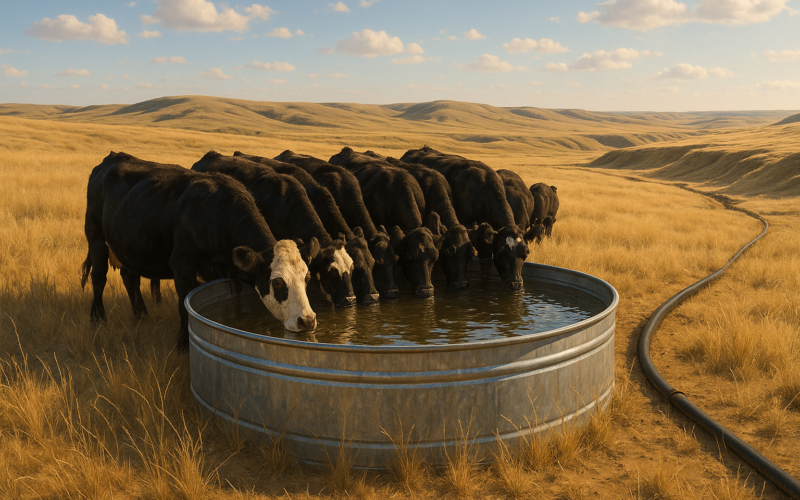
- Fence off the worst source and pipe or haul from a better well if you’ve got one. Even blending bad water with good drops the concentration.
- Rotate cattle off a reservoir before it cooks down to the dregs, rather than letting them ride it to the bottom.
- Watch the younger, faster-growing animals first — they show it before the dry cows do.
- Keep an eye on total sulfur, not just water. If you’re feeding a byproduct or a mineral that’s already high in sulfur, the water doesn’t have to be as bad to tip them over.
A cow can go a while on marginal water and be fine. The risk is the combination — a dropping reservoir, a hot stretch, cattle drinking hard, and nothing to compare against because you never pulled a sample. It’s one of the few summer wrecks you can head off with a jar, a mailer, and a plan for where the cattle go when the number comes back high.