Most of what kills cattle on summer range works slow enough that you get a warning. A lame foot, an off cow standing by the fence, a calf that quits sucking. A blue-green algae bloom doesn’t give you that. A cow can drink from a scummy pond corner in the morning and be dead by mid-afternoon, and the first sign you get is a body near the water with fresh tracks all around it.
This is the time of year to start watching for it. Cyanobacteria — what everybody calls blue-green algae even though it isn’t really algae — need warm, still, nutrient-rich water to take off. By late June the ponds have warmed up, the runoff has quit stirring them, and the water level has started to drop. A pond that took cattle and hay-field runoff all spring has plenty of nitrogen and phosphorus sitting in it. Add a stretch of hot, calm days and a bloom can build in a hurry, sometimes in under a week.
What a bad bloom looks like
Not every green pond is dangerous. A lot of ponds carry a normal load of green algae and pond weed all summer and never bother a thing. The trouble is a specific kind of bloom, and it has a look worth learning.
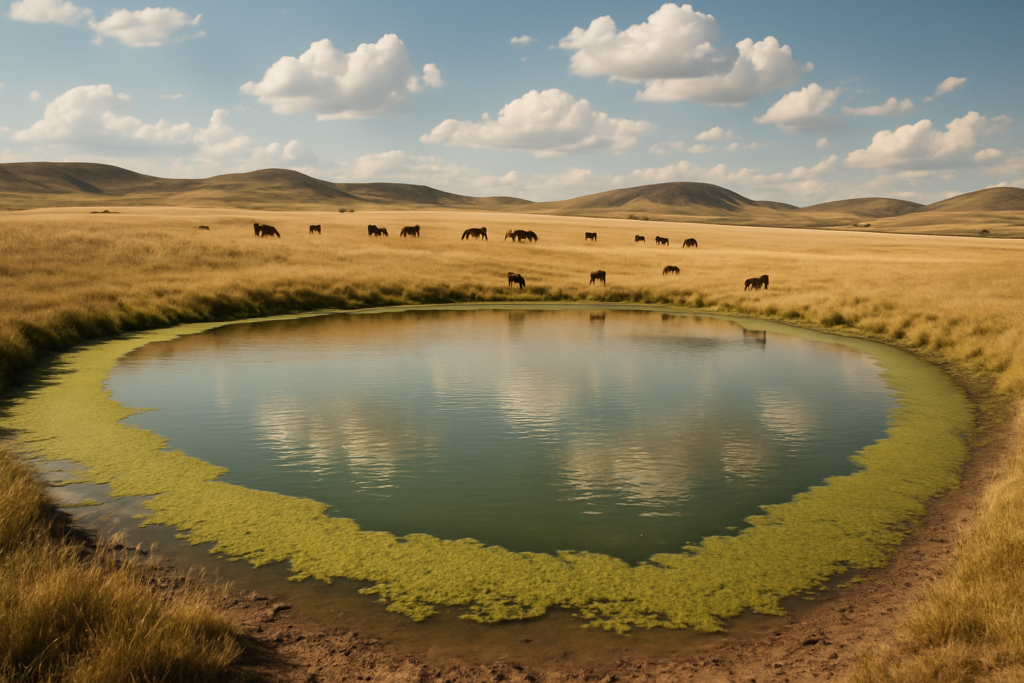
The classic warning sign is water that looks like somebody dumped paint in it. Bright pea-green, sometimes with a bluish or turquoise cast, and it collects into a thick surface scum. Wind pushes that scum to the downwind edge and piles it up, which is exactly the corner cattle wade into to drink. When it dries on the bank it can leave a blue-green or even a whitish crust. If you dip a clear jar and the green stays suspended like paint rather than settling out as stringy mats, treat it as suspect.
The catch is that a bloom can turn toxic and non-toxic almost overnight, and you can’t tell how much toxin is in it by looking. The same pond can be safe one week and deadly the next. That’s why you go by the presence of a heavy bloom, not by whether it killed anything yet.
How it kills, and how fast
The toxins come in two general kinds. Some hit the liver and some hit the nervous system, and you don’t get to choose which your pond grows. The nerve type is the fast one — an animal that takes in a big dose can stagger, go down, and quit breathing within an hour or two. The liver type takes longer, maybe several hours to a day, and those cattle may show weakness, diarrhea, and go off by themselves before they die.
By the time you find a sick one, there usually isn’t much to do. That’s the hard truth about this poisoning. The whole game is keeping cattle from drinking the bad water in the first place. If you do catch an animal alive and showing signs, get it away from the water and call your vet, but don’t count on saving it.
One more thing worth knowing: dogs will drink pond scum and lick it off their coat, and a ranch dog is a lot smaller than a cow. If you’re checking a suspect pond, keep the dog in the truck.
What to do before you lose one
The cheapest insurance is to walk your ponds in the heat of summer instead of just driving past. Look at the downwind edge where the scum collects. If you see a heavy pea-green bloom, fence the cattle off that water and give them another source.
- Have a backup ready. A pasture with only one pond is the one that gets you. A stock tank on a well or a spring-fed trough gives you somewhere to move cattle when a pond blooms.
- Move animals off the whole pond, not just the scummy corner. Wind shifts, and the scum moves with it.
- Don’t count on a bloom clearing on its own timeline. Some fade in a few days, some hang on for weeks. Keep cattle off until the bloom is gone and the water looks normal again.
- Cut down what feeds it where you can. Keeping heavy manure buildup and fertilizer runoff out of a pond over time makes blooms less likely, though there’s no fixing that in June.
If you find a dead cow at a pond with no other explanation and there’s a heavy green scum on the water, blue-green algae belongs at the top of your list. Get the rest of the herd off that water before you do anything else, then sort out the rest. A pond is a convenience right up until it isn’t, and the ranches that get burned are usually the ones that trusted a water source they hadn’t looked at closely in three weeks.