Most of the plants that hurt cattle work slow. Knapweed crowds out grass over years, worms drag on gains until fall, larkspur gets the ones that eat too much too fast. Water hemlock is not like that. A cow that chews a piece of the root can be convulsing inside fifteen minutes and dead inside an hour, and you’ll usually find her on her side in a wet bottom with the ground torn up around her feet. There isn’t much you can do once it’s started. The whole game is keeping them off it in the first place.
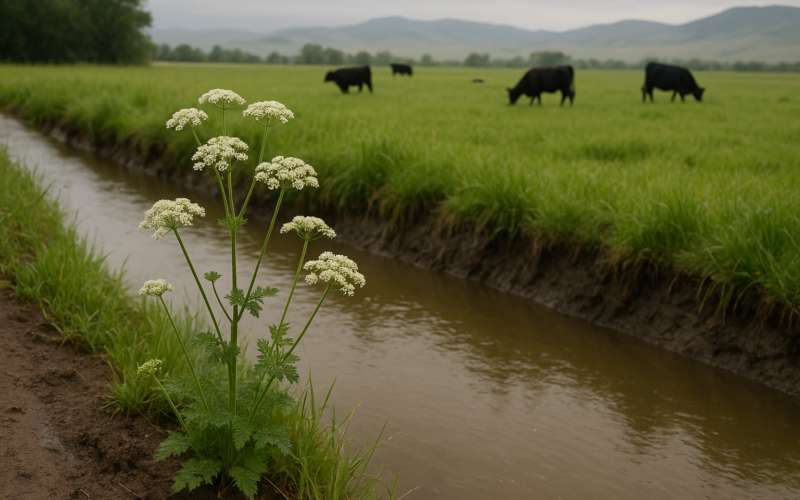
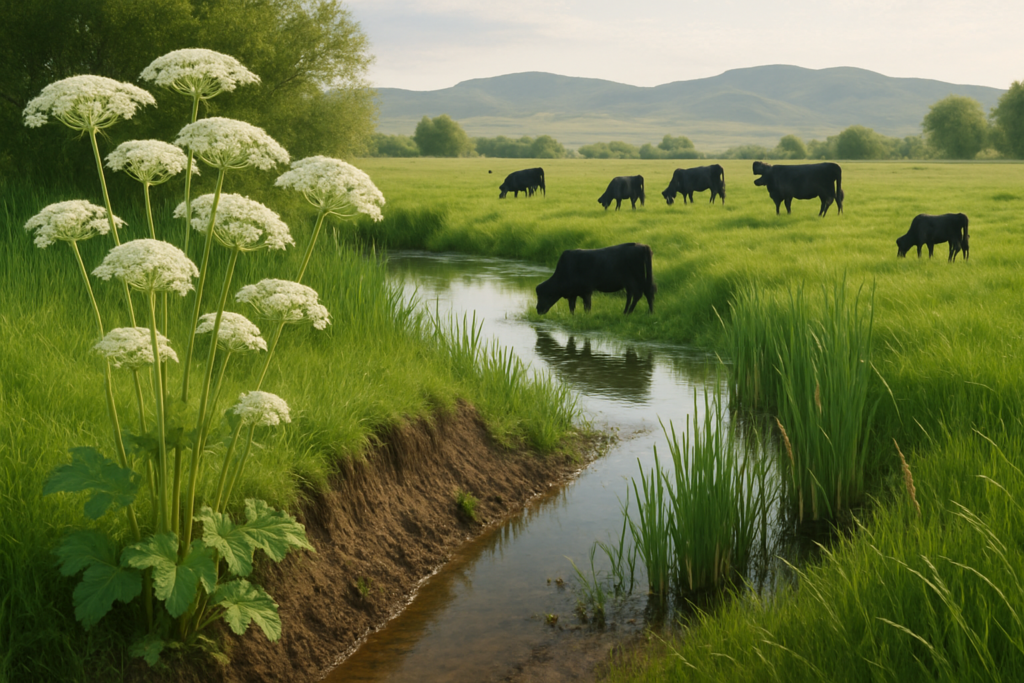
It grows where you’d least like to lose an animal — the same seeps, ditch banks, spring boxes, and marshy meadow edges where cattle drift to drink and cool off in June. And this is the time of year it does the most damage, because the ground is still soft from runoff and cattle grazing the green edges will pull the whole plant up, roots and all. The root is the worst part.
Learn to tell it from the harmless look-alikes
Water hemlock stands two to six feet tall with small white flowers in flat, umbrella-shaped clusters — the same general shape as a dozen carrot-family plants, some of them harmless. Two things set it apart. The leaves have veins that run to the notches between the teeth on the leaf edge, not to the tips, which is backwards from most plants. And the base of the stem, where it meets those thick clustered roots, is chambered — slice it lengthwise and you’ll see hollow crosswise partitions, often with a yellowish oily juice that smells like raw parsnip. That juice is cicutoxin, and it’s concentrated in the root and the lower stem.
Don’t confuse it with poison hemlock, which is a different plant and a different problem. Poison hemlock is a biennial with a smooth, hollow stem marked with purple blotches and a musty smell. It’s more of a slow poison and a cause of deformed calves when bred cows eat it, and it tends to show up on disturbed ground — corrals, fence lines, old feedgrounds, roadsides. Both belong on your radar. Water hemlock is the one that kills fast.
Where and when cattle get into it
Trouble shows up under a few predictable setups. Cattle turned onto a wet meadow or riparian pasture before there’s much else green will nose into the water hemlock coming up along the water. Animals crowding a single spring or a churned-up stock pond edge pull roots out of the mud. And any time you or a hired hand clean a ditch, dig out a spring, or grub brush and leave the pulled plants lying where cattle can reach them, you’ve set a trap — the dug root is more dangerous laid out on the ground than it was growing.
The signs, if you catch a live one, come on hard: nervousness, drooling, teeth grinding, then violent convulsions with the head thrown back. It’s not subtle. By the time most producers see it, it’s a recovery of the carcass, not a treatment. Pull the rest of the herd off that ground and figure out where they got it.
What actually keeps them off it
Timing your turnout matters more than anything. Hold cattle off the wet bottoms until there’s enough good forage that they aren’t grazing right down to the waterline picking at whatever’s green. Hungry cattle turned onto short pasture are the ones that eat things they’d normally walk past.
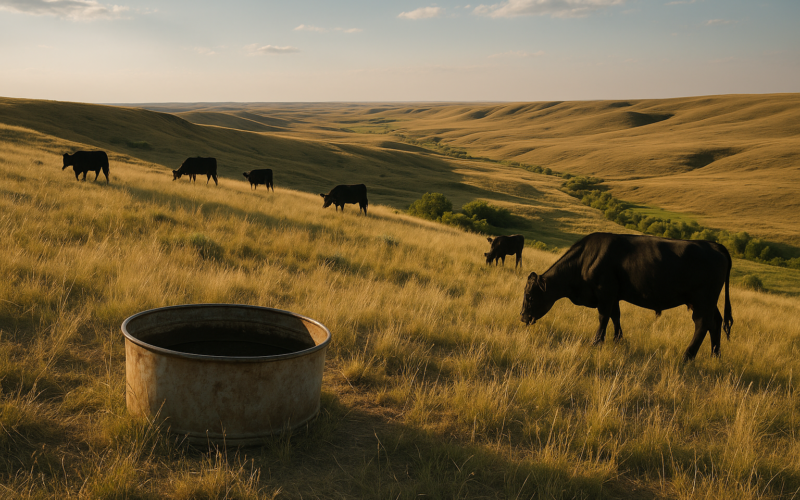
Fence the worst of it. A spring or a boggy seep that grows hemlock every year is worth a stretch of wire and a piped tank set on dry ground away from the plants. That solves the poisoning and takes pressure off the wet ground at the same time.
Dig or spray the patches you can reach. Because the root is the toxic part, grubbing a plant out and hauling it off works — but haul it off, don’t leave it. If you spray, do it early and give the plants time to die and rot down before you graze that ground; a wilting sprayed plant can still poison an animal, and some plants stay palatable as they die. Read whatever label you’re using for the grazing restriction and honor it.
Ride your water in June with this plant in mind. Walk the spring edges and ditch banks where you’d never bother looking for grass, because that’s exactly where it lives. It doesn’t take a big stand to cost you a good cow — a few plants along the water your pairs use every day is enough. Knowing the leaf veins and the chambered stem takes ten minutes to learn and gives you the one thing that matters here, which is the chance to act before an animal ever finds it.