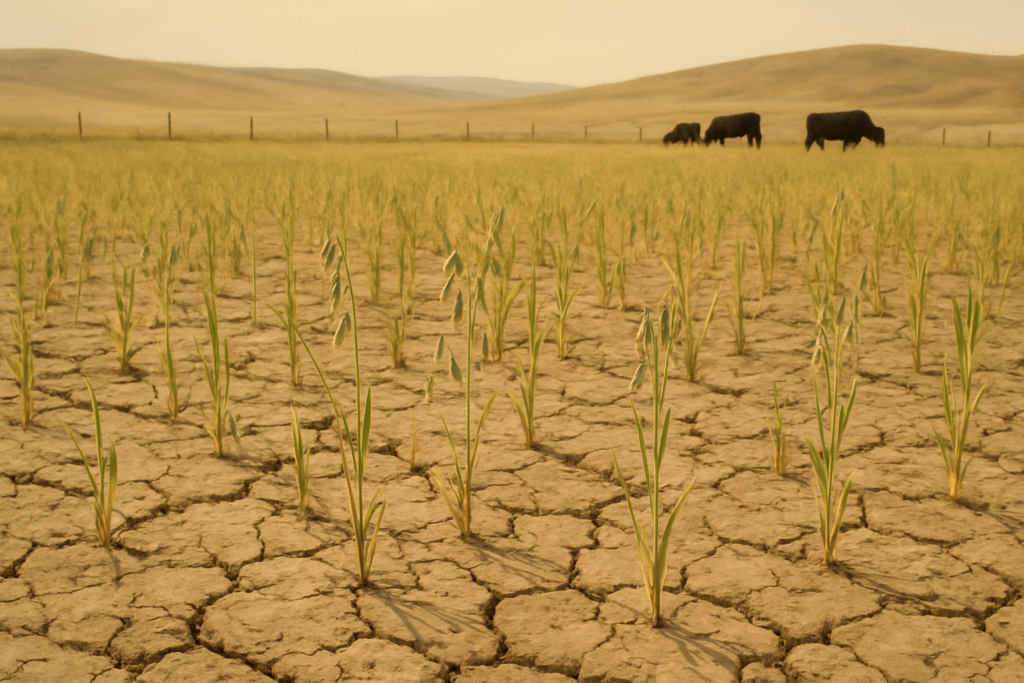
Plenty of Montana ranchers put in a field of oats, barley, or a cereal-pea mix to stretch the hay supply, and in a dry summer that field can do double duty as swath grazing or emergency pasture. The trouble is that the same drought stress that stunts the crop also loads it with nitrate. A cow doesn’t have to eat much of the wrong thing to be in real danger, and the ones that go down usually do it within hours of turning in.
Nitrate poisoning gets talked about less than bloat or larkspur because it hides. The forage looks fine. It cures fine. Cattle eat it without hesitating. The problem is chemistry, not palatability, and you can’t spot it from the pickup.
Why a stressed crop turns dangerous
Growing plants pull nitrate up from the soil and convert it into protein as fast as they take it in. When the plant is running wide open — good moisture, good sunlight — that conversion keeps pace and nitrate doesn’t stack up. Take away the water, hail the field, or hit it with a hard frost, and the plant keeps pulling nitrate from the ground but quits building it into anything. It banks in the tissue instead, and most of it sits in the lower third of the stem.
Cereal grains are the usual suspects — oats, barley, wheat cut for hay — but the same thing happens in sorghum-sudan, millet, and a long list of weeds that green up on disturbed ground. Kochia, pigweed, and lambsquarter are all nitrate accumulators, and they thrive exactly where a thin, drought-beaten stand leaves bare dirt for them to fill in.
The danger spikes after a shower breaks a drought. The plant floods with nitrate from the freshly wetted soil, and for a few days before it catches up on conversion, the concentration runs high. Turning hungry cattle onto that field the morning after the first real rain in weeks is how people get in trouble.
What it does to a cow, and how fast
In the rumen, nitrate gets converted to nitrite, and nitrite is the killer. It ties up hemoglobin so the blood can’t carry oxygen. A cow essentially suffocates with a full lung of air. The gums and the whites of the eyes go from pink to a muddy brown or blue. She breathes hard and fast, staggers, and goes down. Bred cows can abort a few days later even if they pull through.
It moves quick. A heavily loaded feed can put a cow down in under an hour, and by the time you notice one standing off by herself with her sides heaving, the clock is already short. A vet can treat it with a methylene blue injection, but only if you catch it early and have help on the way. Prevention is the whole game here.
Feeding and grazing it without a wreck
Start by testing. A forage nitrate test through your county Extension office or a commercial lab is cheap next to a dead cow, and there are quick field-test kits that give you a rough read on standing forage before you turn in. Pull samples from the lower stem where the nitrate concentrates, not just the leafy tops.
A few things stack the odds in your favor whether the crop is baled or grazed:
- Raise your cutting height. Leave the bottom six inches of a hayed cereal crop in the field. That’s where the nitrate lives, and you’ll leave most of it behind.
- Never turn hungry cattle onto a suspect field. Fill them on grass hay first so they graze slow and selective instead of bolting the bottoms of the stalks.
- Wait after rain. Give a stressed crop several days to a week to convert the fresh nitrate load before you graze or cut it.
- Dilute. If a test comes back marginal, mix that hay with clean forage rather than feeding it straight, and step cattle onto it gradually.
Curing hay does not lower nitrate the way it drives off prussic acid — the nitrate stays put in the bale for months. Ensiling drops it some, but not to zero. So a stack that tested high in July is still high in January. Mark those bales and know what’s in them before you throw them out on a cold morning to hungry cows.
The other quiet risk is water. High-nitrate feed and a stock pond with its own nitrate load, or one that’s turned salty and concentrated as it dries down, add up. If you’re already fighting sulfates in a dropping pond, be extra careful about what forage those same cattle are eating.
None of this means you can’t use a drought-stunted cereal field. In a short year it might be the best feed you’ve got. It just means you test it, you cut it high, and you never turn a hungry, empty cow loose on it and drive away.