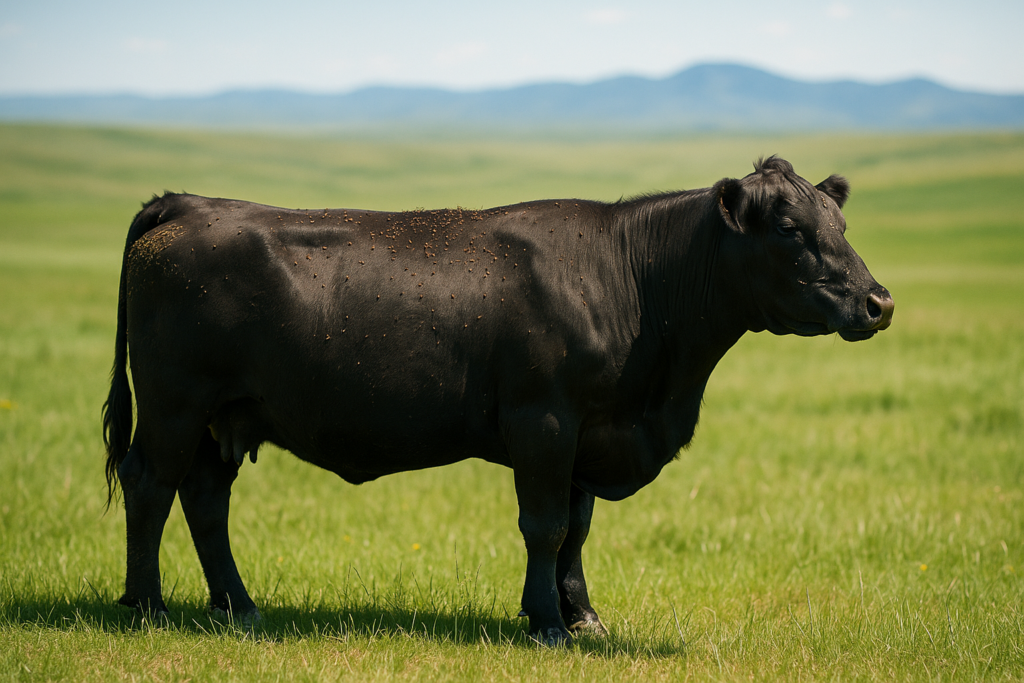
Ride out through the herd on a still June afternoon and you’ll see them — dark clusters riding the shoulders and backs, drifting down onto the belly when the sun leans in. Horn flies. They’re small, they’re easy to write off, and they cost you more over a summer than most of the parasites you actually worry about.
Unlike the face fly that hangs around the eyes and moves between animals, the horn fly lives on the cow. It stays put, feeding twenty or thirty times a day, breeding in fresh manure, and building numbers fast once the weather warms. A cow carrying a heavy load spends her day switching, stomping, and bunching in the corner of the pasture instead of grazing. That lost grazing time, plus the blood the flies pull, shows up as lighter calves in the fall and cows that don’t put on the condition they should before breeding winds down.
Know when the load is worth treating
You don’t treat for horn flies because you see a few. Every cow on grass carries some. The rule of thumb most people go by is roughly a couple hundred flies per animal — about the point where they cover the topline and start creeping down the sides. Below that, the cost of the flies is small enough that spraying or tagging isn’t paying for itself. Above it, the drag on gains starts to add up quick, and it compounds as the summer runs on and the population keeps doubling.
You can eyeball it without counting every fly. Look at a cow standing broadside in good light. If the flies are a solid sheet across her back and packed onto the shoulders, you’re well over threshold. If you can still see hide through them, you’ve got time. Check the herd more than once — the load builds through late June and July and usually peaks in the hottest stretch, then backs off as fall comes.
The tag from last year is the problem, not the fix
Insecticide ear tags work, and they’re the easiest tool most outfits reach for. But two mistakes turn them from a solution into the reason you have a resistance problem.
The first is timing. Tags have a working life — a few months, not a year. Put them in too early in spring and they’re wearing thin by the time fly numbers actually peak. The better play is to tag when the flies hit threshold, not on a calendar date, so the strongest dose lands on the worst part of the season.
The second is leaving them in. A tag that’s spent months slowly dropping below a killing dose is doing exactly what you don’t want: exposing the fly population to a weak concentration that kills the susceptible flies and lets the tough ones breed. That’s how you build a herd of flies your tags no longer touch. Pull the tags in the fall. Don’t let them ride through winter.
Rotate chemistry, too. The two big families of tag insecticides — pyrethroids and organophosphates — have been used long enough that flies in a lot of country have shrugged off one or both. If your tags quit working like they used to, switching to a different class the next season gives you a better shot than doubling down on the one the flies already beat.
Don’t hang everything on one tool
Tags aren’t the only card. Pour-ons and sprays knock numbers down fast when a load spikes mid-summer, and they’re worth keeping on hand for a flare-up between other treatments. Dust bags and oilers hung where cattle have to pass — a mineral station, a water gap, a shady loafing spot — let animals treat themselves every day, and they spread the exposure out instead of hitting the flies with one big dose. A feed-through larvicide in the mineral works from the other direction, killing larvae in the manure before they ever hatch, though it only helps with the flies your own cattle produce, not the ones drifting in from the neighbor.
The point is to mix it up. Any single method used year after year is a straight line to resistance. Combine a couple of tools, rotate the chemistry, treat on the flies’ schedule rather than your own, and pull the tags when the season’s done.
Horn flies are one of those problems that never kills a cow and never makes a dramatic story, which is exactly why they’re easy to let slide. But a summer’s worth of blood loss and lost grazing quietly comes out of your fall weaning weights. It’s cheap ground to hold if you pay attention to it in June.