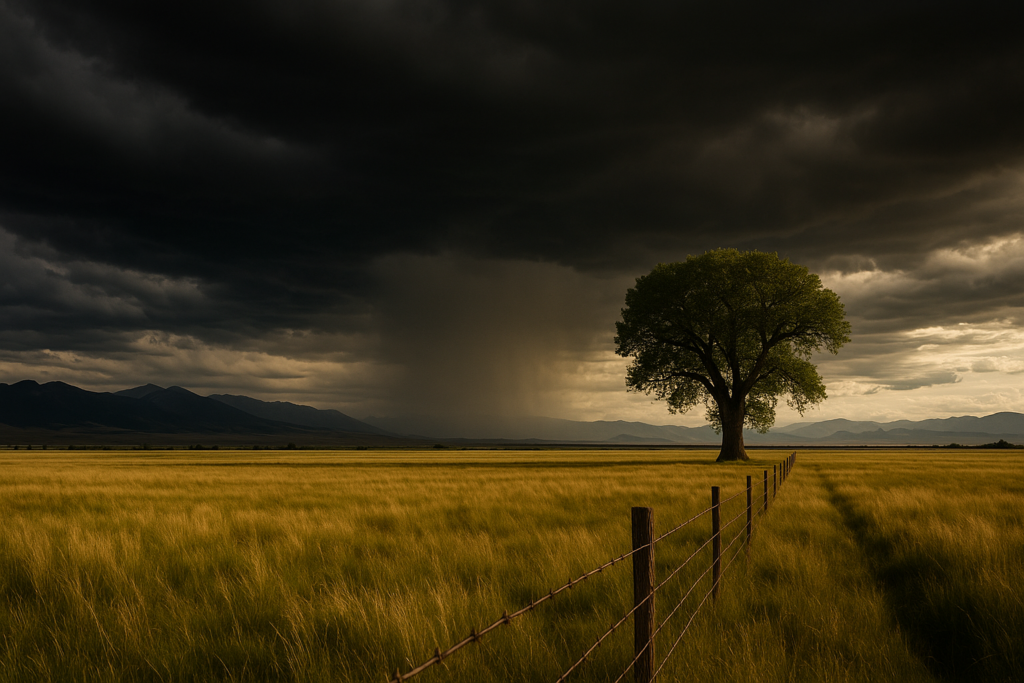
You go out after a hard afternoon storm to check the far pasture and find three cows dead in a heap under the only cottonwood on the flat. No sign of sickness. No bloat, no sunken sides, nothing chewed up around them. Just three good cows lying close together with the ground scorched a little and maybe a split limb overhead. That’s lightning, and it kills more Montana cattle every summer than most people figure.
Storms build fast over this country in June and July. Heat comes up off the dry ground, a cell rolls off the mountains or up out of the southwest, and you get a lot of energy in a short window. Cattle don’t scatter from it the way you’d hope. They do the opposite — they bunch, and they head for the tallest thing around, which is exactly the wrong place to be.
Where they die tells you what happened
Lightning losses have a pattern, and once you’ve seen it you’ll recognize it. The classic is a group down under a single tree standing off by itself. A lone tree in the open is the high point, and when it takes a strike the current jumps to anything standing under it. Cattle crowded in that little circle of shade all catch it at once. That’s why you find them in a pile instead of spread out.
The other spot is the fenceline. A wire fence carries current a long way. A bolt can hit a post or the wire itself a quarter mile off and travel down the line, and any cow standing against the wire or bunched in the corner picks it up. You’ll find them strung along the fence or piled in the corner where they’d drifted ahead of the wind. Same thing happens at metal water tanks and along buried pipelines that surface at a tank.
The animals themselves usually don’t show much. Sometimes there’s a singe mark, a burned line down a leg, or scorched hair where the current entered and exited. Often there’s nothing obvious at all, which is what makes people scratch their heads. A cow that dies of lightning generally drops right where she stood — legs may be out straight, and she’s still in a natural-looking position because it happened instantly. She didn’t struggle. That’s part of how you tell it apart from bloat or a plant poisoning, where the animal thrashes and leaves the ground torn up.
Document it before you do anything else
This is the part that costs people money. A lightning death can be a covered loss, but you have to be able to show what killed the animal, and a dead cow doesn’t stay tellable very long in summer heat.
Get pictures the day you find them. Shoot the animals in place, the ground around them, the tree or the fence, and the split limb or scorched bark if there is any. Photograph the whole scene wide so it’s clear the cattle were grouped under the tree or along the wire, and then get in close on any burn marks. Note the date and the storm. If you carry mortality coverage, or if you’re going to claim the loss another way, call and ask what they need before you drag anything off. The more it looks like an obvious, documented lightning kill, the less argument you’ll have later.
If the value warrants it and you can get one out in time, a vet or a rendering service can confirm the cause. In hot weather that window is short, so don’t sit on it for a couple of days hoping the smell settles down.
You can’t stop lightning, but you can move the odds
There’s no fixing a storm, and you’re not going to keep cattle out of the shade when it’s hot. What you can do is think about what’s standing in your pastures. A single tall tree in an open field is a magnet. Bigger blocks of timber or a low draw are safer than one lone snag out on a flat, because the current has more places to go and the cattle aren’t all packed into one spot.
Where you set water and mineral matters too, since that’s where cattle gather. A tank pushed up tight against a wire fence keeps stock hanging on the fenceline in a storm. Ground rods on your fences and at metal tanks help bleed off current instead of letting it run the length of the wire through a bunch of cattle.
Mostly it’s about knowing what you’re looking at. When you find good cows dead in a bunch after a storm with no other explanation, don’t waste the afternoon second-guessing yourself. Get the camera out, make the calls, and get it recorded while the evidence is still there.