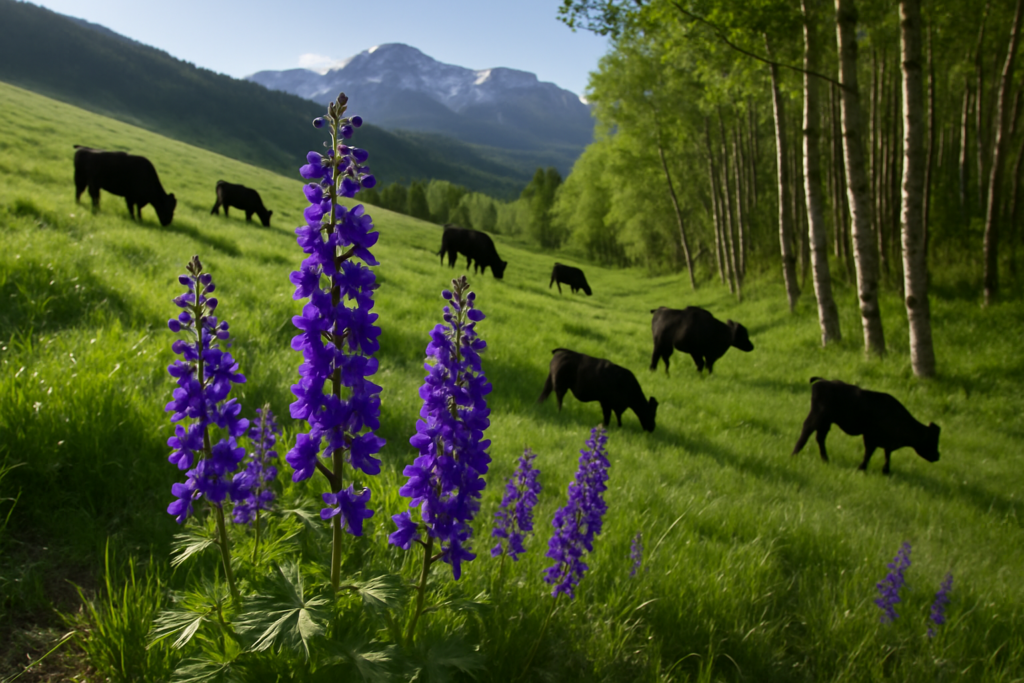
Every June somebody in the foothills loses a good cow to larkspur and can’t figure out why. She was in fine shape, bred, nothing wrong with her. Then she’s dead on a sidehill fifty yards below a patch of tall purple flowers. No struggle marks, no bloat, just down. That’s the way larkspur works, and it kills more range cattle in the West than most poisonous plants combined.
Tall larkspur runs the foothill and mountain country from the Rocky Mountain Front through the Big Belts, the Crazies, and the higher benches all over western and central Montana. It likes the same moist, north-slope draws and aspen edges that grow the good grass you’re trying to graze. That’s the trap. The cattle aren’t stupid for eating it. It comes up when the range is still short, it’s green and tender when the grass is washy, and cows will graze it hard right through the pre-bloom and flowering stage.
Why it drops them and when
Larkspur carries alkaloids that block the signal between nerve and muscle. A poisoned animal gets weak, staggers, goes down on her brisket, and if she takes in enough, she quits breathing or bloats out because she can’t stay upright. Cattle are far more sensitive than sheep, which is why you’ll hear old-timers say they used to graze sheep through a larkspur patch ahead of the cows.
The poison isn’t steady through the season. The plant is most dangerous when it’s young and lush and again when it’s flowering into early pod stage, because the alkaloid load stays high and cattle find it most palatable right then. Once the pods dry down in mid to late summer the plant gets less appealing and the toxin drops off, though dried larkspur can still poison a hungry cow that cleans up a patch. In most Montana foothill country the worst stretch runs from green-up through flowering — roughly late spring into midsummer, depending on elevation and how wet the year is.
A cow doesn’t have to graze it for days. A single hard feeding on a dense patch, especially if she gets crowded onto it or worked up right afterward, can put her down. That’s the part that catches people. The animal grazes the draw in the morning, seems fine, then you gather to move pairs, push them uphill, and she folds. Exertion after a big dose is what turns a sick cow into a dead one.
Grazing around it instead of through it
You can’t spray your way out of larkspur across a mountain pasture, and picking it by hand only works on a few small patches near a corral. The practical control is timing and management.
- Turn out after the danger passes, or graze the safe country first. If a pasture is loaded with tall larkspur on the north slopes, hold cattle on the drier, south-facing ground and the ridges early, and save the larkspur draws for later summer when the plant has podded and dried and cattle are eating more grass than forbs.
- Keep cattle from getting hungry near a patch. Cows graze larkspur hardest when good feed is short or when they’re first turned onto fresh country and looking for something green. Move them onto larkspur ground with a full belly, not gaunt off a truck.
- Don’t gather or push cattle through larkspur in the danger window. If you have to move them, do it slow, and do it before they’ve spent the morning grazing the draws, not after. A stressed, hard-driven cow that just loaded up is the one that dies.
- Ride the country and know your patches. Walk the draws before turnout and mark where the heavy larkspur sits. It comes up in the same places most years. If you know a draw is bad, you can fence it off with a hot wire, water elsewhere, or hold cattle out until the plant matures.
There’s a repellent-type management approach some outfits use with mineral supplements to shift grazing behavior, and your local Extension office or vet can tell you what’s currently recommended. But the surest tool costs nothing: keep cattle off the heavy stuff during the weeks it’s most poisonous and most palatable.
When you find one down
A larkspur-poisoned cow that’s still breathing can sometimes come around if you leave her alone and keep her from bloating. Don’t crowd her, don’t drive her, don’t try to make her stand. Roll her up onto her brisket if she’s flat on her side so she doesn’t bloat out, and let her recover on her own. Any hazing or forcing is what kills the ones that might have lived. If you’ve got a string of losses in one pasture, get a vet or Extension person to confirm it’s larkspur before you change your whole grazing plan — larkspur, water hemlock, and lightning all leave a dead cow with no story.
The country that grows the best summer grass often grows the best larkspur right alongside it. You don’t have to give up that feed. You just have to graze it on the calendar the plant gives you, not the one that’s handiest.