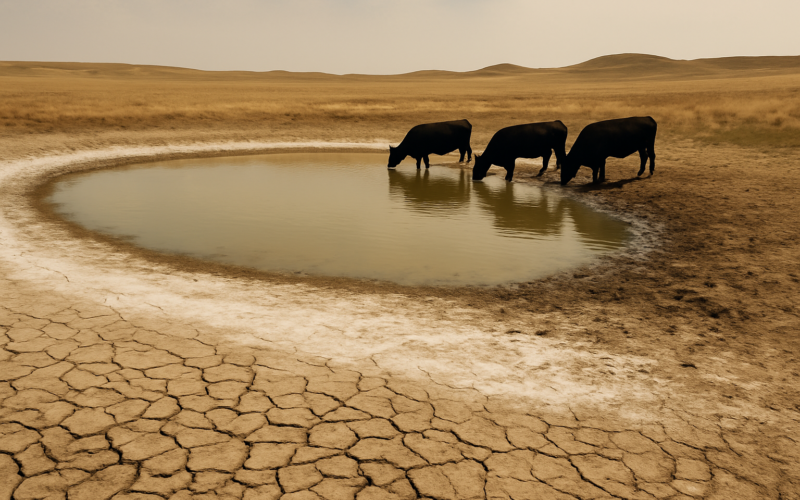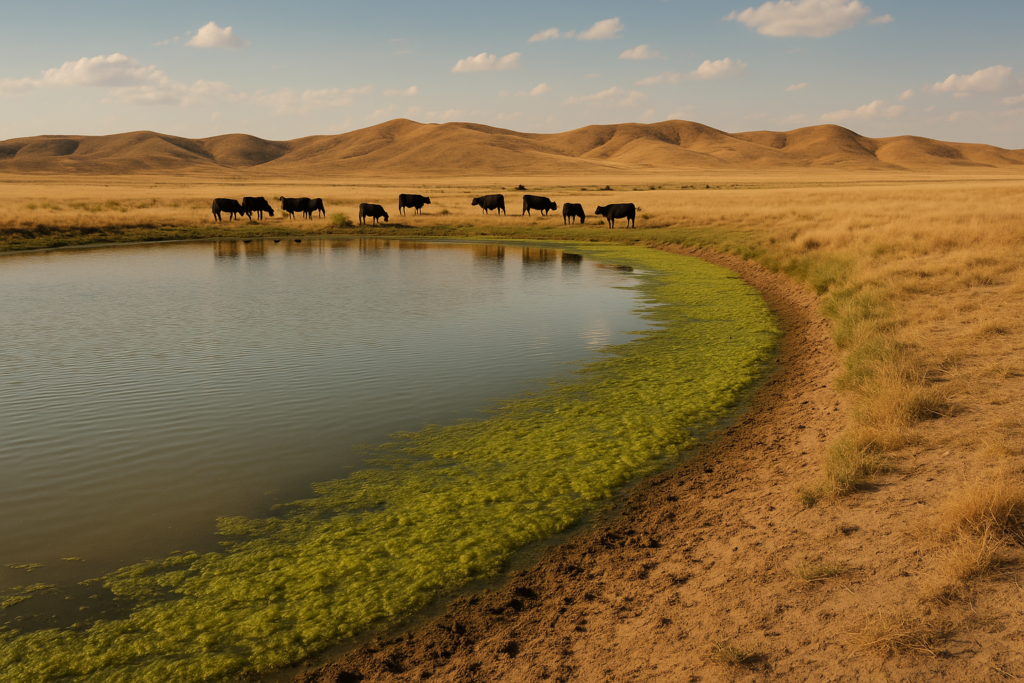
You can ride past the same dugout every day for a month and think nothing of it. Then a stretch of hot, still weather sets in, the water warms up, and one morning there’s a paint-like green film piled along the downwind bank. That film can kill a cow before dinner. Blue-green algae — cyanobacteria, really, not true algae — is one of the few water problems on summer range that goes from harmless to fatal in a matter of hours.
It doesn’t get talked about the way high-sulfate water or a stuck float does, mostly because it’s sporadic. A pond can be fine for years and then bloom hard in one bad week. But when it hits, it hits fast, and the cattle you find down are usually the ones that drank first and drank most.
What a bloom looks like, and why it turns toxic
Cyanobacteria live in most warm, still, nutrient-rich water. Stock ponds and dugouts are ideal — shallow, no current, and loaded with nutrients from manure and runoff. Given heat, sunlight, and a few calm days, the population explodes. A heavy bloom looks like spilled paint, pea soup, or a scum of green, blue-green, or sometimes reddish-brown material. The tell is that it collects on the downwind edge, where the breeze pushes and stacks it. That’s exactly where thirsty cattle wade in to drink.
Not every bloom is toxic, and there’s no way to look at the water and know. Some strains produce toxins that hit the liver over hours to a day or two; others produce a nerve toxin that kills so fast you find animals dead within a short distance of the water, sometimes still near the bank. That’s the frustrating part — you can’t judge risk by the smell or the color. You have to treat a heavy bloom as dangerous until proven otherwise.
Signs in cattle depend on which toxin is present. With the liver type, you may see weakness, diarrhea, reluctance to move, and animals going down over a day or so. With the nerve type, it’s muscle tremors, staggering, difficulty breathing, and rapid death. Either way, by the time you’re seeing symptoms the exposure has already happened. There’s no practical field treatment that reliably turns it around once a cow has taken in a lethal dose.
Watch the weather and the water, not the calendar
Blooms track conditions, not dates, but in Montana the risk window runs through the hot, dry stretch of mid-to-late summer. The setup to watch for: a run of hot days, light or no wind, and a pond that’s dropping and concentrating as evaporation outpaces inflow. Ponds that catch runoff off hayground or a corral, or that cattle have been camping on and manuring heavily, load up with the nutrients that feed a bloom.
Get in the habit of actually looking at the water when you check cattle in hot weather, not just noting that the tank has water in it. Ride the downwind side. If you see scum stacking on the bank, thick green streaks, or water the color of paint, treat it as a problem. A clear surface with a little ordinary green growth around the edges is a different animal than a heavy surface scum being blown into a windrow.
If you suspect a toxic bloom, the safest move is to fence the cattle off that water immediately and get them another source. Don’t wait to be sure. Blooms can also die back and clear within days as the weather breaks, but the water can stay toxic for a stretch after the visible scum is gone, so don’t turn stock back on it the same afternoon the wind comes up.
Keeping ponds from blooming in the first place
You can’t control the weather, but you can make a pond less likely to blow up. The blooms feed on nutrients, so anything that keeps manure and fertilizer runoff out of the water helps. Fencing a dugout and piping water to a tank does two jobs at once — it keeps cattle from manuring directly in their own water and it lets you pull from below the surface scum rather than off the top where the toxin concentrates.
Keeping cattle from loafing in and around a single small pond in the heat also spreads the manure load and cuts the nutrient buildup that sets up the worst blooms. Ponds with some depth and a little flow-through are less prone than a shallow, stagnant dugout sitting in full sun.
A few other habits are worth keeping. Give dogs the same caution you give cattle — they’ll drink and lick scum off their coats, and it kills them fast. If you find dead stock near water in hot weather with no other obvious cause, a bloom belongs on your short list, and it’s worth pulling a water sample so you know whether that pond can be trusted the rest of the season. Once a pond has bloomed toxic, keep an eye on it — the conditions that did it once will do it again.