Most outfits handle culling the same way every year. You wait until fall, run everybody through the chute at preg-check, and the open cows and the old crocks go on the truck together. It’s tidy. It’s also the reason you spend the whole summer feeding cows you already knew weren’t staying.
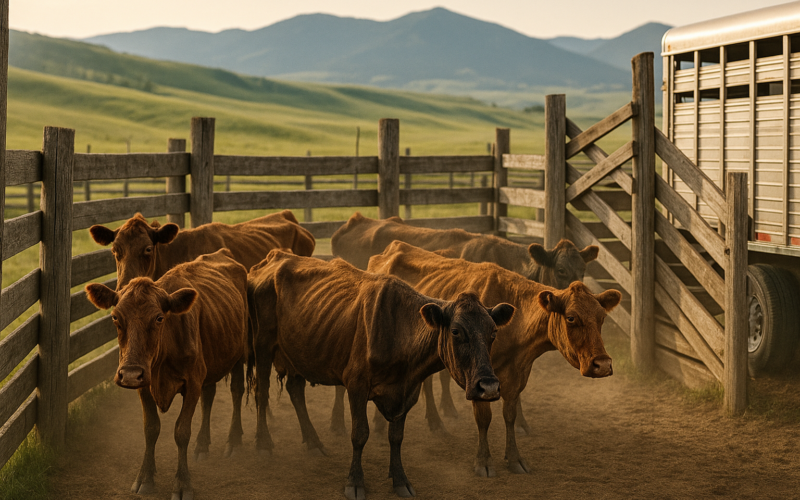
Branding and turnout put your hands on the whole herd. You saw which cows came in thin and didn’t recover. You saw the busted udders, the cows favoring a foot, the ones with a broken mouth that can’t hold condition on good grass, let alone dry fall range. Those cows aren’t a mystery you have to wait for a palpation glove to solve. They’re culls right now, and every day they stay is grass and time you’re spending on an animal that’s already decided.
Who leaves, and why you already know
Open is the obvious one, and yes, you don’t confirm that until fall. But a lot of your cull list has nothing to do with whether she’s bred. Walk through the ones you can call today:
- Bad udders. A cow with one or two dead quarters, or a bag hanging so low the calf can’t find it, is short-changing that calf all summer and won’t get better. She’s a cull whether she’s bred or not.
- Feet and legs. The cow that’s chronically lame, or so post-legged and worn down she can’t travel to water on rough country, doesn’t belong in a summer pasture where she has to cover ground.
- Age and mouth. Check teeth on the old cows. A broken-mouth or smooth-mouth cow can look fine on lush June grass and fall apart by September when the feed gets coarse. If she can’t hold condition through the winter ahead, sell her while she’s still carrying flesh.
- Disposition. The one that tried to run somebody down at branding isn’t going to improve. She’s teaching the younger cows bad habits and she’s a wreck waiting to happen. Load her.
Keep a note or a chalk mark on the ones you flag. It’s easy to forget which cow it was three months later when you’re moving fast through the chute.
The fall run works against you
Here’s the market piece. Come October and November, every ranch in the country is preg-checking and shipping the same cows you are. The sale barns fill up with open and old cows all at once, and when everybody’s selling the same class of cattle in the same six weeks, that class of cattle gets cheaper. It’s basic supply. You’re delivering into the glut instead of ahead of it.
Sell some of those known culls in June or July and you’re marketing into a lighter, hungrier cow trade. You also skip the whole cost of running her—the grass she’d eat, the mineral, the water hauling in a dry summer, the risk she goes down with foot rot or gets struck by lightning under the wrong tree. A cull cow is worth the most the day you decide she’s a cull. After that she’s just eating into her own value.
Fat or thin, sell her right
The catch is condition. Cull cows sell on weight and on flesh, and a thin, worn-out cow brings a lot less than one carrying some cover. You’ve got a decision to make on each one.
If a cow is already in decent shape—say the good-uddered old cow you’re culling on age alone—she’ll never be worth more than she is on early-summer grass with her calf pulled or about to be pulled. Move her while she’s fat. Don’t hold her hoping the market climbs; you’re gambling grass against a few cents.
The thin ones are the judgment call. A cow that came through a hard winter poor can put on real weight and grade up if you give her sixty to ninety days on good feed. Sometimes it pays to run her with the culls in a separate bunch, let her recover, and market her later at a heavier, higher-value weight. Sometimes she’s too far gone or too old to bother, and you’re better off cutting the loss early. Pencil it against your grass. In a year when feed is tight, feeding a marginal cow to gain fifty pounds isn’t the deal it is when the meadows are running over.
The point isn’t a rigid rule. It’s that you make the call in June with your eyes open, instead of hauling a truckload of cows you’d already condemned all the way to a crowded fall sale and taking whatever’s left.