You bought the right vaccine, you ran every calf through the chute, and you charged the syringe careful as you please. Then half of it didn’t take, because the product was dead before it ever went under the hide. Nobody sees that happen. There’s no scour, no cough, no calf down in the corral. The bill comes due in the fall when something rips through your weaned calves that they were supposed to be covered against, and you spend a week wondering how.
Summer working is hard on vaccine. You’re often out at a set of corrals with no shade, the pickup dash reads well over a hundred by ten in the morning, and the crew is moving faster than the cooler management can keep up with. Modified-live products are the touchy ones. The virus in them is alive but weakened, and heat and sunlight kill it fast. Killed vaccines are tougher but not bulletproof. Either way, a little discipline at the chute protects the money you already spent.
Heat and light do the damage, and fast
Most cattle vaccines want to stay between about 35 and 45 degrees, right where a working refrigerator holds them. Push much past that and the clock starts. Direct sun is worse than air temperature alone. A syringe sitting on the tailgate in June sunlight can climb far hotter than the day itself, and ultraviolet light tears up modified-live virus even when the liquid still feels cool to the touch.
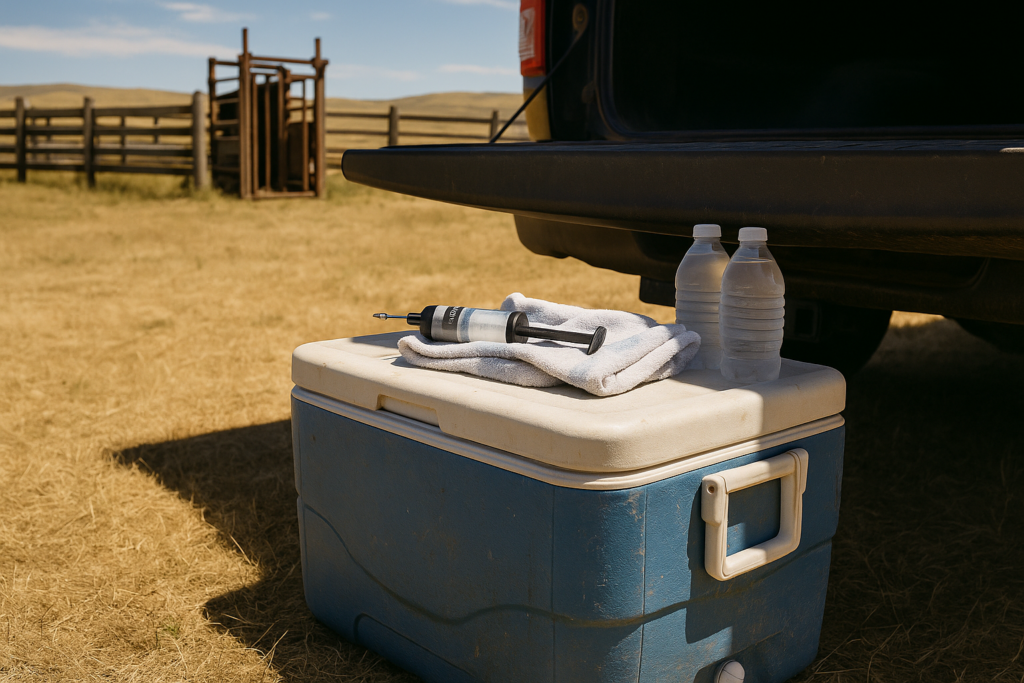
The trap most outfits fall into is thinking the cooler solves everything. It doesn’t, not by itself. A cooler with no ice, or with the lid flopping open every thirty seconds, is just an insulated box holding warm bottles. And a cooler packed tight against a block of ice with the vaccine bottle laid right on it can freeze the product, which ruins a lot of vaccines just as dead as heat does. Frozen and thawed vaccine, especially anything with an adjuvant, is trash.
- Keep a working thermometer in the cooler and actually look at it.
- Use frozen water bottles or gel packs, not loose ice water sloshing around the bottles.
- Put a towel or cardboard between the ice and the vaccine so nothing freezes against the pack.
- Bring only what you’ll use in the next hour out of the main cooler; leave the rest in the pickup fridge or a second cooler in the shade.
Mix small, mix often
The biggest waste happens with reconstituted modified-live vaccine. Once you mix the powder with the diluent, the live virus is on borrowed time. A lot of labels give you a window of just a couple hours to use it, and that assumes it stayed cool the whole time. On a hot day with the mixed bottle riding in a loaded syringe on the chute rail, you can blow through that window and not know it.
Mix only what you can run through in an hour or less. If you’re branding a hundred pairs, don’t reconstitute the whole batch at daylight. Rehydrate a bottle at a time as the syringe runs low. It’s a little more stopping and starting, but it beats spending an afternoon giving calves colored water.
Draw from bottles kept in the cooler, not from a bottle taped to the chute. Wrap the loaded syringe in a wet towel and keep it in the shade between runs. Some folks run a small soft-side cooler right at the chute with the working syringe and the open bottle both inside, lid down between calves. That’s about as good as it gets when you’re out in the open.
Little things at the chute add up
Clean equipment matters as much as temperature. Disinfectant and soap residue kill live vaccine, so syringes used for modified-live products get rinsed with hot water only, never soap, and are left to dry. Keep one set of syringes for modified-live and don’t cross them with anything else.
Change needles often enough that you’re not driving a burred, dirty needle through hide. A dull needle leaves vaccine dribbling back out the hole and sets up knots and abscesses. Give the shot where the label says, under the skin high on the neck for most, and space two products a hand’s width apart so they don’t interfere.
Write down the product, serial number, and date every time you work cattle. If something does break out later, or if there’s ever a question at sale time, that record is worth having. It also tells you honestly whether the protection you paid for had a fair chance to work, or whether it spent the morning cooking on the dash while you were busy roping.