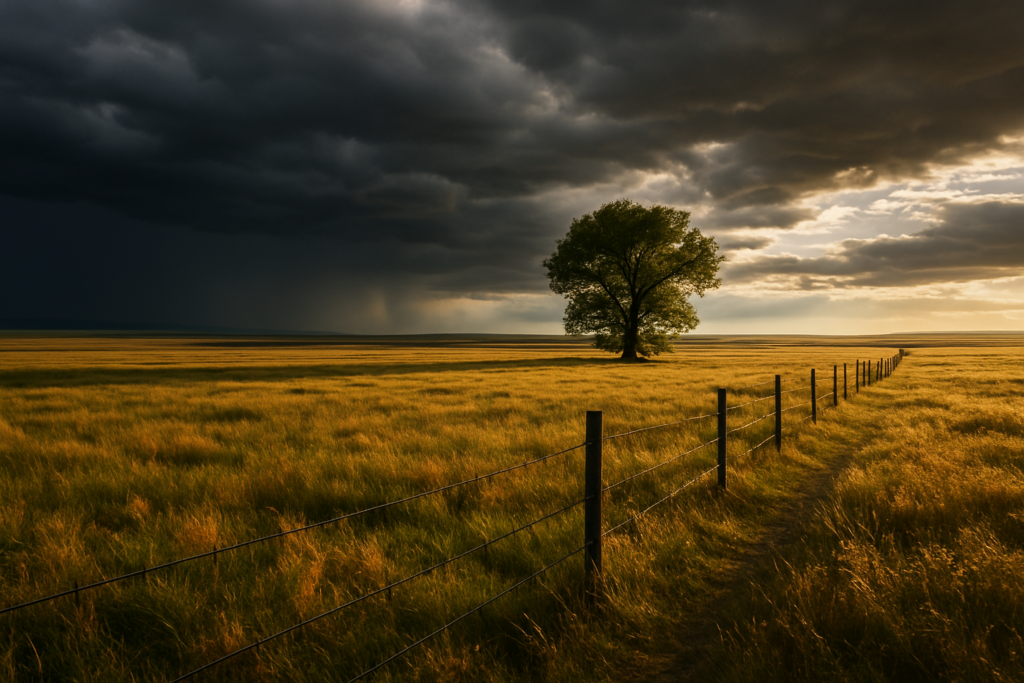
You know the storms. They build over the Rockies in the afternoon, roll east across the plains, and by supper the sky north of the corrals is the color of a bruise. Most of the time it’s rain and a little hail and it’s gone in twenty minutes. Then one morning you ride out to move pairs and find four cows dead in a row under the box elder in the corner, or stretched out along the north fence like they laid down to sleep.
Lightning does that. Not one animal, but a bunch, and almost always in a spot you could’ve pointed to before it happened.
Why It Kills in Bunches
A direct hit is rare and it’s not usually what gets a group of cattle. The bigger killer is ground current. Lightning strikes a tall object—a lone cottonwood, a power pole, a windmill—and the charge spreads out through the wet ground in every direction. An animal standing near that point takes the current up one set of legs and down the other. The distance between a cow’s front and back feet is enough to put a lethal voltage across her heart. A person standing with their feet together in the same spot might walk away. A cow, spread out on four legs over several feet of ground, doesn’t.
That’s why you find them grouped. Cattle bunch under the only shade or crowd against a fence line when the wind and rain come up. They’re all standing in the same charged ground when it hits. One strike, several dead.
Wire is the other trap. A barbed-wire or net fence will carry a charge a surprising distance from where the bolt actually landed. Cattle rubbing or standing tight against a fence during a storm are wired into the whole system. I’ve seen losses a quarter mile from the pole that took the hit, strung out along the wire like the current went looking for them—because it did.
Knowing What You’re Looking At
Lightning kills fast, so the animals usually look peaceful. They’re often down where they stood, legs out, no sign of a struggle, no bloat right away because they died in seconds. Look for the giveaways: singed or curled hair, especially down a leg or across the back; small burn marks where the current entered or exited; grass scorched or a split limb in the tree overhead. Two or more animals dead close together, in open pasture, after a storm, with a tall object nearby—that’s the pattern.
It matters because you’ll want to be sure before you write it off. A cluster of dead cows can also be blue-green algae at the pond, water hemlock in a wet draw, or a downed power line. If there’s any doubt, get your vet out to look. A cause of death you can document is worth the trip.
Document It Before You Move a Thing
Lightning loss is one of the few things a livestock mortality policy or a federal indemnity program will actually pay on, but only if you can prove it. Before you drag anything off, take pictures. Get the dead animals in the frame together, get the tree or fence or pole, get the scorch marks and the singed hair up close. Photograph the ear tags or brands. Note the date, the pasture, and that a storm came through.
Call whoever holds the policy, and if you think a disaster program might apply, call your local FSA office and ask what they need and how fast. These programs run on deadlines and paperwork, and “I lost some cows to lightning last month” without a photo or a vet’s word doesn’t get you far.
What You Can and Can’t Do About It
Be honest with yourself here—you can’t storm-proof a pasture. You can’t tell a cow not to stand under the shade tree. But you can think about where the lone trees and the tallest poles sit in a summer pasture, and know those corners are where you’ll take losses. Grounding your fences well, with rods driven at the ends and at intervals, bleeds some charge into the earth instead of down the wire past your cattle. It’s mostly done for the sake of the fence charger, but it doesn’t hurt.
Past that, it’s Montana in June. The storms come, and once in a while they take a few good cows out from under you before you ever hear the thunder. Ride out after every hard one and look, so you find them in a day and not a week.