Every year somebody finds a good cow dead in a wet draw with no marks on her and no sign of a fight beyond the ground she tore up going down. More often than folks think, the answer is water hemlock. It grows where the ground stays wet into summer, it looks harmless enough, and the part that kills is the part you can’t see until a cow pulls it out of soft mud.
This is the most violently poisonous plant most of us have on our ground. A cow doesn’t get sick and hang on for a day the way she does with a lot of poisonous plants. She goes down, seizes, and is gone, sometimes inside an hour of eating it. There’s rarely time to treat, and treatment rarely works anyway. So the whole game is knowing the plant and keeping cattle off it.
Where it grows and what it looks like
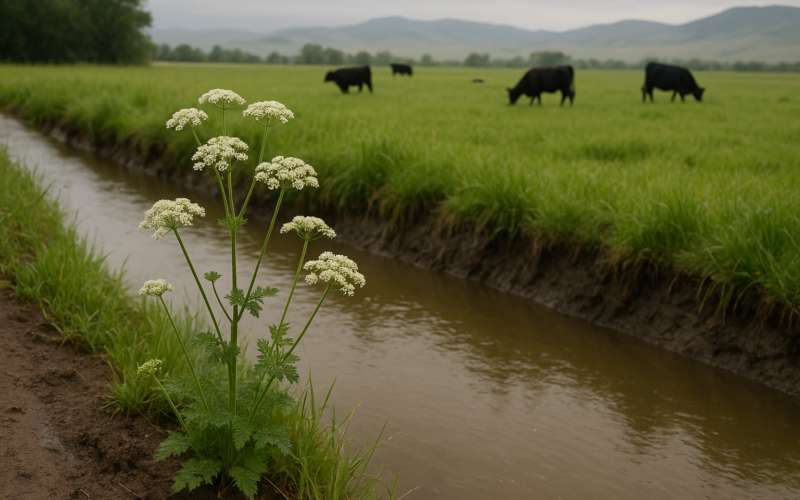
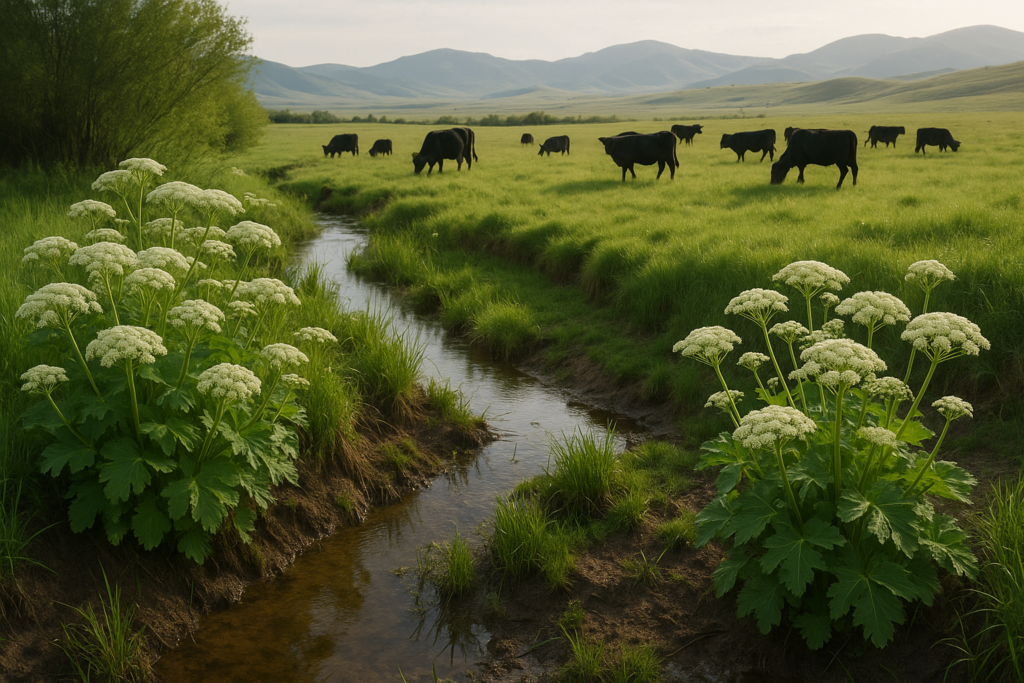
Water hemlock likes its feet wet. Look for it along creek banks and irrigation ditches, in seep spots, spring developments, wet meadow edges, and the boggy bottom of a draw that holds water into June and July. It’s a perennial that comes back in the same spots year after year, so if you had it last summer, plan on it this summer.
Full grown it stands two to six feet tall with a cluster of small white flowers on top, spread out in umbrella-shaped heads like a lot of the carrot family. The leaves are divided, and the veins run to the notches between the leaf teeth rather than to the tips, which is a detail worth learning if you’re trying to tell it apart from harmless lookalikes.
The dead giveaway is down low. The base of the stem and the root crown are swollen and hollow, divided into chambers like the rungs of a little ladder. Cut it open and there’s a yellowish, oily liquid that smells rank, sometimes like raw parsnip. That liquid carries the toxin, and it’s most concentrated in the roots and the tuberous crown. The green tops are dangerous too, especially early, but the roots are the real killer.
Why June ground makes it worse
The danger isn’t just that the plant is there. It’s that the ground it grows in is soft. When a cow grazes the green top in wet, loose soil, the whole plant lifts out, roots and all, and she gets the most toxic part in one bite. On dry, hard ground the tops break off and the roots stay put. That’s a big reason water hemlock poisoning shows up in spring and early summer, when the draws are still boggy from runoff and irrigation.
Turnout timing stacks the odds against you too. Cattle coming off winter feed onto green grass are hungry and not particular. Push a hungry bunch into a pasture where the only green early growth is down in a wet draw, and they’ll graze exactly where the hemlock is. The same goes for cattle that drift to water and start picking along a marshy edge while the upland grass is still short.
Sheep and cattle both get it. Horses do too. It doesn’t take much: a cow can take a lethal dose from a piece of root the size of what she’d pull in a single mouthful.
Keeping the wreck from happening
You won’t out-treat this plant, so keep cattle from ever getting to it.
- Walk your wet spots before turnout. Check ditch banks, spring developments, seeps, and the low end of every draw that holds water. If you find it, you know where the trouble is.
- Fence off the worst patches, or at least the wet meadow edges and marsh where it’s thick. A short stretch of temporary fence around a boggy corner is cheap next to a dead cow.
- Don’t turn hungry cattle onto a pasture where the wet draw is the only green feed. Give them decent upland grass so they’re not forced down into the bottom to fill up.
- Grub out isolated plants where you can. Dig the whole root crown and haul it off, because the pulled plant is still poisonous and cattle will eat the wilted tops. Wear gloves; the sap is toxic to people too, and don’t let it near your mouth or eyes.
- Herbicide will knock it back, but you’re spraying wet ground near water, so check the label and the rules before you do anything along a live ditch or creek.
Learn to spot the plant yourself and show it to whoever rides your pastures. The chambered, hollow root crown with the oily yellow juice is the one feature that seals it. Once you’ve seen it, you won’t mistake it for wild parsnip or cow parsnip again. That recognition, and keeping cattle off the wet ground where it lives, is about all that stands between a normal summer and finding one of your best cows dead in the mud for no reason you can see.