Every crossing where a creek or a coulee runs through your fence is a weak spot, and spring is when it fails. Snowmelt and June rain shove debris downstream, the water rises against the wire, and a gap that held all winter comes off its posts overnight. The trouble is you usually don’t find it on the day it happens. You find it when a bunch of pairs is standing on the wrong side of the line, or worse, mixed in with cattle that aren’t yours.
Once the creeks start dropping — and in most of the state that’s mid-June, after the last of the mountain snow lets go — it’s worth a deliberate ride down every drainage that crosses a fence. Not a look from the pickup. Get down in the bottom where the willows are and see what the water did.
Ride Every Crossing, Not Just the Ones You Can See From the Road
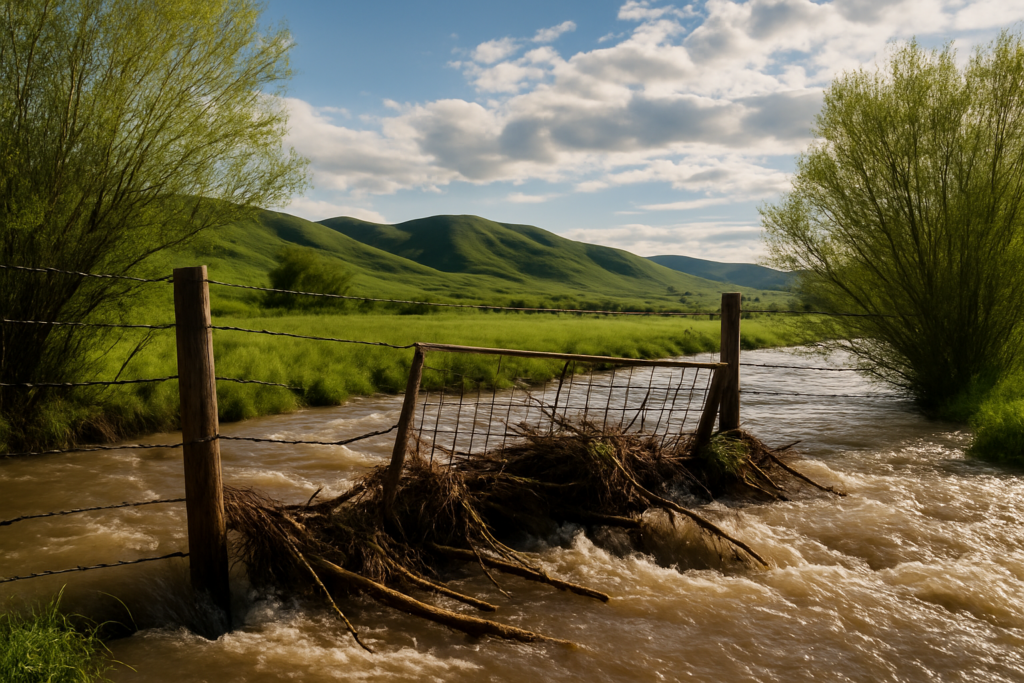
Water gaps rip out for a couple of reasons. Debris piles up against the wire, the current loads it like a dam, and either the panel washes downstream or it packs so full of brush the water backs up and cuts a new channel around the end. Either way you’ve got a hole. A cow doesn’t need much of one. If she can get her head and shoulders through, the rest follows, and the herd follows her.
Look at the whole crossing, not just the gap itself. High water undercuts the anchor posts on both banks, and a post that looks fine standing there will pull out the first time an animal leans on the wire. Check the corner and brace posts nearest the creek. If the ground around them is soft and caved, they’re compromised even if they’re still upright.
The low draws matter too. A dry coulee that carries runoff for two weeks in spring will float a bottom wire full of tumbleweed and grass and mud, and that dead weight sags the whole span. Clean it out while it’s still soft. Come August that same debris is baked into a mat you’ll fight with a pitchfork.
Build the Gap to Give, Not to Hold
A water gap that’s built like the rest of your fence will get torn out again next spring, guaranteed. The point of a good gap is that it lets water and trash pass through and then hangs back up on its own, or fails in a way you can fix in twenty minutes instead of rebuilding from scratch.
There are as many designs as there are ranches, but the ideas behind the good ones are the same:
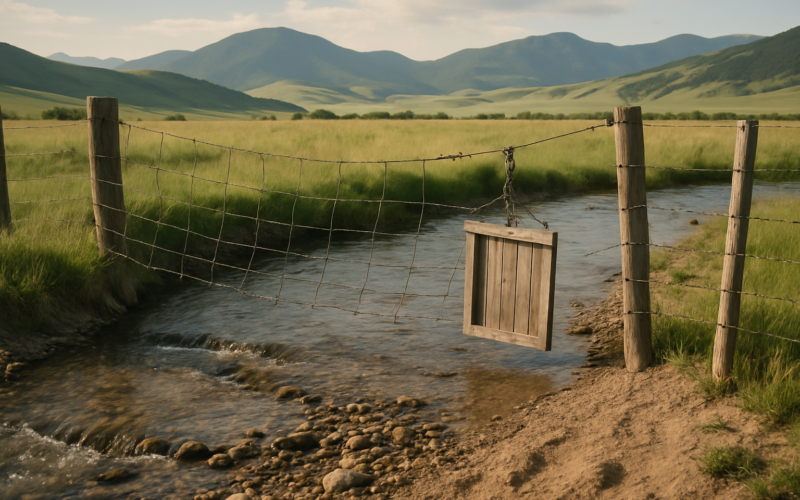
- Hang the wire from a suspension post or a cable above the high-water line so the panel swings up when the water rises and settles back down when it drops.
- Weight the bottom enough to keep a calf from ducking under in normal flow, but not so much it can’t lift when the creek comes up.
- Set your real anchor posts back from the bank, up on solid ground, where the current can’t undercut them. Let the gap itself be the sacrificial part.
- Keep it simple. The gap you can walk out and reset by hand is the one you’ll actually maintain.
Some outfits run a hinged pole gap, some use a floating panel of cattle panel or old drill stem, some just hang loose wire weighted with rock. What works on a wide, sandy creek won’t work in a narrow rock-cut draw. Build for the water you actually get in that spot.
Fix It Before Turnout, or Fix It Ahorseback in July
The reason to do this now instead of later is that a hole in a boundary fence is somebody else’s problem too. If your pairs walk through into a neighbor’s summer pasture, you’re not just gathering strays. You might be dealing with your heifers standing in with his bull, or his cows breeding to yours, and a calving season next spring you didn’t plan and can’t sort out. Trich and other trouble travels through a torn-out water gap the same as a stray does.
There’s also the plain math of it. A gap you rebuild on foot in June, with a spade and a spool of wire and a couple of steel posts, is a morning’s work. The same repair in late summer means gathering cattle off unfamiliar country first, and every day they’re out is weight off a calf and a phone call you’d rather not make.
Carry the tools with you when you make the ride — a hammer, staples, a stretcher, a few posts and a driver, and enough wire to splice. Half the gaps you find won’t need a full rebuild, just a bank cleaned out and a wire reset while you’re standing there. It’s the ones you leave for later that turn into the wreck.