Every June a few Montana outfits turn cattle onto foothill and mountain pasture and lose one before the Fourth. No sickness, no warning. The cow is found down on her brisket or flat on her side, sometimes within sight of the water, and the ground around her is torn up where she fought to get back on her feet. Nine times out of ten in that country the culprit is larkspur, and the maddening part is that she ate a plant that was doing exactly what it does every year at that elevation.
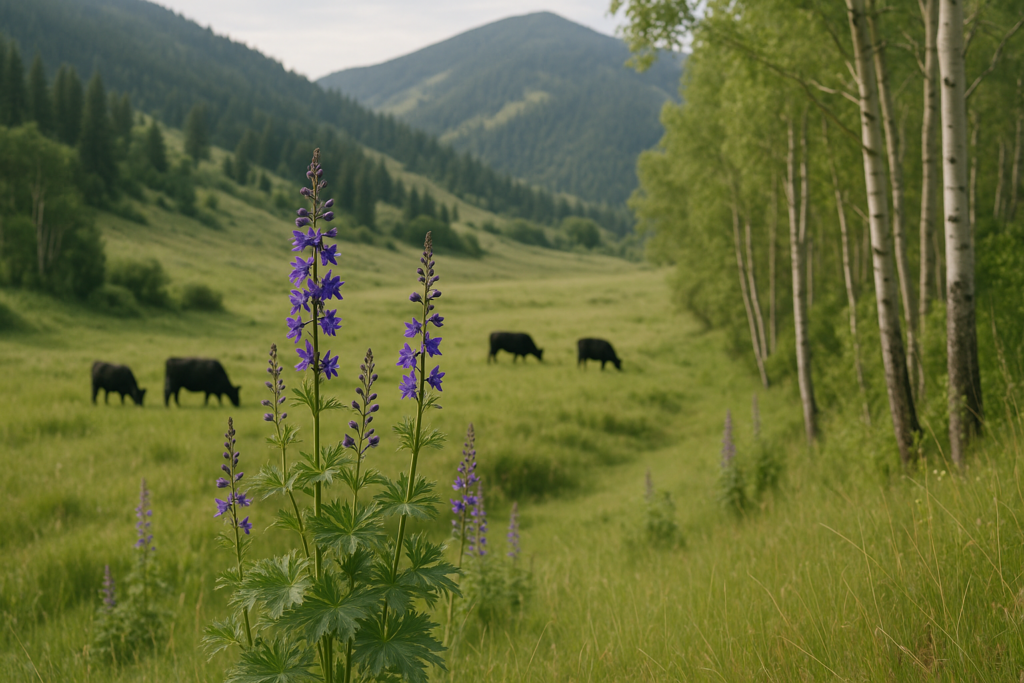
Tall larkspur runs the drainages, the aspen edges, and the north slopes on a lot of Montana’s higher summer range. Low larkspur shows up earlier and lower, on the sagebrush benches and foothills, and dries up by the time the grass cures. Both carry the same alkaloids, and both are worst before and during flowering. Once the plant sets pods, the poison drops off. The trouble is that the dangerous window lines up almost perfectly with turnout.
Why cattle eat something that kills them
Larkspur isn’t unpalatable. That’s the whole problem. Cattle will walk past cured bunchgrass to graze it, and tall larkspur greens up and stays green when the surrounding forage is either not ready yet or already going dormant. Early in the season the plant is leafy and lush and the grass is short, so the ratio of larkspur in a bite goes up. Later, after bloom, cattle actually tend to eat more of it even as it gets less toxic, which is its own kind of gamble.
The alkaloids hit the nerves that run the muscles. An affected cow gets weak, staggers, stands with her legs spread, and eventually goes down. Bloat sets in because she can’t hold herself upright to belch, and a lot of larkspur cattle actually die from bloat while they’re down. Stress makes it worse. A cow carrying a marginal dose can be walking fine until you push the bunch to move or a dog gets after them, and the exertion is what tips her over. That’s why so many losses happen on gather days or right after cattle are worked on the mountain.
Managing around the plant instead of fighting it
You’re not going to spray your way out of larkspur across a section of timbered range, and you don’t need to. The practical control is timing and grazing pressure. The plant is most toxic per pound early, but cattle eat the most of it later, so there’s a middle stretch — often as the larkspur is flowering — that’s the highest-risk period for the herd. Some producers hold cattle off the worst larkspur pastures until the plant is past bloom and into the pod stage, then turn in when the poison has dropped and the cattle are less likely to load up a lethal dose.
A few things that help on real ground:
- Know your patches. Larkspur grows in the same draws and slopes year after year. If you’ve lost cattle in a particular pasture before, you already know where the trouble is.
- Don’t turn hungry cattle straight into larkspur country. A cow that steps off the truck empty and hits a green larkspur patch eats a lot in a hurry. Let them fill on grass first.
- Handle quiet on those pastures. Save the hard gathers and the sorting for other ground. Exertion turns a survivable dose into a dead cow.
- Move cattle through the worst areas when the grass is good and competing with the larkspur, not when the plant is the only green thing standing.
Sheep tolerate larkspur far better than cattle and have been used to graze it down ahead of cattle in some operations, but that only pencils out if you’re already set up for sheep.
When you find one down
There’s no antidote you carry in the pickup. A cow caught early and standing may pull through if you leave her completely alone and let the dose wear off — chasing her to doctor her can be what kills her. If she’s down and bloated, relieving the bloat and keeping her upright, brisket down with her head uphill, buys time, but a lot of them are too far gone by the time you find them. Talk to your vet before the season about what’s worth trying in your country.
The honest answer is that larkspur is managed, not cured. The ranchers who quit losing cattle to it are the ones who learned which pastures kill and which don’t, and matched their turnout dates to the plant instead of the calendar. The mountain grass will still be there in July. Get up into that country in June and see whether the larkspur is leafing, budding, or in bloom before you decide what to turn out and when.