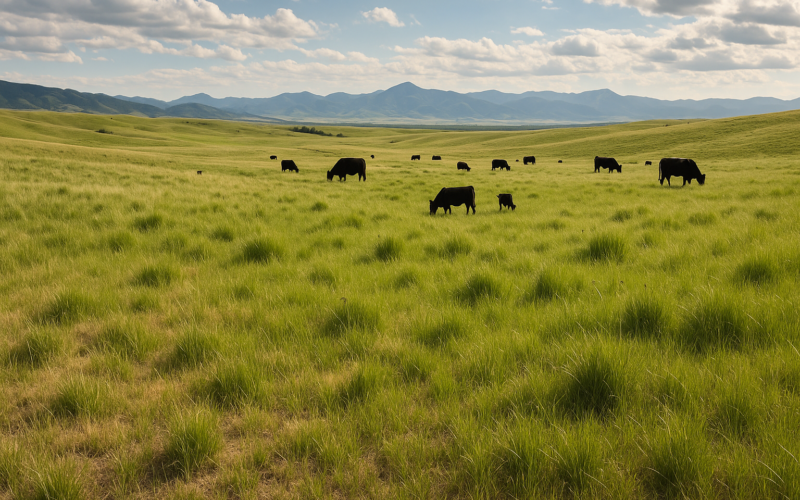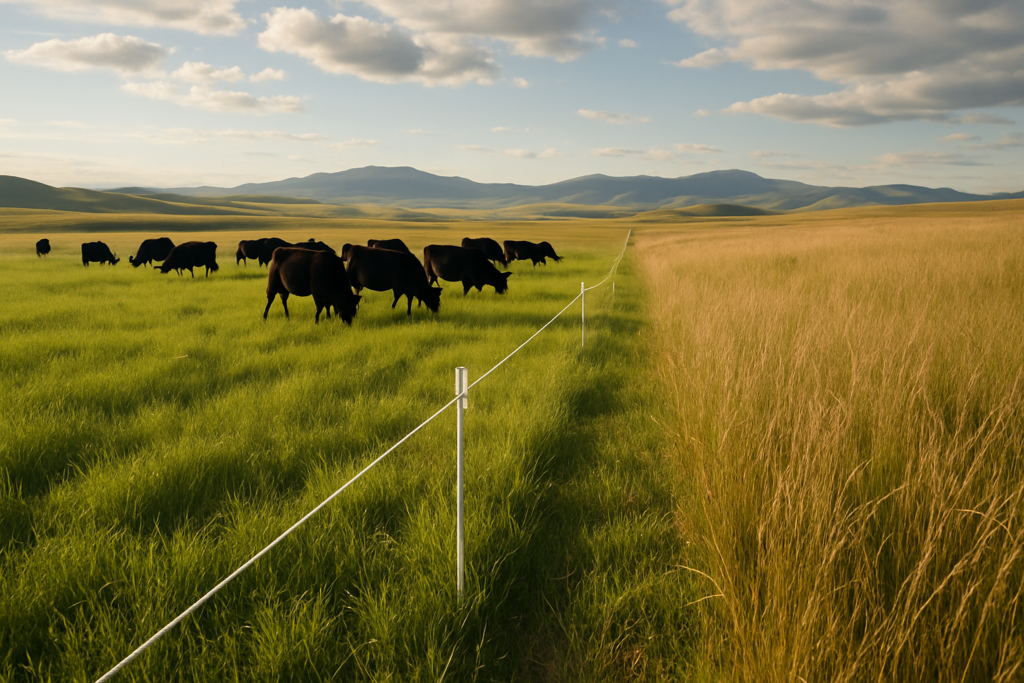
Most of the grazing mistakes I’ve watched cattle make happen because a fence didn’t exist. Cows graze the way water runs downhill. They hit the creek bottom, the shady draw, the flat by the gate, and they’ll come back to those same spots until the grass is chewed to dirt while a whole hillside stands untouched a quarter mile off. A permanent cross-fence fixes that, but permanent fence costs money and time you may not have. A reel of polywire and a decent energizer will do most of the same work for a fraction of the price, and you can move it whenever you want.
Mid-June is the time to be thinking about this, because the grass you have right now is close to as much as you’re going to get. Cool-season country in Montana grows hard from green-up through late June and then coasts. If you can graze half a pasture now and rest the other half, that rested half is standing feed in August and September when everything else has cured out and quit. You can’t grow more grass in a dry August. You can only save some of June.
What it takes to hold a cow with one wire
People who’ve never run temporary fence assume a single strand of polywire can’t hold cattle. It can, but only if the cattle respect it, and respect comes from the shock, not the wire. A cow that touches a hot fence once and gets bit will leave it alone for the rest of the summer. A cow that touches a dead wire learns the opposite lesson, and once a few of them figure out the fence is bluffing, the whole bunch walks through it.
So the fence is only as good as the energizer and the ground. Buy more joules than you think you need, especially if you’re running a long line or the vegetation is tall and green. Green grass touching the wire drains voltage fast, and a mile of polywire loaded up with June growth will pull an underpowered charger down to nothing. If you’re on a solar or battery unit out on summer range, size it for the worst case, not the day you set it up.
Grounding is where most temporary fences fail, and it’s the part nobody wants to hear about. One short ground rod pounded into dry summer soil is close to useless. Dry dirt doesn’t conduct. You want several feet of galvanized rod in the ground, and if the country is bone dry, drive it where the soil holds a little moisture or run more of it. When a fence tests weak, the ground system is the first place to look, not the charger.
Setting it out so it actually works
Train cattle to the wire in a small paddock next to a fence they already know before you turn them onto a big polywire pen out in the open. A few days of getting tagged in familiar country teaches them the wire means business. After that they’ll honor a single strand across a whole section.
Set your reels and posts so you can move the fence in an hour, not a day. Step-in posts, one hot wire at nose height for the cows, and a gate handle you can reach without dropping the whole line. Plan where the cattle drink before you plan where the grass is. A paddock with no water is worthless, and you don’t want cattle trailing a mile back to the tank every few hours because that beats down the country around the water and defeats the whole point. If your water is fixed, run your temporary fences like spokes off it so every paddock touches the tank or the creek gap.
Move them before they’ve grazed a paddock into the ground. The rule of thumb people use is take about half and leave half. When the good grass is grazed down and the cattle start hunting the stuff they turned their noses up at on day one, they’re telling you it’s time to move. Grass grazed to a stub in June doesn’t recover the way grass with some leaf left behind does. You’re not just feeding cattle today, you’re setting up the regrowth.
Where it pays and where it doesn’t
Temporary fence shines on big open pastures where cattle are ignoring most of the ground. It’s less useful in broken timber and coulee country where you can’t run a straight line and the cows can’t see the wire anyway. It won’t fix a water problem, and it won’t make grass in a drought. What it does is buy you control over where the cattle are and when, and control is the thing you give up the day you turn out and shut the gate on a section.
A reel of wire, a good charger, and enough ground rod is a few hundred dollars against the cost of hauling in hay or selling cows early because the grass ran out. On most Montana outfits, the wire pays for itself the first dry summer you make it through with grass still standing.