Most of the poison plant talk in June runs to larkspur on the foothills and lupine on the dry benches. Those will hurt you. But if you want to lose a good cow fast, with almost no time to do anything about it, water hemlock is the one. It’s the most toxic plant that grows in this country, and it likes the same wet ground your cattle head for when the uplands cure out and the seeps stay green.
The trouble with water hemlock is speed. A cow that gets a mouthful of the root can go from grazing quiet to down and convulsing inside of fifteen minutes to an hour. By the time you find her, she’s usually dead or dying, and there’s no practical treatment out on summer range. This is a plant you manage by keeping cattle off it, not by doctoring after the fact.
Where it grows and why June is the danger window
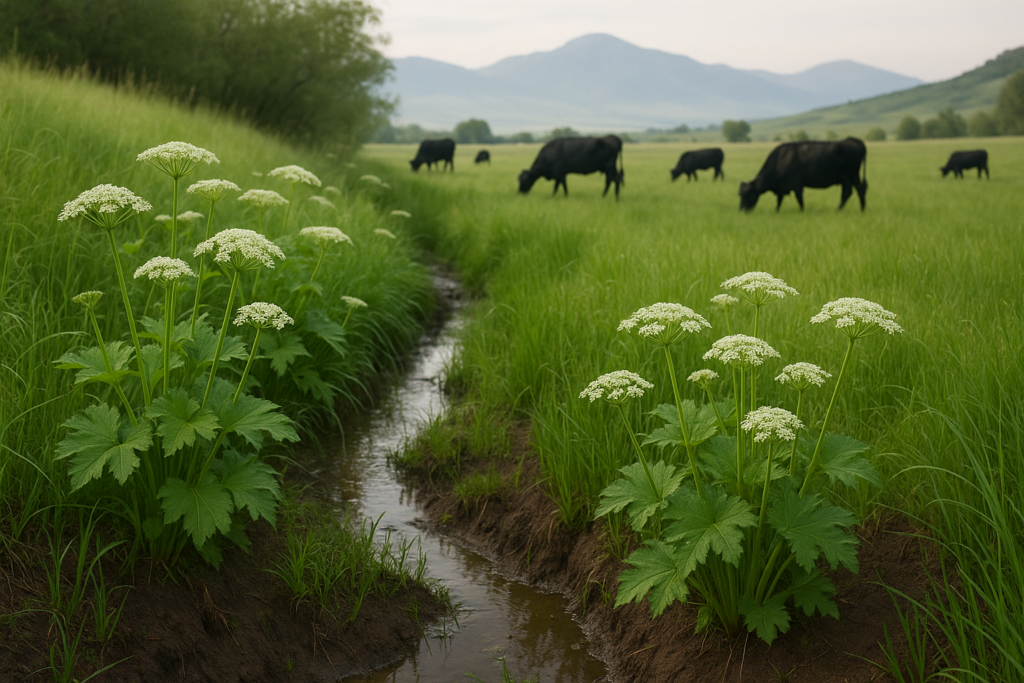
Water hemlock lives with its feet wet. Look for it along slow creeks, spring seeps, irrigation ditch banks, the edges of stock ponds, marshy meadow corners, and the low draws that hold runoff after a wet spring. It’s a perennial that comes back thicker every year in the same spot, so the wet corner where you found it last summer is the wet corner to check first.
June is the worst month for a couple of reasons. The plant is up and lush while a lot of the surrounding grass is either just as green or starting to head, so it doesn’t stand out as much as you’d like. And the ground around water is soft this time of year. That matters, because the real poison is in the root — a cluster of fleshy, tuberous roots that a cow can pull straight out of saturated soil while she’s grazing the tops. On dry, hard ground she’d bite off the leaves and leave the root behind. In a boggy ditch bank she gets the whole works.
Cattle don’t seek it out. Most poisonings happen when hungry cattle hit a wet area hard — turned out onto fresh pasture, trailed to new country and let go on green bottom ground, or pushed into a draw where the only green left is down by the water. A full cow picks at what she likes. A hungry cow grabs whatever’s green, roots and all.
How to tell it from the plants it grows with
Water hemlock is in the carrot and parsley family, and so are a lot of harmless plants it grows alongside, which is how people get fooled. A few things to sort it out:
- It gets tall — knee to shoulder high by mid to late summer — with a stout, hollow, often purple-streaked stem.
- The flowers are small and white, held in umbrella-shaped clusters, like Queen Anne’s lace or wild parsnip.
- The leaves are divided, and the veins on the leaflets run to the notches between the teeth rather than to the tips — a small detail, but a reliable one.
- The giveaway is the root. Cut the base of the stem or a root lengthwise and you’ll see chambers separated by cross partitions, and it oozes a yellowish, oily liquid that smells like raw parsnip or celery. That chambered root is what nothing else in the ditch has.
If you’re not certain, don’t taste-test it and don’t handle it more than you have to — it’s toxic to people too. Dig one up with a shovel, bag it, and get it identified. Your local Extension office can confirm it.
What to actually do before turnout
Ride the wet ground before you turn out, not after you find a dead cow. Walk the ditch banks, the pond edges, and the spring boxes where you know it’s damp. Mark the patches. If it’s a small stand, digging it out works, but you have to get the whole root and pack the plant off — a root left drying in the sun still carries poison, and so does one that washes downstream to lodge on a bar where cattle water.
Fencing off a bad seep or the marshy end of a meadow is often more practical than trying to spray a creek bottom clean. A hot wire around a quarter-acre of ditch bank is cheap next to a bred cow. Herbicide can knock it back where a label allows use near water, but read that label hard, because most of these spots drain into something.
The biggest thing is turnout management. Don’t dump gaunt, hungry cattle onto green bottom ground and walk away. Let them fill on dry grass first, or feed a little hay before you move them, so they’re picking rather than gorging when they hit the wet corners. On new leased country you don’t know, walk the water before the cows do. The draw that looks like the best feed on the place in June is sometimes the one that’ll cost you.