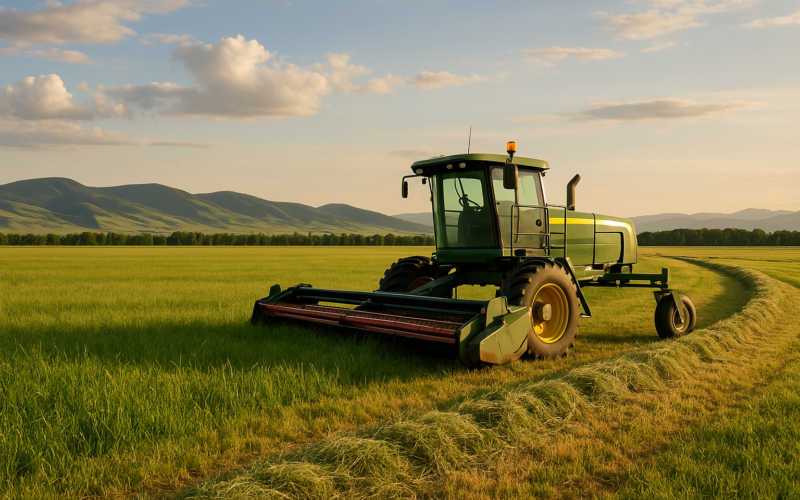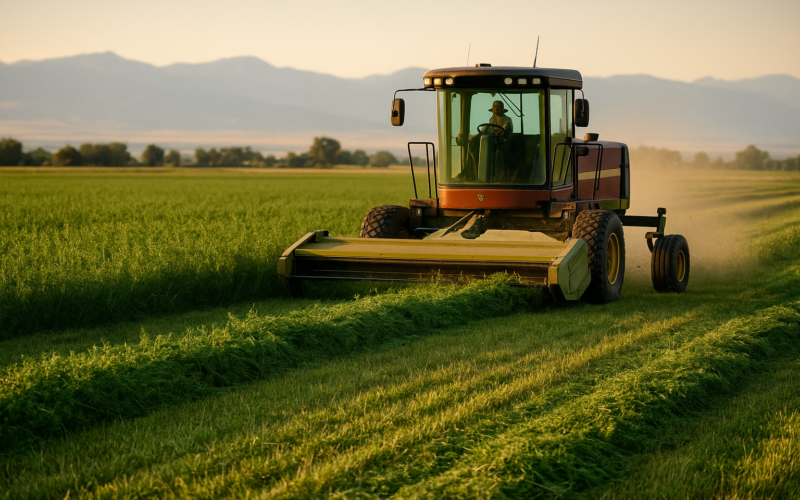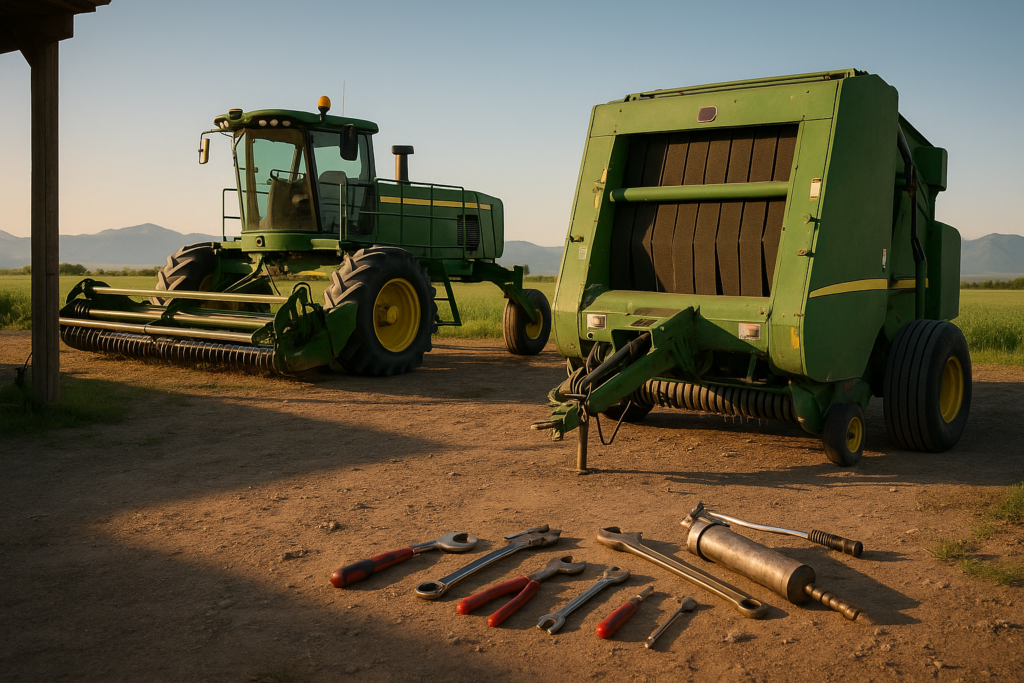
The alfalfa is close. Another warm week and the bud stage will be here, and you’ll want to be laying it down while the weather holds. That’s exactly the wrong time to find out the baler pickup teeth are half gone or the swather sickle is bound up with last year’s crud. Nobody wants to be under a machine in the dust with a thunderhead building over the Bridgers.
Haying is a short window in Montana. You get a handful of dry days, you cut, you cure, you bale, and you do it again on the second crop if you’re lucky. A breakdown in the middle of that window costs you more than a repair bill. It costs you leaf, it costs you test, and sometimes it costs you a whole cutting that gets rained on while you wait for a part to come from Billings or Great Falls.
Start with the swather or mower-conditioner
Pull the guards and look hard at the sickle. Cracked or chipped sections cut ragged and plug easy. Worn guards let the knife float and miss. Set the hold-downs and register the sickle so the sections center in the guards through the whole stroke. Have a couple of spare sickle sections, rivets, and at least one full spare knife on the shelf before you start, not after you break one.
Grease every zerk on the machine, and don’t guess at which ones. Walk it with the manual if you have to. Wobble boxes and pitman drives take grease and get forgotten. On a rotary disc header, check the oil in the cutterbar and look for any weep at the seals. A dry disc bar or a starved wobble box will let go at the worst possible moment.
On the conditioner rolls, check the gap and the tension. Rubber rolls wear and go smooth; if they’re glazed over they won’t crimp the stem and your hay dries slow and uneven. Even crimping is what gets a heavy first cutting dry before the next rain finds it.
The baler is where the wrecks happen
Whether you run a round baler or a big square, the pickup is the first thing to check. Bent or missing teeth leave hay on the ground and rake it into a rope that plugs the throat. Look at the belts on a round baler for cracks, frayed lacing, and tracking. A belt that’s ready to split will do it two hundred bales into a good afternoon.
Chains and bearings are the quiet killers. Oil the chains, check them for tight links, and set the slack. Spin every roller you can reach by hand and listen for a bearing that’s going rough. A seized roller bearing doesn’t just stop you, it starts fires. Dry chaff, a hot bearing, and a full stack of dry hay is how balers burn up in June and July every year.
Speaking of that: keep a working fire extinguisher on the tractor and one on the baler, and blow the chaff off the machine every few loads when it’s bone dry. A leaf blower or the air hose does it fast. Carry water. Watch your exhaust and turbo if you’re running an older tractor through tall dry grass on the ends.
Rakes, tires, and the boring stuff that strands you
The rake seems too simple to fail, and then a wheel rake loses teeth and windrows crooked, or a rotary rake tine arm bends and drags. Check the tines, tighten the hardware, and grease it.
Now the stuff everybody skips. Air up and eyeball every tire on every implement, including the spare. A flat baler tire in the far field at 8 p.m. is a long walk. Check the driveline shields and the PTO shear bolts, and have spare shear bolts of the right grade in the toolbox. Look at the hydraulic hoses for cracking and rub-through where they route past the frame. Top off oils and check the twine or net wrap supply so you’re not out at the halfway point.
None of this is complicated. It’s a day, maybe two, with a grease gun and a wrench while the hay finishes making. The producers who get their first cutting up clean and tested aren’t luckier with the weather. They just weren’t in the shop hunting a part when the sun was shining.