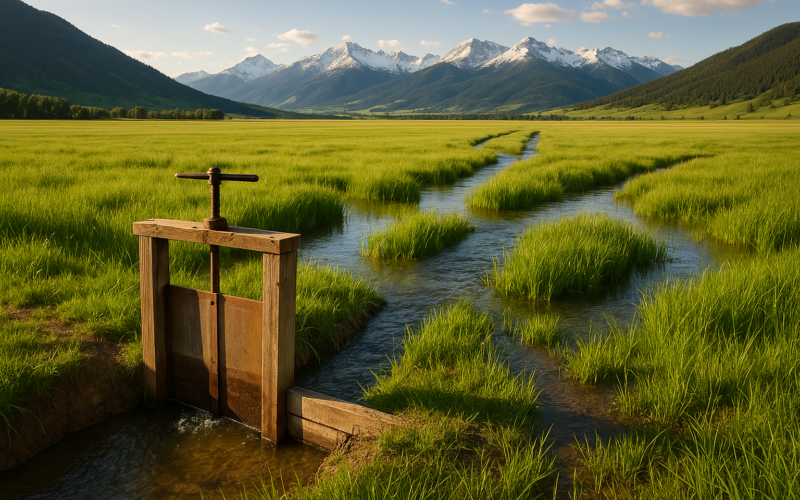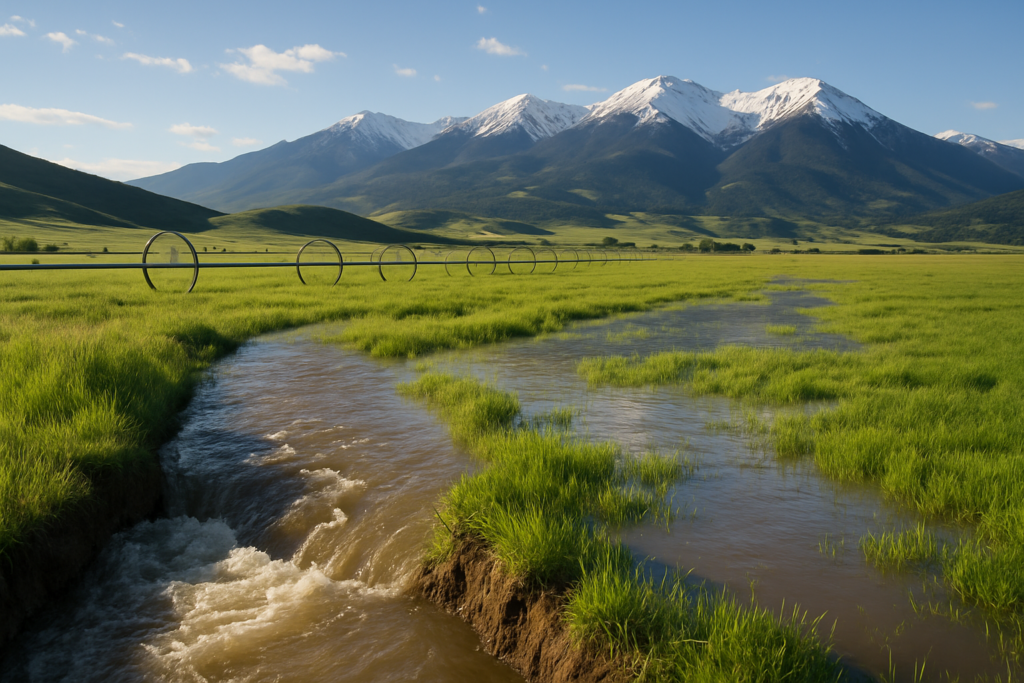
The creek is up right now. Snow is still coming off the high country, the ditches are running full, and the head gate opens easy. That’s the trap. The water you have in June feels like it’ll last, and every year it doesn’t. By late July the flow drops, the senior rights upstream take their share, and the tail end of your meadow starts to fire before you’ve gotten two soakings on it. What you put down now is a lot of what your second cutting and your fall pasture are going to live on.
Irrigation in Montana is mostly a question of timing, not effort. You can only spread the water that’s in the ditch, and the ditch is fullest early. The producers who come out ahead in a dry year are the ones who treated June runoff like the finite thing it is instead of assuming the creek would hold.
Front-load the ground that pays you back
Not every acre deserves the same water when the supply is tight. Get a good, deep set on your best hay ground first, the fields with real soil and good stand, because that’s where the water turns into tonnage. Thin, gravelly ground or a played-out old stand will take all the water you can throw at it and give you back very little. If you’re going to have to short something in August, short the ground that was never going to yield much anyway, and know that going in.
Deep and slow beats fast and shallow. A quick pass that only wets the top few inches evaporates and grows shallow roots that can’t ride out a dry spell. Set your wheel lines long enough, or run your flood sets long enough, to push moisture well down into the profile. Subirrigated meadows along the bottoms will carry themselves for a while once the water table is charged, so getting them saturated early buys you time when the surface flow drops.
Watch your tail water. Flood irrigating a field that’s slightly out of level, or running a set too hard, sends good water off the low end and into the borrow ditch. That’s water you paid for in a wet spring and won’t have in August. Walk the bottom of the field, see where it’s leaving, and adjust your sets or your dams before you’ve wasted a week of runoff.
Know what you’re actually entitled to
When the creek drops, priority date is what decides who keeps irrigating. If you’re on a ditch company or a shared decree, the senior rights get satisfied first, and a junior right can get called off entirely in a short year. It pays to know where you sit before it matters, not by arguing over the head gate in August. Talk to your ditch rider or water commissioner early, understand your delivery schedule, and don’t assume last year’s flow tells you anything about this one.
Measure if you can. A cheap flow marker or even a consistent look at the same point in the ditch tells you when the supply is starting to fall off. The moment you see it dropping is the moment to prioritize, not two weeks later when half the field is already stressed.
Line up irrigation with the swather
Water and haying fight each other every June, and the field usually loses. You need the ground dry enough to run equipment for first cutting, but you don’t want to leave it bone dry for two weeks either. Get a good set on before you cut, let the field firm up, and be ready to put water back on right behind the baler. Regrowth for a second cutting starts the day the windrows come off, and that early moisture is what determines whether you get a real second cutting or a light one.
Keep the system itself honest while you’re at it. A stuck wheel-line mover, a plugged nozzle, or a gopher-blown ditch bank wastes water at the worst possible time. A washed-out check dam floods one corner and starves the rest. None of that shows up until you walk the line, so walk it in June while there’s still water to fix the problem with.
The creek isn’t going to hold. It never does. The water is here now, and the ground that gets a deep drink before runoff quits is the ground still green when your neighbor’s is brown.