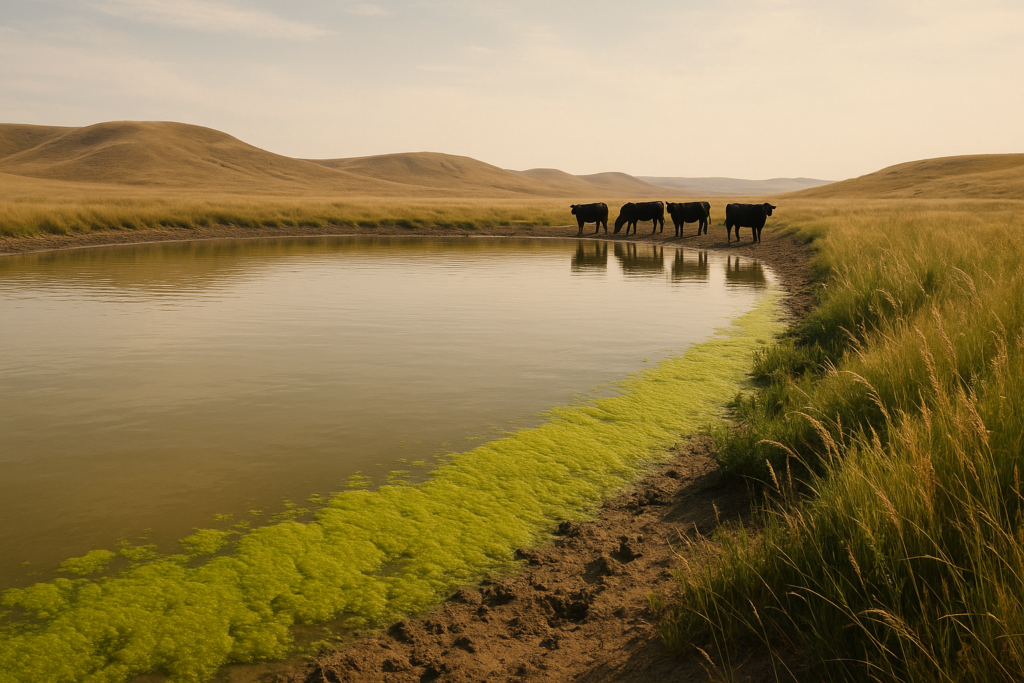
You can ride the same dam every week in May and never think twice about it. Then a stretch of hot, dead-calm weather sets in, the runoff quits moving, and by the time you come back the water has a green sheen on the downwind edge that looks like somebody spilled paint. That sheen can kill a cow before you finish gathering the pasture.
Blue-green algae isn’t really algae. It’s cyanobacteria, and it lives in most surface water at low levels all the time. The trouble starts when it gets everything it wants at once: warm water, sunlight, still air, and a load of nutrients. Late June and July in Montana hand it all four. Stock dams, dugouts, and slow ponds warm up fast, and if that water sits without wind to mix it, the bacteria multiply into a bloom in just a few days. Some of those blooms produce toxins. Some don’t. You can’t tell the difference by looking, which is the whole problem.
What a bloom actually looks like
A real toxic bloom usually shows up as bright green to blue-green scum, often piling up on the downwind shore where the breeze has pushed it. People describe it as spilled latex paint, pea soup, or a film of grass clippings floating on top. It’s different from the stringy, hair-like mats of harmless green algae that drape off rocks and sticks — that stuff you can pick up and it holds together. A cyanobacteria bloom smears and breaks apart.
The scum concentrates the toxin, and it concentrates it exactly where a thirsty cow puts her mouth. Cattle don’t wade to the middle; they drink at the edge, on the leeward side, where the wind has stacked the worst of it. That’s why you’ll sometimes find losses right at the waterline instead of scattered across the pasture.
Two kinds of poison come out of these blooms. One hits the nervous system and works fast — animals go down, tremble, struggle to breathe, and can be dead within an hour of drinking. The other targets the liver and takes longer, sometimes a day or two, and those cattle may show weakness, go off feed, or scour before they die. Either way, by the time you find sick animals, the ones that drank the most are usually already gone. There’s no practical field antidote once a cow has a bellyful.
Keeping cattle off the bad water
The cheapest fix is to keep the source moving and clean, but that’s not always in the cards on a dryland dam. What you can control is access and observation.
- Walk the water in hot, windless spells, not just when you happen to be in the pasture. A bloom can build between Monday and Thursday.
- Check the downwind bank specifically. Open water in the middle can look fine while the leeward edge is coated.
- If you see scum, fence the cattle off that source or move them to a different pasture until it clears. A hot wire and a few posts is a lot cheaper than a dead cow.
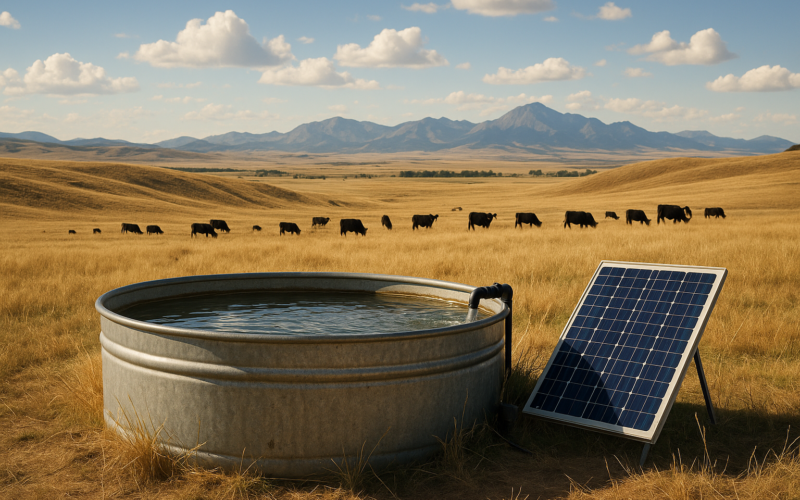
- Have a backup — a tank on a well, a hauled tank, or a clean spring — so pulling cattle off a suspect dam doesn’t leave them dry in July heat.
- Watch dugouts and small ponds hardest. Big reservoirs with wave action and depth are less likely to bloom than a shallow, warm dam with no wind.
Blooms come and go with the weather. A good wind or a shot of cool, moving water can knock one back in a day or two, and the same pond that was deadly on Friday may be fine the following week. That’s part of why people get burned — they check it once, it looks clear, and they quit worrying. Don’t quit worrying until the hot, still stretch breaks.
If you lose one
Sudden deaths right at a green pond, especially in a heat wave, point toward toxic water until proven otherwise. If you can, get a vet to look and pull water samples from the affected edge, because ruling in cyanobacteria changes how you handle the rest of the herd. Keep other cattle off that source immediately.
Dogs and horses are just as vulnerable, and dogs will drink or lick scum off their coats after a swim. A ranch dog that goes down after cooling off in a green pond is telling you something about water the cattle are about to drink too.
Most summers, most dams are fine. It only takes one bad week on one bad pond to cost you, and that week almost always arrives during the kind of hot, still weather that makes you least likely to be out horseback checking water.