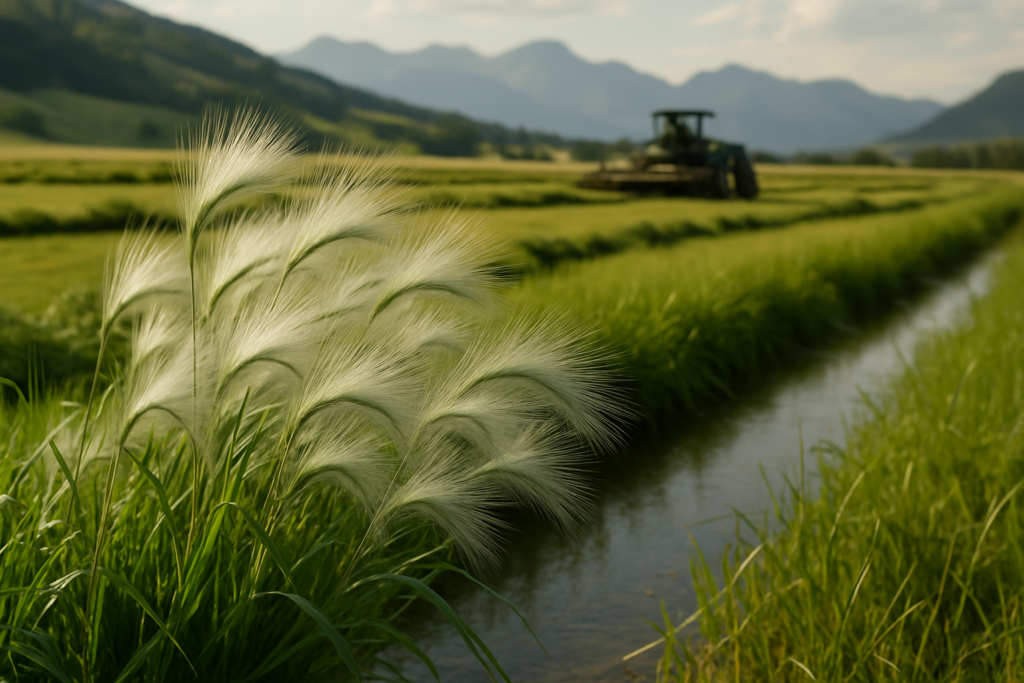
Take a walk through the sub-irrigated corners of your hay ground right now and you’ll find it—foxtail barley coming into head, silvery-green seedheads bowing over in the wet ground along the ditch banks and the low corners the swather always struggles to dry down. It’s pretty in the evening light. It’s also one of the sneakiest problems in a Montana hay stack, because the damage it does doesn’t show up until months after you’ve forgotten it was even in the field.
Foxtail barley isn’t the same plant as the annual foxtails people fight in a hayfield down south, but it does the same dirty work. Each seedhead is loaded with long, barbed awns. Those awns break off, and every barb points one direction. Once one works into soft tissue, it can only travel deeper. In a cow that means gums, the lining of the cheeks, the tongue, and the soft flesh around the eyes.
Why June is when it gets away from you
Foxtail barley is a cool-season perennial that thrives in exactly the ground you can’t afford to give up—saline seeps, the edges of stock ponds, the wet end of a flood-irrigated meadow, the borrow pit along a county road. It greens up early and heads out ahead of your good grass. By mid-June the awns are hardening off while your bromegrass and timothy are still building.
That timing is the trap. When you finally swing the swather in for first cutting, the foxtail is already mature and brittle, and it goes into the windrow with everything else. Bale it, and you’ve packed those barbed awns into feed you’ll be forking out in a February wind, when there’s no green grass left for the cows to sort around it.
Grazing animals will avoid it if they have a choice. A cow on decent summer pasture usually noses past a foxtail patch. But once it’s chopped into hay, or once the good grass is grazed off and the foxtail is all that’s left in a dry pasture, the cattle don’t get a vote.
What it does once it’s in the mouth
The first sign is usually nothing you’d notice from horseback. A cow quits cleaning up her hay. She quids—balls feed up in her cheek and drops it. You might see her drooling, or working her jaw sideways like something’s caught. Pull her in and open her mouth and you’ll find ulcers along the gums and the inside of the cheek, sometimes with awns still stuck in like splinters. Those ulcers abscess. The infection can track into the jaw and turn into a hard swelling that looks a lot like lump jaw.
The awns don’t stop at the mouth. They lodge in the eye and cause the same weepy, squinting, irritated look you fight with pinkeye and face flies—except this one you caused when you baled the wrong corner of the meadow. Horses eating the same hay get it worse, because their mouths are softer and they’re pickier about quidding.
A cow that can’t eat comfortably in the coldest part of winter loses condition fast, and she’ll go into calving thin. That’s the real cost, and it’s easy to blame on the weather or the hay quality instead of the actual culprit.
What to do about it, in the order that matters
The cheapest fix is to keep it out of the bale. Scout your hay ground before you cut and know where the foxtail is. If it’s confined to a few wet corners and ditch banks, cut those separately and either graze them green earlier in the year or leave them out of the winter-feed hay entirely. Foxtail before it heads out is decent feed with no awns—the whole problem is the mature seedhead.
Longer term, foxtail barley is telling you something about that ground. It moves in on saline, poorly drained, overgrazed, or run-out spots where the desirable grasses have thinned. Heavy stands often mark a salinity or drainage problem worth addressing. Reworking the stand, improving drainage where you can, and not grazing those areas into the dirt gives your good grass a chance to crowd it back.
If you already fed some this winter and you had cows go off feed or a rash of runny eyes, check mouths before you assume it’s teeth or an infection. And when you buy hay, look at what’s in the bale, especially anything cut off marginal or irrigated bottom ground. A bale full of those silvery seedheads is a bale you don’t want, no matter how it pencils out on price.
Foxtail barley won’t kill a cow the way water hemlock or an overnight algae bloom will. It just quietly chips away—less feed cleaned up, more weight lost, a few open-mouthed cows you can’t quite figure out. Walk the wet corners this month while it’s still standing, and you’ll save yourself the guessing come winter.