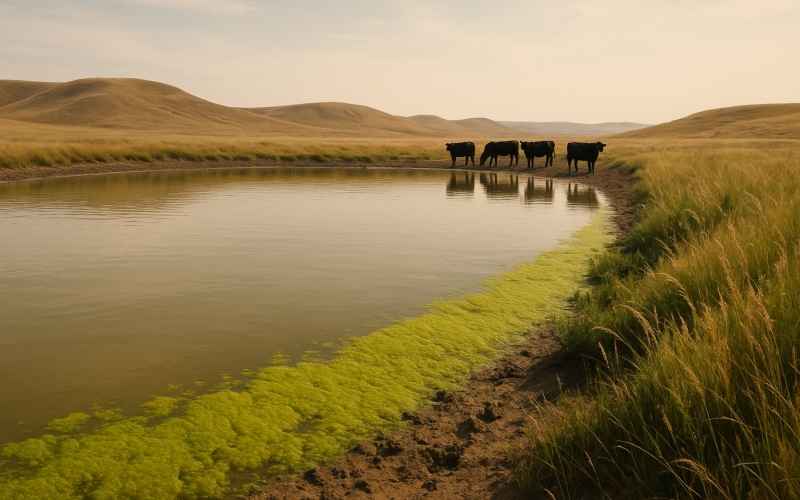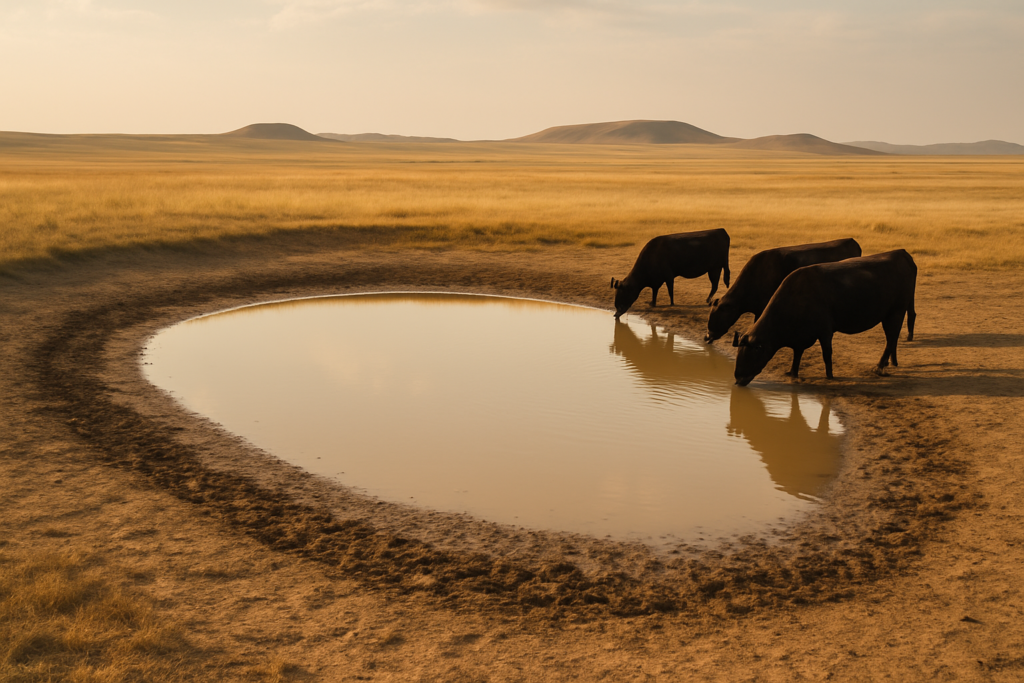
The grass problem in a dry June gets all the attention. The water problem sneaks up behind it. A dugout that carried good water in May keeps evaporating through July, and everything dissolved in it—salts, sulfates, the works—gets left behind in a smaller and smaller pool. By August the cows are drinking something a lot stronger than what you turned them out on, and you never saw it change because it happens a spoonful at a time.
Most of us think of stock water as safe or not safe, drinkable or fouled. The truth is a slope. Water can be perfectly clear, no smell, no scum, and still be loaded with enough dissolved minerals to knock the edge off a cow’s intake. She’ll drink less, eat less because she’s drinking less, and the calf at her side gains a little slower than the neighbor’s on the same grass. You won’t see a dead cow. You’ll see a light weaning check in October and wonder where it went.
Sulfate is the one that bites hardest in Montana
A lot of the shallow groundwater and a lot of the stock ponds across the eastern and central part of the state run high in sulfate, and it gets worse the more the water concentrates down. Sulfate is the mineral that does two things at once. At moderate levels it acts like a laxative and cuts palatability, so cattle back off the water and off the feed. At high levels it turns into a real killer through sulfur toxicity—the rumen bugs turn sulfate into hydrogen sulfide, and that gas does damage to the brain that shows up as polioencephalomalacia, the same brain swelling you’d see from a thiamine problem.
A cow going down with sulfur-induced polio doesn’t look like a poison case at first. She stands off by herself, seems blind, may push her head against a post or wander in a circle. Some go down and paddle. It hits growing calves and yearlings harder than mature cows because they’re drinking more water per pound. If you catch it early a shot of thiamine from your vet and getting them off the bad water can save some. Catch it late and you’re dragging a carcass.
The trap is that the water looks fine. Sulfate has no color. Some of it smells a little like rotten eggs, but plenty doesn’t. The only way to actually know is to pull a sample and have it tested for sulfate and total dissolved solids. It’s cheap insurance, and a dry summer is exactly when the number you got two years ago no longer applies.
Test the water you’re actually asking them to drink
Take the sample from the source the cattle are using right now, not the well by the house. If a pasture only has one dugout and it’s down to the last third, that’s the water that matters, and it’ll test worse than a full pond a mile away. Pull it in a clean container, keep it cool, and get it to a lab that runs livestock water panels—your county Extension office can point you to one. Ask for sulfate and TDS at a minimum.
What you do with a bad number depends on what you’ve got. Options in rough order of how much they cost you:
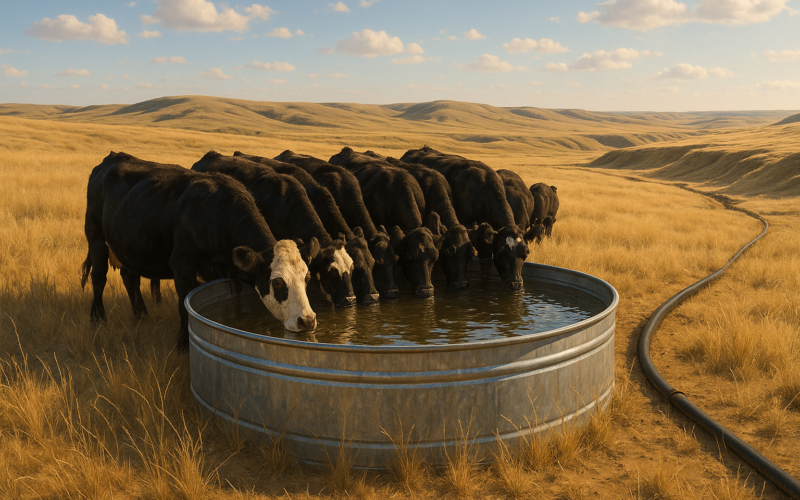
- Fence off the worst source and haul or pipe better water in. A tank fed off a decent well beats a concentrated dugout every time.
- Give cattle a choice. If a pasture has both a marginal pond and a cleaner spring or pipeline, keeping both open lets them dilute themselves. They’ll often self-regulate if they have somewhere better to go.
- Move the cattle sooner than you planned. A pond that’s worth grazing to in June may not be worth it in late July, and pulling out early beats calling the rendering truck.
- Back off any feed or mineral that adds more sulfur on top of the water load. Some byproduct feeds and some sulfate-form mineral mixes stack right onto the problem.
Young stock and anything that’s been hauled and is drinking hard are the ones to watch closest. A load of yearlings turned onto a strange, salty pond after a dry haul will hit that water hard before they know any better, and that’s when the wreck happens.
Water’s the one input a cow can’t cut back on for long. She’ll trim her grass intake to match a bad drink, and that’s the quiet cost you pay all summer. Pull a sample before the ponds get to the bottom, and you’ll know whether the water in the far pasture is feed or a slow leak.