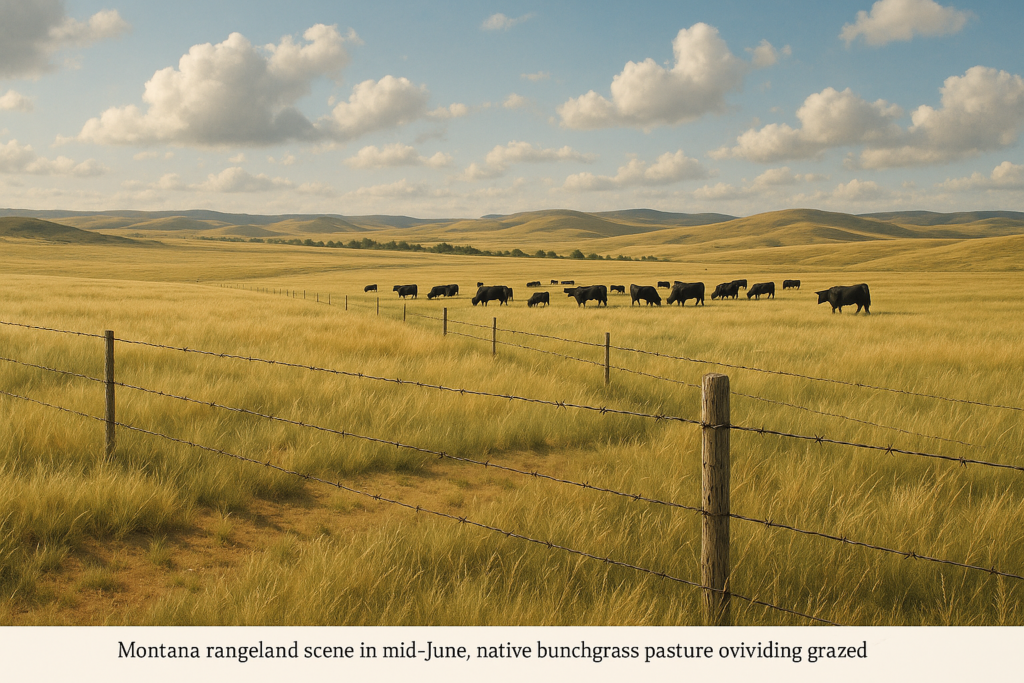
June grass fools people. The country greens up, cows spread out and gain, and it looks like you’ve got all the feed in the world. So the gate stays shut and the herd sits in the first pasture because it’s easy and the water’s good. The trouble is that the plant you graze off in June doesn’t just sit there waiting. It has to rebuild leaf before it can grow again, and every time a cow bites it back to the crown you set that clock back further.
On most Montana range, cool-season grasses like bluebunch wheatgrass, needle-and-thread, and green needlegrass do the bulk of their growing between about mid-May and early July. That’s the window where they put up leaf, set seed, and store energy in the roots for next year. Hammer a plant flat during that stretch and it spends what little it has left trying to grow leaf back instead of building reserves. Do it two or three years running and the good grass thins out. What fills the gap is usually cheatgrass, clubmoss, or bare ground.
Take half, leave half
The old rule still holds: graze about half the year’s growth and leave the rest. That leftover isn’t wasted. The standing leaf shades the soil, catches what rain does fall, and keeps the plant photosynthesizing so it can regrow after the cows move. Graze it to the dirt and you strip off the very tissue the plant needs to recover. A pasture grazed hard and then rested can come back. A pasture grazed hard and grazed again on the regrowth, before it’s had time to rebuild, is the one that goes backward.
You don’t need a grazing chart to see it. Walk out ahead of the herd and look at what they’ve been leaving. If they’re still leaving good stubble and the plants have leaf on them, you’ve got time. If they’re grazing the same plants down to the crown and chasing every green blade, they’ve cleaned it up and it’s time to move, whether the calendar says so or not.
Rotate before the grass tells you it’s too late
The mistake is waiting until a pasture is used up before you move. By then the damage is done and the next pasture is already a week past its best. Moving cattle a little early, while there’s still cover left, gives the grazed pasture a running start on regrowth and lets you come back to it later in the summer if you get a rain. That’s the whole point of splitting country into more than one or two pastures: not to move cows for the sake of moving them, but to give each piece of ground a rest during the growing season instead of grazing all of it, all summer, all at once.
Even a couple of cross-fences and a second water source change the math. A pasture that gets grazed in June and then rested until fall carries far more feed the following year than one that’s grazed season-long. And in a dry summer, that rested grass is money in the bank when the rest of the country quits growing in July.
Stock to the grass you actually have
The other half of this is numbers. It’s easy to carry the same cow count year after year out of habit, but the range doesn’t grow the same amount of feed every year. A dry spring means less grass, period, and no amount of rotation fixes an overstocked outfit. If the grass came slow this year, the country will be short later, and it’s cheaper to sort off a few pairs or open cows in June than to run out of grass in August and buy hay at summer prices or wean early into a poor market.
Keep it simple. Know roughly how much forage each pasture grew this year compared to a normal one. Match your cattle to that, not to what the ground raised in a wet year. Leave stubble behind you. Move before it’s grazed off, not after. The grass you protect in June is the grass that’s still standing when the neighbor’s country has burned up and dried down, and that’s the summer where good grazing pays for itself.