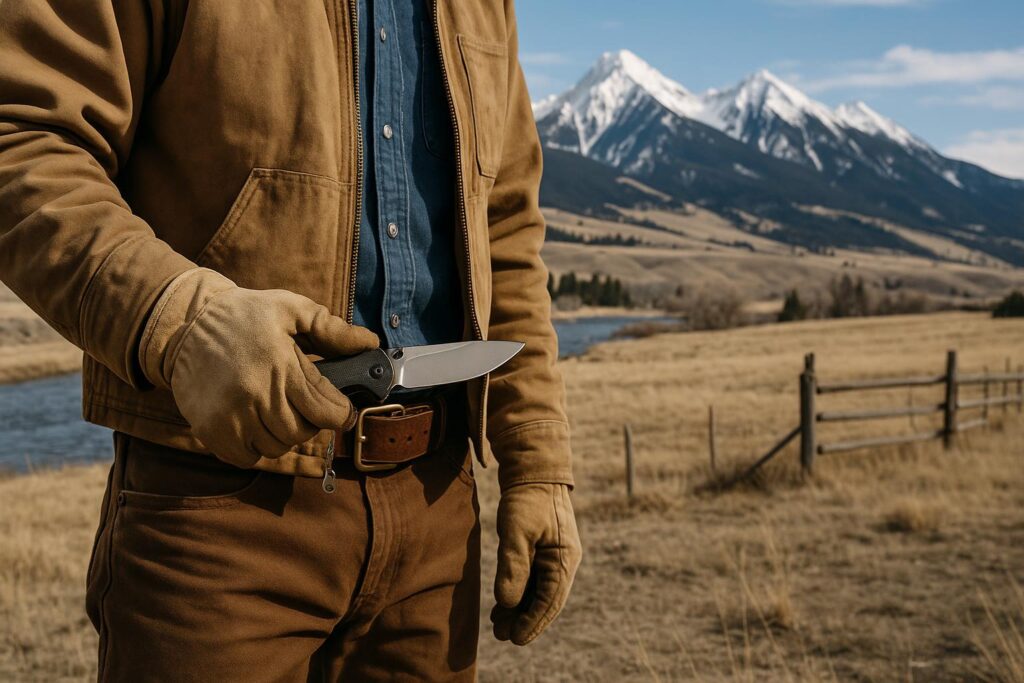
In Montana, a good everyday-carry (EDC) knife isn’t a fashion accessory — it’s a small tool that ends up doing a lot of unglamorous work. One minute it’s cutting twine off a bale, the next it’s opening mineral bags, trimming a stubborn tag off a calf jacket, slicing apples for the kids, or cleaning a trout at the tailgate. Hunters, anglers, farmers, and ranchers all end up leaning on the same kind of tool: something that’s handy, dependable, and safe when you’re tired, cold, or wearing gloves.
There’s no single “best” knife for every job, but there are clear features that separate a useful EDC from one that lives in the junk drawer. Here’s a field-focused guide to what matters in Montana — from blade steel and lock types to carry comfort and maintenance — plus a few practical scenarios to help you pick what fits your day.
Why an EDC knife still earns pocket space
A multi-tool can do more, and a fixed blade can do heavier work. But most days don’t call for either one. An EDC knife is the “grab it and go” tool: quick one-handed access, enough blade for common cuts, and small enough that you’ll actually carry it.
- On the ranch: feed bags, twine, poly rope, banding supplies, vet wrap, hose packaging, and the occasional “how is this even stuck?” knot.
- On the farm: seed bags, irrigation odds and ends, fertilizer tote straps, zip ties, and opening parts boxes in the shop.
- Hunting and fishing: cutting cordage, slicing tape, trimming moleskin, food prep, plus basic field tasks when your primary knife is packed away.
Blade shape: pick the geometry that matches your chores
Blade shape affects control, tip strength, and how the knife behaves in messy real-world cuts.
- Drop point: A solid all-around choice. The tip is strong, and the belly handles basic slicing well. If you only own one, this is a safe bet.
- Clip point: A finer tip for detail work, but it can be easier to snap if you pry with it (don’t).
- Tanto: Tough tip geometry, but can be less friendly for long slicing cuts on rope or hide.
- Sheepsfoot/wharncliffe: Great control and safer tip orientation for some tasks, but can feel less versatile for general ranch use.
For Montana chores, a medium-size drop point with a usable belly tends to cover the most ground.
Steel and edge: the practical tradeoffs (no magic)
Knife marketing can make steel sound like a superpower. In reality, you’re balancing three things: edge retention (stays sharp), toughness (resists chipping), and corrosion resistance (handles moisture and sweat). You rarely get maximum of all three.
- Stainless-leaning steels are helpful if your knife rides in a sweaty pocket all summer or sees wet snow and slush. They’re also forgiving if you don’t baby your gear.
- Tougher, less stainless steels can be great for hard use, but they may need a wipe-down and occasional oil to avoid rust spotting.
Edge style matters too:
- Plain edge: Easier to sharpen and cleaner for most cutting tasks.
- Partially serrated: Can bite rope quickly, but is harder to maintain and may snag on some materials.
If you’re cutting a lot of twine, feed bags, and zip ties, a plain edge that’s easy to touch up usually wins over a “never sharpen” fantasy.
Locking mechanisms: safety you’ll appreciate when you’re wearing gloves
If you’re using a folding knife for work, a reliable lock is non-negotiable. A slip-joint (non-locking) has its place, but it’s less forgiving when you’re tired or rushing.
- Liner lock / frame lock: Common and generally strong. Watch for grit and pocket lint in the lock area, especially around the shop and barn.
- Back lock: Often very secure, but can be slower to close one-handed depending on design.
- Crossbar-style locks: Popular for one-handed operation and ambidextrous use. As with any mechanism, keep it reasonably clean.
Whatever you choose, test it with gloves on. If you can’t confidently open and close it safely in cold weather, it’s the wrong knife for Montana shoulder seasons.
Handle and carry: comfort matters more than you think
A knife can have the best steel in the world and still be miserable to use if the handle creates hot spots or the clip tears up your pocket.
- Handle texture: You want secure grip when wet, not a cheese grater that shreds coveralls.
- Size and thickness: Too small gets slippery with gloves; too big becomes a brick in your pocket.
- Pocket clip: Deep-carry is discreet, but make sure you can still grab it quickly. Reversible clips are helpful for left-handed users.
For ranch and farm use, a slightly larger handle that fills the hand tends to reduce fatigue — especially when you’re doing repeated cuts through heavy packaging.
Real-world Montana tasks: what your knife will actually see
Here are a few common scenarios and the features that help:
- Baling twine and poly rope: A sharp plain edge with good slicing belly; a lock you trust; a handle that won’t slip when your hands are cold.
- Feed and mineral bags: Corrosion resistance helps; so does a blade coating if you’re around salty supplements. Avoid using the tip as a pry bar on frozen bags.
- Shop packaging and zip ties: Tip control matters. A drop point or wharncliffe can be handy for controlled cuts near hoses and wiring.
- Hunting camp odds and ends: A knife that cleans easily. Blood and fat find every corner, so fewer crevices can be a plus.
Maintenance: the difference between “good knife” and “good tool”
Most knives fail in the boring ways: they get dull, gritty, or loose. A few simple habits go a long way:
- Touch up the edge before it’s completely dull. A small field sharpener or a ceramic rod at home can keep you ahead of the problem.
- Keep the pivot reasonably clean. Compressed air, a toothpick, or a quick rinse (then dry) helps after dusty days.
- Check screws and clip tension. Vibration from equipment and daily carry can loosen hardware over time.
- Light oil, when needed. Especially if you’re carrying in wet weather or around corrosive materials.
If you want sharpening basics from a trusted industry source, the Work Sharp guides and products are widely used by hunters and landowners. For general knife care and safety, resources from organizations like the National Shooting Sports Foundation often touch on responsible tool handling in the field.
Legal and common-sense considerations
Knife laws can vary by city, county, and situation, and they can change. If you travel for work or hunting, it’s worth checking local rules before carrying an unfamiliar style. When in doubt, keep it simple: a practical folding knife that’s clearly a tool tends to avoid misunderstandings, and safe handling matters more than blade length bragging rights.
For Montana-specific questions, start with official sources and local guidance. The Montana Legislature website is a reliable place to look up current statutes, and local law enforcement can clarify how rules are applied in your area.
What this means for Montana
In a state where a single day can include frozen gates at dawn, a windy calving check at noon, and a quick run to town before dark, your EDC knife needs to be more “work glove” than “trophy buckle.” The best choice is the one you’ll carry every day, can operate safely with gloves, and can maintain without a full shop setup.
Montana’s mix of dust, grit, snow, and sweat is hard on gear. That favors knives with dependable locks, corrosion resistance (or at least easy cleaning), and a handle that won’t slip when it’s wet. If you hunt and fish, it also pays to think about cleanup: a knife that’s easy to rinse and dry is more likely to stay in rotation.
Finally, an EDC knife is a tool — not a pry bar, screwdriver, or chisel. If you regularly need those functions, toss a small multi-tool in the truck and save your knife edge for what it does best: cutting.
Inspiration: www.agdaily.com