The cattle you lose to pasture bloat are rarely the poor-doers. They’re the big, aggressive eaters that hit a fresh stand of alfalfa or clover hard the first morning after a move. By mid-June across a lot of Montana — irrigated bottoms along the Yellowstone, clover-heavy hay aftermath, reseeded pastures running heavy to legumes — there’s enough lush, fast-growing forage out there to set this up. A cow can be fine at daylight and dead by mid-morning. It’s one of the few cattle problems that kills that fast.
Frothy bloat isn’t the simple gas bloat you fix with a tube. When cattle graze legumes that are growing fast and full of soluble protein, the rumen fills with a stable foam. The gas gets trapped in thousands of tiny bubbles instead of forming one pocket the animal can belch off. Pressure builds against the lungs and heart, and if nothing breaks that foam, the animal suffocates. The classic picture is a cow down on her side, left flank distended, breathing hard with her tongue out.
What loads the gun
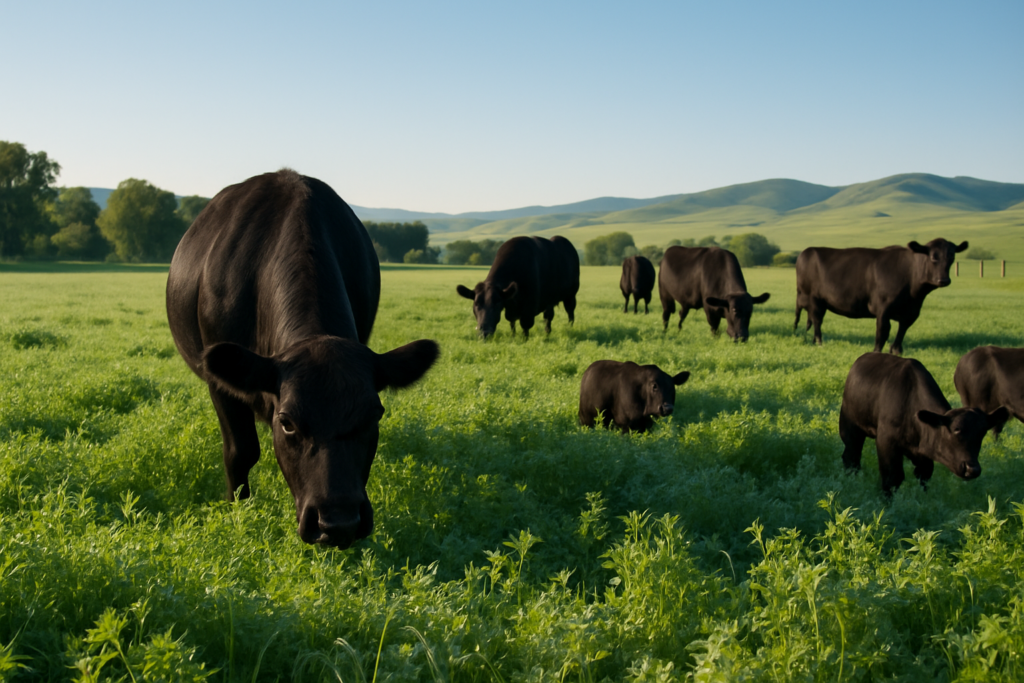
Pure or near-pure stands of alfalfa, white clover, and red clover are the usual culprits. The danger climbs when the plants are vegetative and growing fast — pre-bloom, lots of leaf, high moisture. That’s exactly where a lot of legume forage sits in June. A few things stack the odds against you:
- Turning hungry cattle onto a fresh, wet legume stand first thing in the morning. They gorge before the rumen can adjust.
- Dew or a light rain on the forage. Wet legumes seem to make the foam worse.
- A frost, then regrowth. Frost-damaged legumes have been tied to bad bloat outbreaks.
- Rotating onto a brand-new paddock after cattle have grazed something safer. The novelty and the fill both work against you.
Grass changes the math. A pasture that’s a real mix of grass and legume — and not more than roughly half legume — carries a lot less risk than a thin, lush alfalfa stand. Mature forage with stem and seed heads is safer than young leafy growth.
Keeping cattle off the ground
You can graze legumes without burying animals, but it takes some management instead of luck.
Fill them up first. Don’t turn hungry cattle onto a hot legume pasture. Let them graze grass or feed dry hay before the move so they’re not starving when they hit the new stand. A full cow eats slower and is far less likely to founder herself on the foam-producers.
Move later in the day, not at dawn. Let the dew burn off and give the plants a chance to dry. Some operators wait until afternoon for the first turn onto a new legume paddock, then leave cattle on it rather than pulling them off and bringing them back hungry — yanking them on and off resets the gorge cycle every time.
Bloat preventatives work, but only if cattle actually take them in. Poloxalene is the standard anti-foaming agent, fed in blocks, loose mineral, or top-dressed. The catch is consistency: an animal that doesn’t eat its share the morning it counts isn’t protected. If you’re running a real bloat risk, make sure the blocks are out a few days ahead and there are enough of them that every animal gets to one. Cull or watch the boss cows that hog the supplement.
Ionophore additives can help slow rumen fermentation, and some producers manage daintier with strip grazing — giving a measured slice of legume each day so cattle never get a full belly of fresh, foamy forage at once. Letting a pure alfalfa stand get past early bloom before grazing also knocks the risk down considerably.
When one’s already down
If you catch a bloated animal early and she’s still up, walking her slowly can help her belch. A passed stomach tube will release simple gas bloat, but frothy bloat often won’t come off a tube because the gas is locked in foam — you need an anti-foaming product (a poloxalene drench or, in a pinch, a recommended dose of mineral oil or a commercial surfactant) delivered into the rumen to break the bubbles. Work with your vet on what to keep on hand and the right dose.
An animal that’s down, bloated, and going blue is an emergency. A trocar or a knife into the left flank at the high point of the bloat is a last resort to save her life, and it’s ugly and not without consequences — but a dead cow is worse. Know where to make that cut before you ever need to.
The cheaper play is never letting it get there. Check legume stands before you turn out, fill cattle first, time the move, and keep the preventative in front of them when the forage is at its most dangerous. Bloat is one of those losses that looks like bad luck and is usually a management gap.