The bales coming off the meadow right now feel like money in the bank. They look good stacked in the yard, and it’s easy to assume the pile will be enough because it usually is. But “usually” has been getting harder to count on, and the worst time to discover you’re a hundred tons short is in February when the cheap hay is already gone and everybody else is calling the same sellers you are.
June is the month to run the numbers. You’ve got a first cutting on the ground or close to it, you know roughly how the pastures wintered and greened up, and you still have time to do something about a shortfall while it’s cheap to fix. Waiting until the grass quits and the trucks need loading takes every good option off the table.
Figure out what the cows actually eat
The math isn’t complicated, it just gets skipped. A dry cow eats somewhere around two to two and a half percent of her body weight in dry matter every day. Take a 1,300-pound cow, call it 30 pounds of hay a day to keep it simple, and add a little for waste — feeding round bales in the open, you’ll lose feed to trampling and weather whether you like it or not.
Multiply that daily figure by the number of days you actually feed. That’s the part people fudge. Be honest about your operation. If you’re feeding from late November until grass turns the corner in early May, that’s pushing 160 days, not the 120 you’d like it to be. A late spring stretches it further. Then multiply by your cow number, your bred heifers, the bulls, and whatever you’re backgrounding through the winter. Bulls and growing calves eat differently than a dry cow, so account for them separately rather than lumping everyone into one average.
Run that out and a 200-cow outfit can need north of 600 tons before you’ve fed the first replacement heifer or thrown a flake to a sick calf. Put a real number on paper. Round it up, not down.
Weigh a few bales before you trust the count
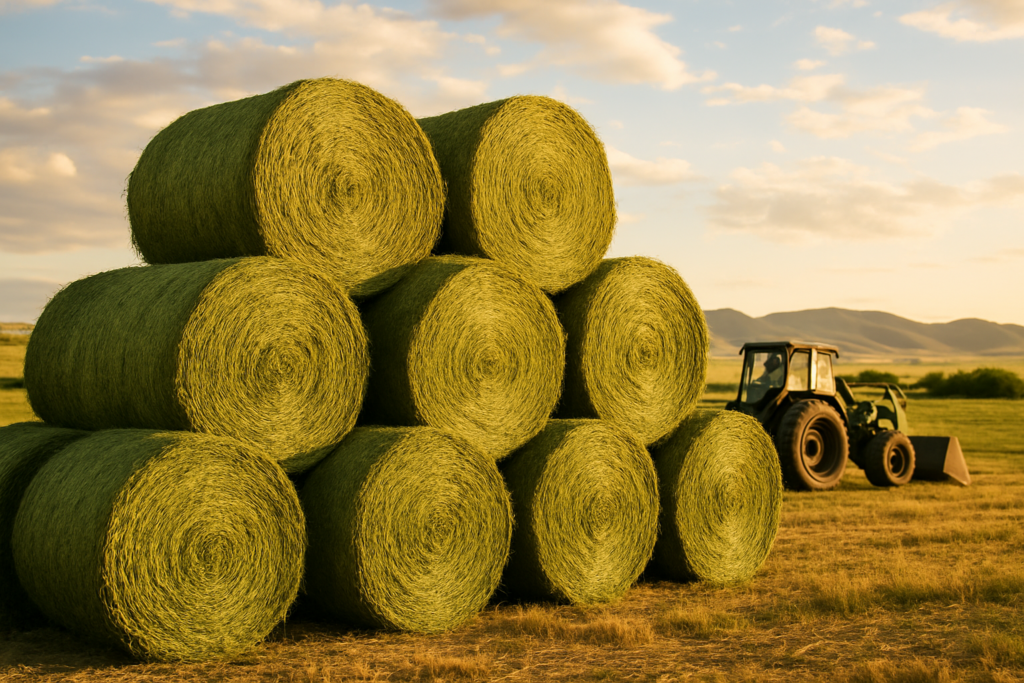
Counting bales tells you how many you have. It doesn’t tell you how much feed you have, and those are not the same thing. A 5-by-6 net-wrapped bale of dense alfalfa can weigh half again what a soft, dry grass bale of the same size weighs. If you’re estimating tonnage off bale count and a number you remember from three years ago, you can be off by a lot.
Weigh a handful of representative bales if you’ve got a scale or a loader with one. If you don’t, at least be conservative — a lot of grass-hay round bales run lighter than people assume, especially when they were baled dry in a hurry ahead of weather. Knowing your real average bale weight turns a guess into a plan.
While you’re at it, think about quality, not just quantity. A cow in late gestation through a cold snap needs more than a maintenance ration of stemmy, rained-on hay. If your first cutting got weathered or went up past bloom, you may have plenty of tonnage but feed that won’t carry a cow through the hard part of winter without supplement. That’s a cost you want to see coming in June.
If you’re short, June gives you choices
Say you do the arithmetic and you’re light. Now is when you can still act without bleeding money. You might pick up a few more acres to hay, lean harder on a second cutting, or buy standing hay off a neighbor before the price reflects a tight market. You can line up early on purchased hay while the supply is fresh and freight hasn’t stacked up. You can plant an annual forage — oats, a cereal mix — for a fall cutting or fall grazing if you’ve got the ground and the moisture.
You can also adjust the other side of the equation. Culling open or hard-keeping cows in late summer instead of carrying them through winter cuts your feed bill and puts them on the market while they’re in decent shape. Weaning a little earlier or selling calves rather than backgrounding them changes how much feed you have to find. None of those are emergency moves in June. They become emergency moves in December.
The whole point is to make the decision on your terms. A producer who knows in June that he’s 80 tons short has a dozen ways to cover it. The same producer finding out in a January storm has about two, and both of them cost real money. Run the math now, while you’re already out there counting bales anyway.