Every June the same argument runs through ranch country: cut now, or let it grow another week and put up more hay. The extra week almost always wins in the moment, because you can see the crop getting taller and you can’t see what you’re losing. But the feed value is leaving the plant faster than the tonnage is coming on, and by the time the alfalfa is in full bloom or the grass has headed out and started to yellow at the base, you’ve traded a truckload of protein for a few more bales of stems.
That trade matters most for anybody feeding cows through a cold Montana winter or trying to keep condition on bred heifers. A late-cut, coarse first cutting will fill a cow’s gut and keep her alive, but it won’t do the work of hay put up at the right stage. You end up buying protein tubs or cake to make up the difference, and that pencils out worse than the bales you thought you were saving.
What’s Actually Happening in the Plant
When a forage plant is young and leafy, most of the weight is leaf, and leaf is where the protein and digestible energy live. As the plant matures and pushes up a seed head or a bloom, it lays down fiber in the stem to hold itself up. That stem fiber is bulk with very little nutrition, and it keeps the cow from eating as much because it moves through her slower.
So two things happen at once as the crop matures. The percentage of protein and energy in each pound drops, and the animal can’t eat as many pounds. You lose on quality and on intake at the same time. The plant gets heavier, so your yield number climbs, but a lot of that added weight is fiber a cow can’t do much with.
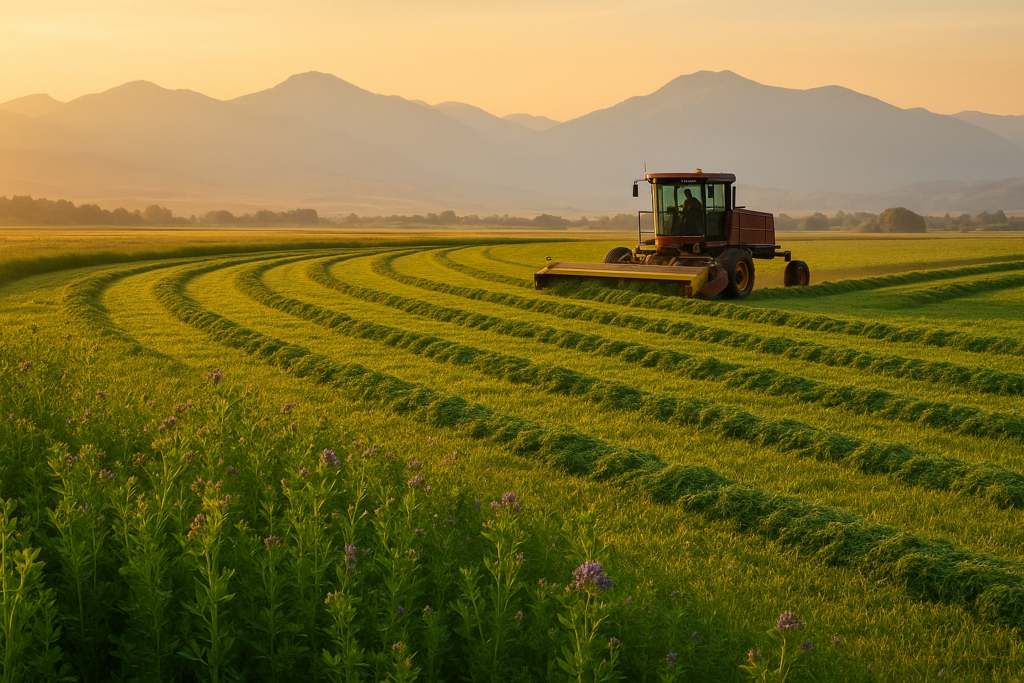
For alfalfa, the window most people aim for is late bud to first flower. Once you see the field turning purple with bloom, quality is already sliding. Grass hay holds its value best if you catch it around the boot stage, before the seed heads fully emerge. Wait until it’s headed out and starting to cure standing up, and you’ve got roughage, not feed.
Reading the Field Instead of the Calendar
The calendar lies because seasons don’t line up year to year. A cold, wet spring pushes everything back; a warm dry one runs it ahead. Walk the field and look at the plants. On alfalfa, pull a few stems and check for buds and the first flowers. On a grass stand, feel for the swelling in the stem where the head is about to push out — that’s the boot. When you can feel it and it’s just starting to show, that’s your signal to get moving.
Elevation and aspect matter too. A south-facing bottom near Billings or the lower Yellowstone is ready before a cool bench up toward the Front or a high meadow in the southwest valleys. If you farm ground spread across different exposures, they won’t all come ready together, and trying to cut them all on one date guarantees some of it gets cut too late.
There’s real tension here with the weather. Cutting early puts your hay on the ground during a stretch of June that likes to throw thunderstorms. Rain on cut hay leaches out nutrients and can knock quality down as far as cutting late would have. So you’re reading two things at once — plant maturity and the forecast — and sometimes the smart play is to wait three days for a clean window rather than drop it ahead of a storm. Just don’t let a nervous eye on the sky turn into a two-week delay that costs you the whole first cutting’s quality.
Weigh It Against What You’re Feeding
Not every field needs to hit dairy-quality numbers. If you’re putting up filler for dry cows in good flesh, a little more maturity and a little more tonnage is a fair trade. But the hay you’ll feed to lactating cows in February, to first-calf heifers, or to anything you’re trying to grow — that’s where cutting on time pays. Sort your fields by who’s going to eat the hay before you decide which ones to cut first.
The other quiet benefit of cutting on time: you leave more of the growing season for a second cutting. Hay cut late shoves your regrowth back, and on dryland or short irrigation you may not get a decent second crop at all. Get the first cutting off while the plant still has summer ahead of it and the regrowth comes faster.
Nobody hits it perfectly every year. But if you find yourself defaulting to “one more week” every June, it’s worth remembering that the extra week rarely gives you what your eye thinks it will.