You feel it before you can prove it. A stack of first cutting that went up a shade green will throw off a sweet, tobacco-and-caramel smell inside of a couple weeks, and if you climb up top on a still morning you can sometimes see the heat coming off it like a road in August. That smell isn’t the hay curing. It’s microbes and chemistry cooking the inside of the pile, and given the wrong bale and a tight stack, it ends with the fire department parked in your yard.
Every June a few Montana producers lose a barn or a haystack to hay that put itself on fire. It almost never happens to hay that was truly dry. It happens to the load somebody baled at dusk to beat a rain, or the heavy windrows off a good bottom that looked ready on top and were still green underneath.
Why green hay heats
Fresh-cut forage is still alive and full of moisture. Bale it before it’s cured and the plant cells keep respiring, and mold and bacteria go to work on the sugars. All of that throws off heat. In a loose windrow that heat blows off. Packed into a dense bale and stacked tight, it has nowhere to go, so the core temperature climbs.
Up to a point that’s just a musty, dusty bale the cows will eat around. Past a point it becomes a chemical reaction that doesn’t need the microbes anymore and doesn’t need oxygen the way you’d think. The center chars, and the day air finally reaches it, it lights. That’s the part that catches people off guard: the fire can come three, four, even six weeks after baling, long after you’ve quit thinking about that stack.
Big round and big square bales are the worst offenders because they pack dense and hold moisture in the middle. A small square that’s a little damp can breathe. A four-foot round bale can’t.
Bale it dry enough in the first place
The fix starts in the field, not the stack. Small squares want to be down around 18 to 20 percent moisture before you bale. Big rounds and big squares need to be drier than that, because they don’t shed heat. A moisture tester is cheap next to a burned barn, and the old trick of twisting a stem still tells you something — if it twists without cracking and you can wring anything out of it, leave it lay.
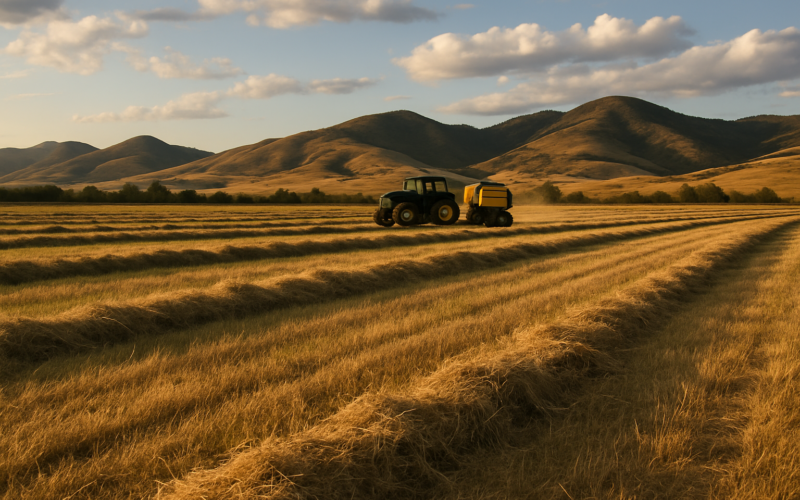
Get it to cure faster and you widen your safe window. Lay wider windrows so more of the swath sees sun. Ted or rake to turn the wet bottom up, keeping in mind that raking alfalfa dry-side-down at noon costs you leaves. Bale in the morning once the dew is off rather than pushing into a heavy evening dew. If rain is bearing down and you’ve got hay that isn’t quite there, a propionic-based preservative applied at baling lets you put up hay a few points wetter without it heating — but it’s a tool for the margins, not a license to bale wet.
Check the stack, then check it again
The dangerous stretch is the first two to six weeks. Any stack that went up marginal, watch it.
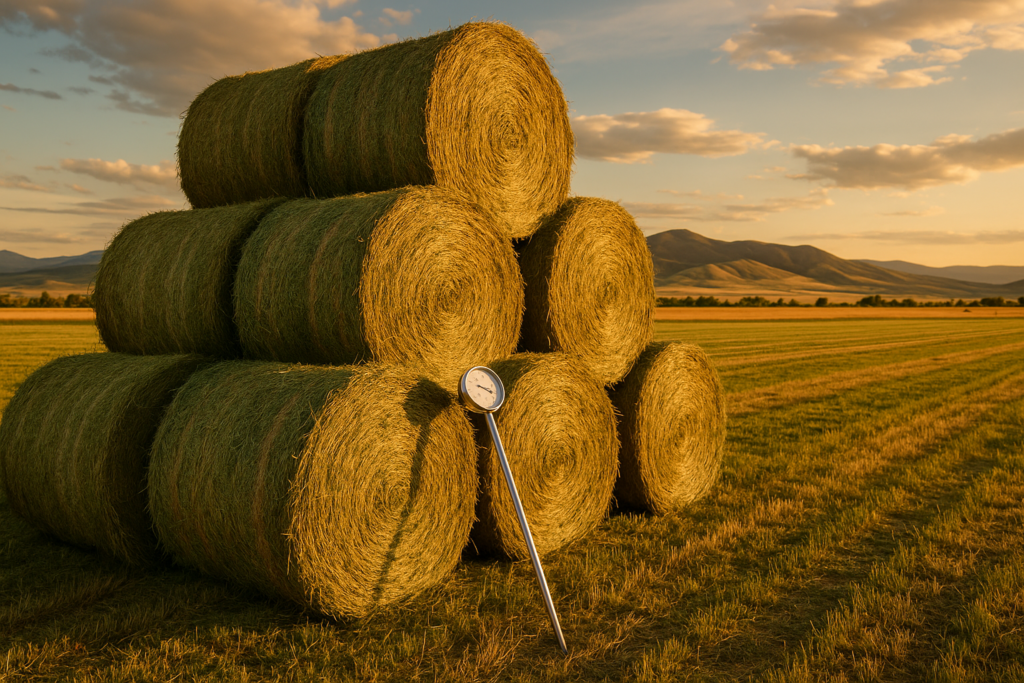
You don’t need fancy gear. A long metal probe, or a piece of pipe or electrical conduit you can drop a thermometer into on a string, will get you a core reading. Push it into the middle of the stack, where the heat builds. Rough guide most of us go by:
- Under 130°F — hay’s fine, keep an eye on it.
- 150°F — check it every day, it’s working.
- 175°F — the reaction is getting away from you; pull bales apart to let heat out and get air moving, and be ready.
- Over 200°F — treat it as a fire waiting to start. Call the fire department before you touch the stack.
Here’s the part that gets people hurt: don’t go pulling apart a hot stack on your own without help standing by. Charred pockets inside can be starved for oxygen, and dragging bales out hands them the air they need. Fires have flared up the second the pile was opened. If it’s that hot, get help and water on hand before anything moves.
Leave space when you stack marginal hay. Don’t wedge hot bales tight against a barn wall or bury the questionable load in the middle of the pile where you can’t reach it with a probe. Stack the driest hay tight and inside, and keep anything you’re unsure about on the edge where it can breathe and where you can watch it.
Most first cutting goes up fine and never gives you a bit of trouble. It’s the one wet load, put up in a hurry under a black sky, that burns the winter’s feed. Test it, cure it, and walk the stack with a probe for a month. That’s cheap insurance against smelling caramel and knowing exactly what it means.