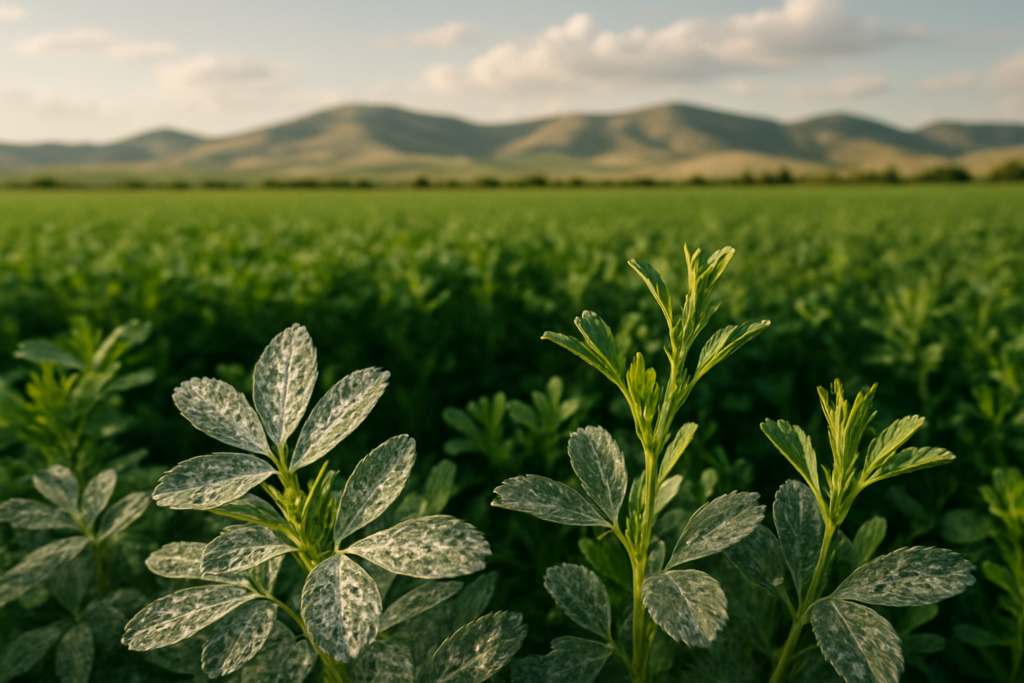
Drive past a good alfalfa field in the second week of June and it ought to look deep green and heavy, leaning toward its first cutting. When it looks a little gray or frosted instead — like somebody dusted the top of the canopy — you’re not looking at drought stress or a light freeze. You’re looking at alfalfa weevil larvae working the growing tips, and they’ve been at it for a while before the color change ever shows from the pickup.
This is a crop pest that times itself to the worst possible moment. The little green larvae feed hardest in late spring and early summer, right as the stand is putting all its energy into the leaves you’re about to bale. The damage they do is direct hits on the part of the plant where the protein lives. A stand can green up fine, grow tall, and still hand you hay that tests low because the top leaves got skeletonized before you ever dropped the sickle.
What the larvae actually do
The adult weevil is a small, dull brown snout beetle that overwinters in field trash and lays eggs in the stems. The larvae that hatch out are the problem. They’re pale green with a white stripe down the back and a dark head, and they climb up into the folded new leaves at the tip of each stem. They don’t eat the whole leaf — they scrape the surface and chew holes, leaving the leaf tissue shredded and lacy. Multiply that across a whole field and the canopy takes on that silvery, frosted look because you’re seeing the pale underside and the damaged tissue instead of solid green.
The feeding is concentrated at the top, on the newest growth, which is exactly the material that carries the most feed value. That’s why weevil damage costs you more than it looks like it should. You can lose a real chunk of the leaf-to-stem quality that makes alfalfa worth growing, and the stems keep standing there looking like a crop.
Get out and scout before you decide anything
You can’t judge weevil pressure from the truck window until it’s too late. Walk the field and look at the top few inches of the plants. Chewed, ragged tips and that frosted cast are the first sign. Pull stems from several spots — corners, the middle, the low wet end where the stand is thickest — and shake or beat them into a bucket to count the larvae that drop out.
A sweep net is the honest way to check. Take a set number of sweeps in a few separate parts of the field and see what’s in the net. What matters is that you sample more than one spot, because pressure is almost never even. The heavier, ranker stands and the warmer south-facing ground usually build the highest counts. Scout again a few days later if the numbers are borderline, because larvae grow fast in warm weather and a field that’s marginal on Monday can be over the line by Thursday.
If you’re not sure how to read the counts against a treatment threshold, your county Extension office and MSU have the current guidelines for larvae per stem and per sweep, and those are worth a phone call before you spend money on spray.
Cutting early is often the cheapest control
Here’s the part that works in your favor: alfalfa weevil and haying season overlap. If a field is close to cutting anyway and the larvae are heavy, swathing early takes their food and their cover away at the same time. The windrow dries down, the exposed larvae die off or quit feeding, and the regrowth usually comes back clean. That beats paying for an insecticide on hay you were about to lay down anyway.
The time to watch is the stubble after that first cutting. If the count was high going in, larvae and adults can keep chewing the crown regrowth and stunt your second cutting. Check the stubble a week or so after you bale. If the green-up is slow and you’re finding larvae still working the new shoots, that’s the situation where a treatment can pay — and where you need to mind the pre-harvest and grazing intervals on whatever product you use.
The main thing is to look before first cutting instead of after. By the time the whole field reads gray from the road, the larvae have already eaten the best of what you were going to feed.