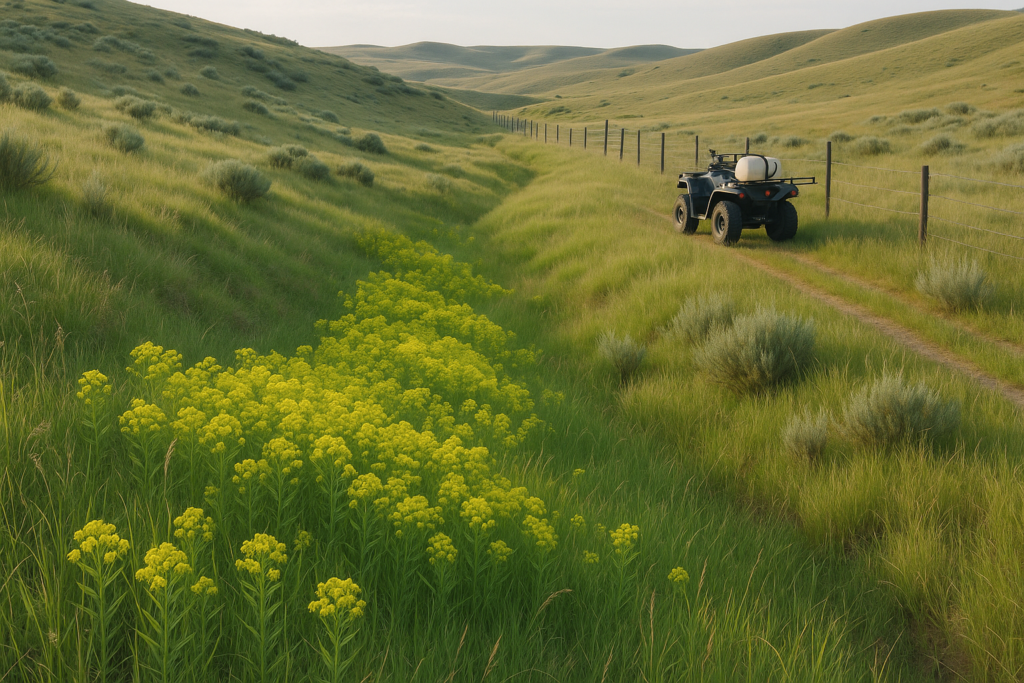
Every rancher who’s fought leafy spurge knows the shape of the problem. It starts as a yellow-green patch on a coulee bank or a fenceline where nobody looks, and three summers later it’s crowded out the grass across a whole draw. Cattle won’t touch it. The root system runs deep and sideways, and by the time a patch is obvious from the pickup, the plant has already banked years of energy underground and thrown seed across the county.
Mid-June is when a lot of Montana’s worst rangeland weeds line up in a window where you can actually do something about them. Leafy spurge is flowering — those flat yellow bracts that people mistake for the bloom. Spotted knapweed is bolting and headed toward bud. Both are pulling nutrients and moving them around inside the plant, which is exactly when a foliar herbicide gets carried down to the roots instead of just burning off the top.
Timing beats gallons
The mistake is treating weed spraying like a chore you get to when the hay’s baled. By August the spurge has set seed and started to shut down, and a shot of herbicide then mostly cosmetic — it browns the plant off without touching the root reserves that push up next spring. Spotted knapweed is the same story once it’s fully bloomed and seeding.
Spurge gives you two decent windows in a normal year: the flowering stage in June, and again in fall when the plant pulls resources back down before frost. Knapweed responds best from the rosette stage through bolting, before the purple flowers open. If you only get one pass, June is usually the one that pays, because you’re hitting the plant while it’s actively moving sugars downward and before it drops a fresh load of seed.
Read the label on whatever product you’re running and match it to the stage you’re actually looking at in the field, not the stage the calendar says. Rangeland herbicides carry grazing and haying restrictions that vary by product, and some have real setbacks near water — which matters, because spurge loves ditch banks, creek bottoms, and the wet edges of a coulee where you’re most tempted to spray without thinking about what’s downstream.
The parts nobody sprays are where it wins
Weeds don’t respect the middle of a clean pasture. They move along disturbance — fencelines, two-tracks, gates, the gravel where you unrolled hay last winter, the spot where the county graded the road ditch. That’s where new patches show up, and that’s where scouting in June actually finds them small enough to knock out with a backpack sprayer or an ATV boom instead of a contractor and a big tank.
Walk or ride the edges you never look at. The fenceline you share with a neighbor who doesn’t spray is a seed source whether you like it or not, and the runoff channel that carried spurge seed down from the ridge in a wet June is planting next year’s problem for you. A patch you catch at a few plants is a five-minute job. The same patch left three years is a spraying budget.
Spraying alone won’t finish it
Nobody sprays their way out of established leafy spurge in one season, and anyone who tells you different is selling something. The seed stays viable in the soil for years, and the lateral roots regrow. What works is stacking pressure on it.
- Flea beetles and other established biocontrol insects can hold big spurge stands where spraying every acre isn’t practical — the coulees and rough ground you can’t reach with equipment.
- Sheep and goats will graze spurge and knapweed that cattle refuse, and running them through an infestation before it seeds takes the pressure off next year’s regrowth.
- Grazing management that keeps a healthy stand of grass is your cheapest defense. Bare, overgrazed ground is an invitation. The thicker the desirable forage, the less room a seedling has to establish.
The point is to keep after the same ground year over year instead of chasing a new fire every June. A patch treated three summers running and grazed to keep the grass competitive shrinks. A patch sprayed once and forgotten comes back bigger.
Your county weed district can tell you what’s spreading in your area, what herbicides and rates are working locally, and whether cost-share is available for the acres that’ll eat your budget. Most Montana counties will point you at the biocontrol insects too, sometimes at no cost. The infestation on your place didn’t start this year, and it won’t end this year — but June is when you decide whether it gains ground or loses it.