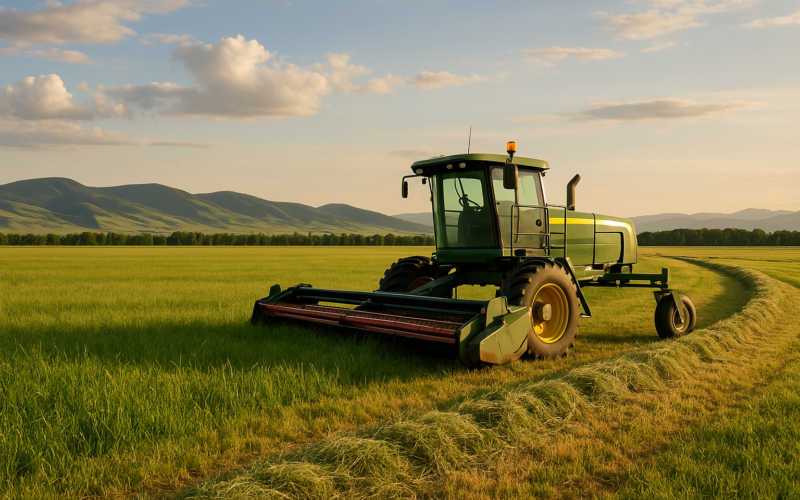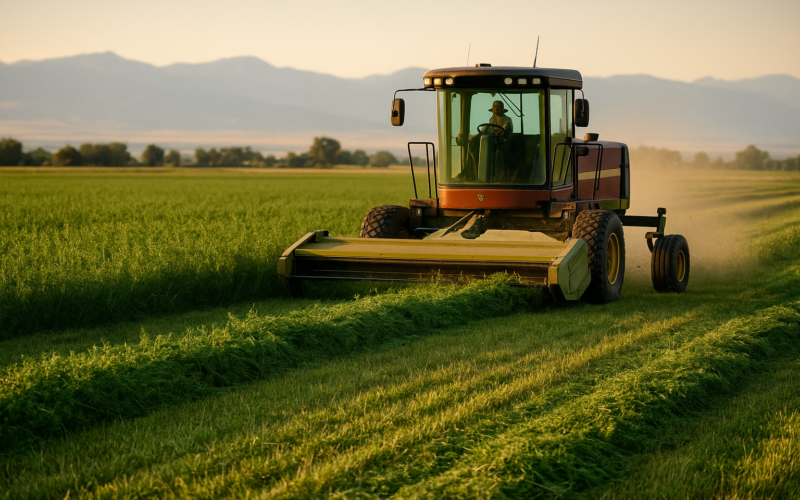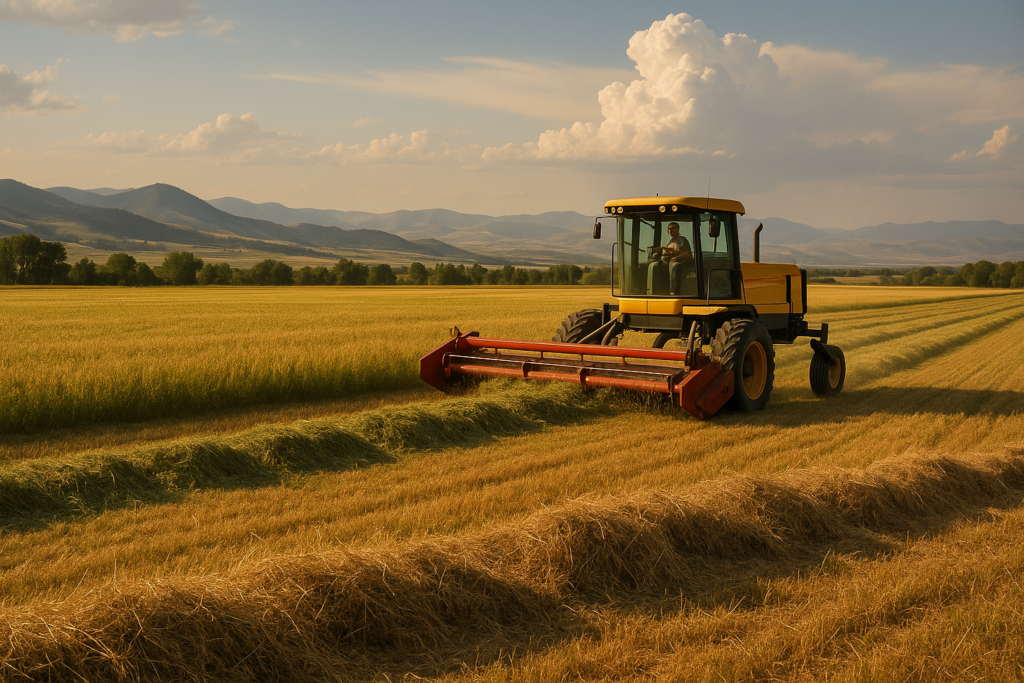
You spend all spring waiting for the hay to come, and then it comes all at once. Everybody’s cutting, everybody’s racing the next thunderhead, and the machinery that sat in the shed since last August is suddenly running ten and twelve hours a day in the heat. That’s the setup for the kind of fire nobody plans for—the one that starts under your own tractor.
Wildfire off dry lightning gets the attention, and it should. But a good share of the acres that burn during a Montana summer light off from farm equipment working dry, cured hay. A cut windrow is about the most flammable thing on the place. It’s dead, it’s dry, and there’s a machine with hot metal and moving parts dragging right through the middle of it. Get those two together and you’ve got a fire moving downwind faster than you can turn the swather around.
The parts that start fires
Bearings are the usual culprit. A dry or failing bearing in a header, a baler, or a hay conditioner runs hot enough to ignite the trash packed around it, and by the time you smell it the flame’s already licking up into the crop feeding through. The old swather that’s been sitting all winter is exactly the machine most likely to have a bearing on its way out. Grease everything on the schedule the manual gives you, and don’t guess at it—put your hand near the hubs and bearings when you stop to check the crop. A bearing you can’t hold your hand next to is telling you something.
Chaff and leaf trash is the other half of it. Fine hay dust packs into the engine compartment, around the exhaust, on top of the manifold, against the turbo. It builds up over a day of cutting until there’s a mat of tinder sitting on the hottest surface on the machine. A baler is worse—all that pickup trash works its way into places you’d never think to look. Blow the machine off every day with a compressor or a leaf blower, and pay attention to the exhaust and any hydraulic lines that could weep onto hot metal.
Then there’s the sickle. A knife section hitting a rock throws sparks the same as a horseshoe on granite, and it does it down in the driest, finest material on the place. There’s not much you can do about the rocks, but a sharp, properly adjusted sickle that isn’t hammering along half-plugged runs cooler and cleaner than one that’s fighting the crop.
What to carry, and when to quit
Every machine that goes to the hayfield ought to carry a fire extinguisher, and not the little dashboard one that’s been rattling around since the tractor was new. Get an ABS-rated extinguisher big enough to matter, mount it where you can grab it without climbing down into a burning cab, and check the gauge at the start of the season. A shovel behind the seat is worth its weight, too—most equipment fires start small, in the trash under the machine, and a shovel of dirt thrown fast will smother what an extinguisher might not reach.
Better yet, don’t work alone in bad conditions, and keep water close. A lot of outfits run a pickup with a slip tank or at least a full stock tank and a couple of five-gallon buckets parked at the field edge when the humidity drops and the wind comes up. A hundred gallons at the turn-row has saved more than one hay meadow.
Know when the day’s gotten too dry to keep going. Hot afternoon, single-digit humidity, wind out of the west—that’s when a spark that would’ve smoldered and died at nine in the morning takes off across the stubble. There’s no rule that says you have to bale through the worst of it. Cutting early and late, when there’s a little dew and the air’s heavier, is easier on the crop leaf and a lot easier on your nerves.
Have a number ready before you need it
If something does light off and gets past you, the difference between a scorched half-acre and a black quarter-section is how fast a truck rolls. Know how your local volunteer department wants to be called and have that number in your phone, not written on a shed wall five miles away. Tell whoever’s in the house where you’re cutting. A fire found early in a cut field is a nuisance. Found late, with a west wind behind it, it’s the kind of thing that takes the neighbors’ ground and your winter feed with it.