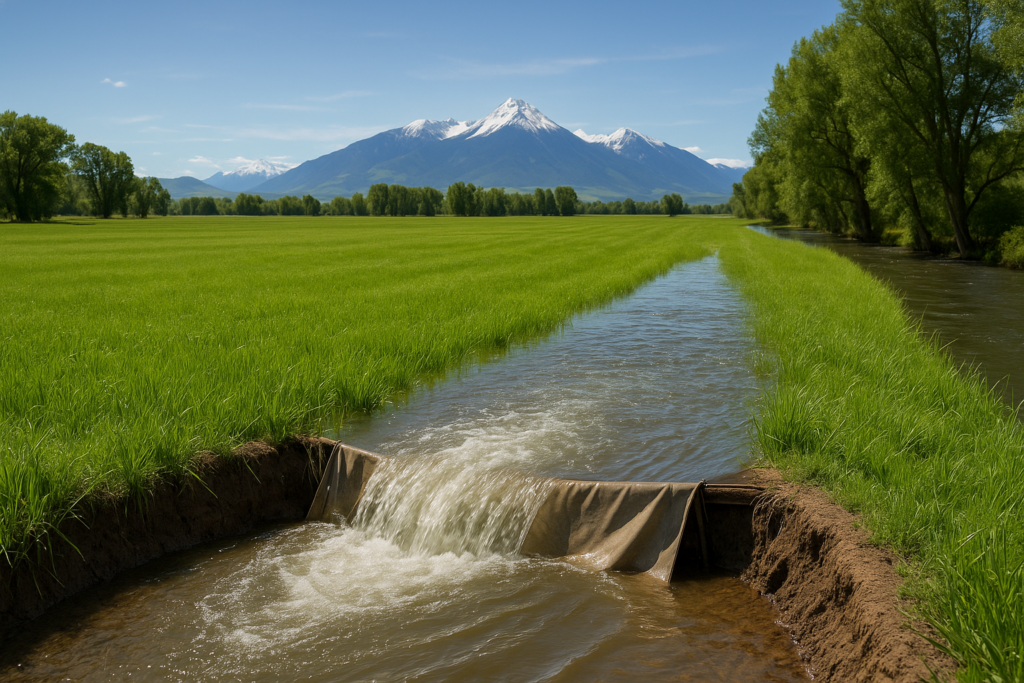
The creek behind the place tells you where you stand in June. It’s up over the rocks, brown with mountain dirt, moving hard enough that you can hear it from the corral. That’s the water you’ve got to work with, and it doesn’t last. Snowpack comes off the high country in a rush, peaks somewhere in June depending on how hot it gets, and then the flow falls off a cliff. The ranchers who make a full season out of their water are the ones set up to catch it while it’s running big.
If you flood irrigate off a ditch or a decreed creek right, timing is the whole game. Water on the ground now grows the first cutting and, more to the point, banks the moisture and momentum for a second cutting. The field you skip in mid-June because you’re branding or fencing is the field that browns off in July while your neighbor is baling again.
Get the water where it’s supposed to go
Half of irrigating is the water and half is the dirt work that moves it. Head ditches settle over winter. Gophers and muskrats tunnel the banks, and a hole you can’t see from the truck will blow out a dike the first time you run a full head down it. Walk your ditches before you turn water in, not after. Pack the low spots, pull the trash out of the head gate, and check that the boards seat clean so you’re not losing a third of your flow under the gate before it ever reaches the field.
On flood ground, the ridges and the fall of the land decide everything. Water runs where it wants, not where you want, and a set that looked even in May can leave the high corner dry all summer. Move your dams before the low ground gets sour and the high ground burns. Canvas or plastic dams, set right, spread the water thin and slow so it soaks instead of racing to the bottom of the field and out the tailwater ditch. Water moving too fast waters nothing but the county road.
Wheel lines and pivots don’t forgive neglect any better. A plugged nozzle leaves a dry stripe you’ll see from the highway at haying. Blown gaskets, a wheel line that won’t roll straight, a pump losing prime at three in the morning — that’s the difference between a field watered on schedule and one that gets behind and stays behind. Grease the movers, carry spare nozzles and gaskets, and check the far end of the line, because that’s where the pressure drops off and where you’ll never notice a problem from the pump house.
Know where you sit on the ditch
Montana water runs on priority. First in time, first in right. In a wet year nobody thinks about it, but the minute the creek starts dropping, the senior rights upstream get their full head and the junior users downstream get what’s left, which in a dry August can be nothing. If you don’t know your priority date and your decreed amount, find out before it matters, because a call on the water in July is not the time to be reading your own filing for the first time.
On a lot of shared systems there’s a water commissioner who splits the flow according to the decrees. Stay on good terms and stay honest about your set. The rancher who steals an extra head when the water’s short is the one who finds his gate mysteriously fixed the next week. Water fights on a small creek go on for a generation, and they never end well for anybody’s grass.
Spend it like it’s short, because it is
Even a good runoff year runs thin by late summer. Water the ground that pays first — the productive hay meadows and the pasture you’re counting on for late-season grazing. If the creek is already dropping fast, there’s no shame in accepting that some of the marginal ground won’t get a full irrigation this year. Better to grow a solid crop on your best acres than to spread a short water so thin that everything comes up half.
Keep an eye on your soil, not just the calendar. Flood ground on gravel drinks water fast and needs it more often; heavy meadow bottom holds a set for a good while and can drown out if you leave the water on too long. Pull the water before the ground goes soggy and you’re rutting it up at haying. The moisture you put down in June is what carries the crop through the dry stretch, and there’s no getting it back once the creek quits and the head gate’s running dry.